

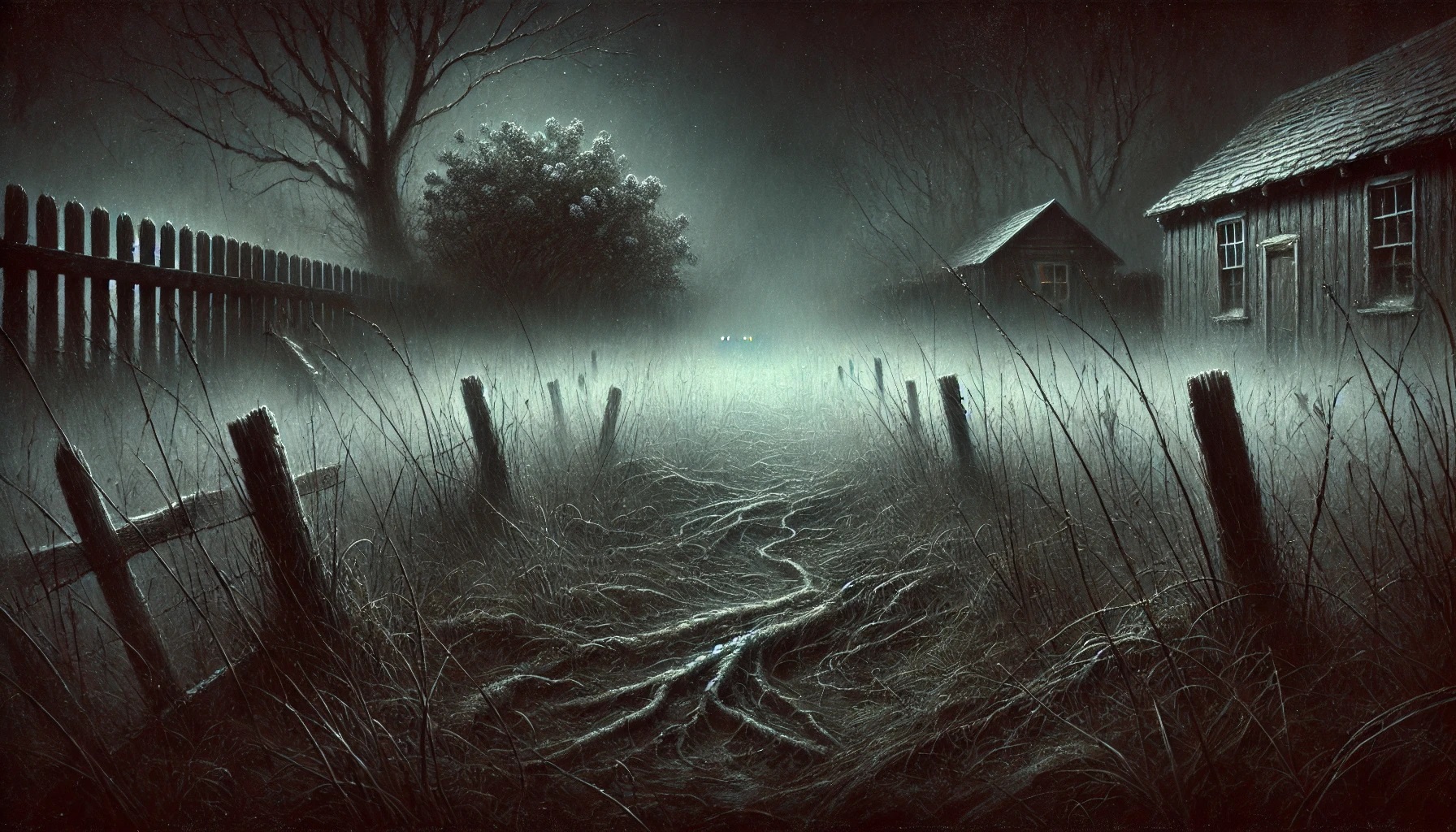
13 Aug The Black Devil of Keegan
“The Black Devil of Keegan”
Written by Wesley Dunroe Edited by Craig Groshek Thumbnail Art by Craig Groshek Narrated by N/ACopyright Statement: Unless explicitly stated, all stories published on CreepypastaStories.com are the property of (and under copyright to) their respective authors, and may not be narrated or performed, adapted to film, television or audio mediums, republished in a print or electronic book, reposted on any other website, blog, or online platform, or otherwise monetized without the express written consent of its author(s).
🎧 Available Audio Adaptations: None Available
⏰ ESTIMATED READING TIME — 30 minutes
FOREWORD
Recovered from the home of Thaddeus Collins – Keegan, Wisconsin
My name is Lucy Collins. Thaddeus—“Thad” to most—was my grandfather. He vanished from his home in Keegan, Wisconsin, in early November of last year. There were no signs of forced entry, no struggle, no blood. The front door was locked from the inside, the television still on, and his truck parked neatly in the driveway.
The Keegan police spent three weeks searching the surrounding fields, the wooded lots at the edge of town, and the banks of the Willoway River. Winter came early that year and buried what little ground they hadn’t scoured. When the snow melted in March, all they found was emptiness.
Grandpa had lived in Keegan his whole life. He wasn’t the kind of man to wander off—he’d kept a predictable routine for as long as I’d known him. Coffee at six. Church on Sunday. Grocery run on Tuesday. Journal entry every night before bed. That was his thing. He started journaling when he was twelve and never stopped. Over the years, he filled nearly fifty composition books with small, blocky handwriting.
The one you’re about to read was the last.
I didn’t find it until June, six months after he disappeared, when the county finally declared his property abandoned and put it up for auction. I drove up from Wausau to salvage what I could before the place was stripped bare.
Most of his belongings were already gone, hauled off by cousins or donated to the parish rummage sale. But when I pulled the refrigerator away from the wall to unplug it, a battered black-and-white notebook, the cover curled at the edges from heat and dust, thudded against the linoleum. It had slipped down the gap and gotten wedged against the wall.
Inside, the first pages were dated from late summer, written in the same casual style he used for decades: weather observations, notes on the Packers’ preseason, complaints about his knees. Then the tone changed. The entries got longer and jumpier. He started writing more about the neighborhood children, about strange things in the grass, about deaths.
By the final week of entries, his handwriting had grown erratic, words trailing into the margins. His last few pages are the hardest to read, not because of smudges, but because of what they describe. The things he claimed to see. The things he claimed to know about them.
Some will dismiss what follows as the ramblings of an old man losing his grip. But I know my grandfather. He was steady, stubborn, and rarely frightened by anything. For him to write the way he did… Well. I’ll let you judge for yourself.
I’ve transcribed his words here exactly as I found them, correcting only where his pen slipped or the ink ran dry. If what he says about the thing’s weakness is true, it might still matter—especially for anyone still living in Keegan.
—Lucy Collins
July 14
August 4
Figured I ought to start this one with a proper introduction, seeing as whoever’s reading might not know me. My name is Thaddeus Collins, but everyone in Keegan just calls me Thad. I’ve lived here all my life—sixty-eight years in the same town, same zip code, same everything. You could drive through in under three minutes, and unless you were aiming for the feed store, there’s no reason you’d stop.
Keegan’s the kind of place folks forget about until they need something from it. People come here for pumpkins in October and sweet corn in July, and then we’re back to being a dot on the county map.
I wasn’t a farmer myself, though I grew up surrounded by them. My parents had a small house on Pine Street, with a view of the grain elevators and the Catholic church steeple. Dad was a mechanic, Mom worked part-time at the post office, and between the two of them they knew everyone worth knowing.
Summers as a kid were long and humid, smelling of cut hay and diesel. Most of my friends were farm kids, up at dawn to do chores, but we always found time in the evenings for games. My favorite was ghost in the graveyard. We didn’t just play it in somebody’s backyard—we used the real thing. The cemetery behind St. Brigid’s was open on all sides back then. No chain link, just the occasional low stone wall, easy enough for us to hop.
You ever play tag between tombstones after dark, with the crickets loud in your ears and the marble angels casting shadows? It sticks with you. Every time the moon came out from behind the clouds, someone would squeal and swear they saw a face peeking around a headstone. Most of the time, it was just one of us trying to get the jump on the others.
We didn’t think of it as disrespect. Father O’Rourke would say otherwise, of course. He was already old back then, shuffling from the rectory to the church with his long black cassock swaying. We’d see his light in the rectory window and scatter before he caught us.
Church was never optional in our house. Sunday mornings meant 8 a.m. Mass, no excuses. I learned early on about heaven and hell, angels and devils. I can’t remember a time I didn’t believe in the devil—not in the Halloween-costume sense, but as a real presence in the world. Didn’t mean I walked around expecting to meet him. Keegan didn’t seem like the kind of place that would catch his attention.
Life went on here in a steady loop: births, weddings, funerals. The seasons told the time better than any clock. People came back for the Fourth of July parade, the county fair, and deer season. We had the occasional burglary or bar fight, but nothing that would be considered dangerous.
I met Mary at one of those summer fairs. She was working the pie booth, smiling at every person in line like she’d been waiting just for them. We married in ‘79, had our daughter two years later. She was the one who got me into wine tastings. Funny, the little habits you pick up for someone else’s sake. After she passed, I kept drinking, only it wasn’t wine anymore. Wasn’t strong enough. Hard liquor did the job faster.
I’ve filled journals for decades. Most are dull as dishwater—daily notes on the weather, the score of last night’s game, what I made for supper. I never wrote thinking someone else might read them. But I’ve always believed it’s worth keeping track, even of the ordinary.
If you write long enough, though, you start to notice patterns. Who comes and goes. When the first frost shows up each year. When the deer move. And sometimes, you see when something changes, when the rhythm you’ve known your whole life gets thrown off.
That’s why I’m writing this the way I am now. There’s something happening here in Keegan, something I can’t make sense of, and I think it’s worth recording, not just for myself, but for whoever finds this later.
Keegan isn’t the kind of place people expect evil to set up shop, but I’ve lived long enough to know that the devil doesn’t care about zip codes.
September 2
School doesn’t start here until after Labor Day, so the kids have been wringing the last drops out of summer. Our block turns into a track meet most evenings. Games of tag spill from yard to yard, and children’s laughter travels farther than you’d think. I’ve always liked that sound. Reminds me the place still has a pulse.
Tonight ended early.
I was on the porch with a cup of coffee, watching the Olson boys chase the Schmidt girls along the hedges. They were using the ditch as a “safe zone.” Around dusk, Bjorn—he’s the oldest Olson kid—tripped and went down. I stood to see if he needed a hand, but he was back up quick, pointing at the grass by the far mailbox. Then he shouted something I couldn’t quite catch.
The others froze. Then, just like that, they gathered themselves and jogged home in a tight little group, looking back nervously over their shoulders. I’ve seen dogs act that way when a coyote is close—ears forward, bodies angled to make themselves look bigger, eyes sideways.
When I went to check the ditch, I saw nothing except flattened blades where they had been jumping the culvert. Everything seemed ordinary. A few mosquitoes. Streetlight humming. I chalked it up to shadows at dusk spooking them, their minds playing tricks on them. Kids see faces everywhere at that hour.
September 3
Father O’Rourke stopped by to pick up a donation for the fall bazaar and stayed long enough to drink a glass of water and comment that I should oil the squeaky hinge on my screen door. He gave me a small St. Michael medal. Said he’d been giving them out to the altar boys at the end of summer since he started at the parish. “We send them to school with a little protection,” he said. I put the medal on a nail by the back door and thanked him. He looked worn. Fewer families at Mass these days. More gray hair in the pews.
I asked if he had ever heard of anyone seeing things in the grass. He said plenty of folks see snakes this time of year. I didn’t press it.
September 5
Word is traveling faster than facts. This morning at Tilly’s Diner, the talk at the counter was about “the shadow.” That’s what the kids are calling it: the shadow in the grass. Mrs. Schmidt said her daughter described it as something that skimmed along the ground. “Like a stingray,” she said, palms flat, as if she could shape its outline in the air. Black all over. Eyes “like the embers in a woodstove,” not red, but a yellow that glows under ash. Spines along its back.
I kept my opinions to myself. Kids combine shapes and fear into good stories. Still, I thought about the way Bjorn had pointed, the way every kid on the block decided to leave the field of play at once.
September 7
I didn’t see the first real incident, though I wish I had, only so I wouldn’t have to rely on secondhand pieces that don’t quite fit together.
The Larson girl, eight years old, small and fast, was playing tag at the schoolyard with half a dozen others. They were away from the swings, out near the soccer field where the grass runs wild at the edges. She sprinted for the chain-link gate, and halfway there she went down as if someone had tripped her with a stick. Her cousin reached her first and started screaming. The adults at the picnic tables ran. By the time they got there, she was bleeding badly from both ankles. The tendons were cut. Clean. I won’t write the next detail. If you’re reading this and you know anything about how a person stands up, you understand what happens when that part of a leg is taken away.
They say a shape skimmed past the fence, stirring the tall grass at shin height, and slipped into the drainage ditch that runs behind the ball diamonds. They also say—because this is how people talk when they’re afraid—that the thing looked back once, and that its eyes were the color of old lamps.
There were no coyotes in the field, nor were there any feral dogs. No farm equipment with exposed blades anywhere near her path. The sheriff wrote “unknown cause.” People in town called it an attack.
September 9
There were sirens after dark. We’re not used to that here. You can hear a single siren from one end of Keegan to the other, and it makes you feel like you’re part of a long wire. Two patrol cars, then the volunteer ambulance rolling slowly with the lights on but the horn quiet. They turned down Willow Run, toward the rental houses near the river. I stayed on the porch and watched until the trees took the lights away.
The next morning, we learned it was Mr. Petry from the VFW. He was eighty-one, and still walked to the barbershop twice a week for a trim that never seemed to change his hair. He was found behind his shed, the grass pushed flat around him as if something had dragged a blanket over the lawn. Same injuries at the ankles. Same lack of footprints. The paper didn’t say much, but folks sure did. If a dog had done it, they said, there would have been a mess. If a person had been there, there would have been signs.
By noon, the words “lockdown” and “recommended curfew” were coming out of the school district office. After-school activities were canceled. No kids were to be outside after dusk. The sheriff recommended porch lights be left on all night and told people to keep their pets close.
September 11
I walked the edge of my yard with a rake, combing through grass for anything that didn’t belong: wire, fishing line, trap, anything. I found nothing except a chip bag and a lone golf tee. The Olsen boys came by to ask if they could throw a ball against my garage since their dad needed the driveway. I told them yes, but to keep away from the ditch and to throw high, not low. They nodded in that careful way kids do when they want to show they’re listening without agreeing that any of it is necessary.
That night I couldn’t sleep. I kept thinking about how fast a person’s life can tilt. I thought about Mary. We used to sit on this same porch and name the constellations we could see without moving our necks. She’d pick out the Big Dipper, and I’d pretend I couldn’t see it until she leaned into me and traced it against the sky.
I poured a little something and told myself it was for sleep. I also told myself I would stick to one. The bottle disagreed.
September 12
Three calls came into the sheriff’s office before midnight: shapes gliding across lawns; something slipping under the hedges; a cat gone with no blood left behind. Two of the calls came from people I’d trust with my house keys. You can say panic makes a witness imagine more than what was actually there, and sometimes that’s true. But panic doesn’t make cuts like the ones at the schoolyard. Panic doesn’t carry off Mr. Petry without leaving a single footprint larger than a squirrel’s.
At Tilly’s, I heard a new name for it: the black devil, on account of its “devil ray” way of moving. One of the teenagers said it eats more than bodies. “It eats souls,” he said, and the counter went quiet.
I don’t know about souls, not in the scientific sense. But I do know what it looks like when a town starts to lose heart. People are moving in groups now. There are fewer porch conversations and more shut curtains.
September 14
They tied out sheep behind Kloiber’s place, a half mile past the water tower, with permission from the farmer who raises them. I wasn’t there—I only heard the report afterward—but enough people were that the story carries weight. The men sat in pickup beds with rifles, taking turns with binoculars. They kept quiet. They didn’t smoke or drink. Nothing came.
Something did pass near the little pond by the tree line, where two boys from town were supposed to be hiding to catch it on a phone. The boys said they saw the grass bend, saw a streak go by low as a knee, but nothing touched the sheep. The fathers packed everyone up before midnight. The sheep were fine the next morning.
The message folks took was not comforting: the thing knew what it wanted, and it wasn’t livestock.
September 16
A group from out of town arrived in a lifted truck with decals for a channel I won’t name. They wore GoPros and matching hats. One of them carried a bow. They asked at Tilly’s which ditch had “the action,” and then they drove out toward Willow Run like they were on a scavenger hunt.
By supper time, one of them had gotten a trip to urgent care with a deep cut along his calf. He claimed he brushed against “something moving like water through the grass,” and the cut opened as if the skin had been pulled apart by a thin blade. He used more colorful language. They uploaded shaky video of the aftermath and received hundreds of comments. They didn’t capture any solid proof, and left town at daybreak.
If you’re thinking, “At least it didn’t kill them,” I had that thought, too. But the pattern keeps tugging at me: children first, then the old. The strong and boastful receive injuries that send them home with stories. The weak do not get that chance.
September 18
The school board moved recess indoors. The parish canceled the harvest picnic and replaced it with a rosary novena. The sheriff requested more state support. We got money for signs and overtime, and a memo about “maintaining calm.” Calm is a fine thing, but it doesn’t set traps or patrol ditches.
I walked to the cemetery this afternoon, because that is where my mind goes when life turns strange. I stood where we used to play ghost in the graveyard and tried to remember the exact route I always ran between the Branski plot and the row of Civil War stones. The map was still in my head. I could see the angles and the sprinting lines. I could also see the low grass beyond the wall, the places where the mower doesn’t quite reach. If I were a thing that wanted to move unseen at the height of a child’s shins, I’d choose the same paths we once used for games.
On the way home, I noticed a line in the lawn of the house two doors down. It wasn’t a mower stripe, more like a shallow groove, and it ran from the hedge to the base of the lilac bush and then disappeared. I touched the grass. It was damp because the sprinklers had been on, and there was a faint smell—a little mud, a little algae—that reminded me of a lake in late August. I turned the thought over and set it aside, because a wet lawn smells like that, too.
September 20
If you are reading this to learn when people started staying inside after sunset, circle this date. Porch lights are on before supper. Men who used to stand with a beer and talk about nothing now wave from behind screens. The town has withdrawn.
I told myself I would not fill this entry with warnings, but I need to set down what I think I understand: whatever is running through our ditches and along our hedges already knows us. It knows our old paths. It uses the parts of town we ignore to navigate. It does not want bait. It does not want a challenge. It wants the ones who never imagine they are being hunted.
September 21
I brought the St. Michael medal in from the nail and set it by this notebook. Old habits kick in when a person runs out of practical steps. I don’t pretend to know what business the devil has in Keegan, but I’ve believed in him all my life, and if this thing isn’t him, it’s kin to whatever makes a pervert look at a schoolyard and see opportunity.
The creature’s territory is growing. Folks speak of it as if it has borders that can be drawn with a pencil on a map, but that’s not how it feels here on the ground. It’s more like a tide you don’t notice until your shoes are wet.
I don’t know what tomorrow brings. I do know the kids on our block haven’t asked to use my driveway in two days, and that sits heavier than any siren.
September 24
There’s a heaviness around town you can measure in how people speak. Voices drop in the grocery aisles. We choose shorter sentences, as if the extra words might draw attention.
The paper ran an editorial asking folks to check on their elderly neighbors after dark. Everyone knows why we’re checking. But no one dares to print the word that lives in our mouths.
At supper time, I heard shouting from three streets over. Sirens followed, then the low thump of a helicopter from the city doing a half-circle and heading back. Later, I learned one of the Wideman twins didn’t make it home from the playground at the Methodist church. His brother had run all the way to the parsonage and pounded on the door with both fists. The minister, still in his vest, took a flashlight and went with the boy along the fence. They found nothing there but a dark ripple in the grass and a single sneaker.
The next morning, the sheriff said there were no remains to recover. The word he chose was “absent.” It did the job without describing anything.
September 26
Wakes used to be social here—people stood shoulder to shoulder and told stories until the family smiled. Now the funeral home is a place to sign a book and step out of the way. We had two services in as many days. One for Mr. Petry, the other for Mrs. Hennings, who went missing after going out to shoo raccoons off her bird feeder. The deputy found her walker tipped on its side behind the garage. She had painted flowers on the frame in bright, chipper colors. The frame was unbent. The grass beside it was pressed flat in a narrow lane that ended at the hedgerow.
Father O’Rourke said Mass for both. He spoke about mercy and the mystery of life’s end, about rising on the last day. I watched him rest his hand on each casket lid and stand an extra second as if concentrating might do more than a full homily. After the second service, he stepped off the sanctuary and sat down hard in the front pew while the organist played the recessional. I’ve known him long enough to recognize when he prays with his head and when he prays with his backbone. This was the latter.
September 28
The county set up trail cameras borrowed from the DNR and the snowmobile club, and volunteers mounted them along the ditches and around schoolyards. A few captured motion blur, such as smudges racing across the bottom of the frame, bent grass, and a fox startled mid-step. Nothing you could take to a lab. The sheriff posted stills anyway, hoping a sharper eye would see what ours couldn’t. The comments were exactly what you’d expect: some folks saw proof, some saw tricks of the eye, some argued about shutter speeds.
A farmer out past Kloiber’s tied out a goat. They tried sheep the week before with no result. The goat bleated and tugged at its tether until midnight, when the farmer—who is not a sentimental man—untied it and walked it back to the barn because he couldn’t stand the sound anymore. He said later that he had the sense he was embarrassing himself, offering the wrong gift to a guest who had already chosen its own menu.
September 30
The cryptid hunters returned, not the same ones as before, a new set with branded jackets and a drone they flew low over the ditches. They parked outside Tilly’s and staged a little speech about community and courage into their phone, then took off for Willow Run. Two locals followed to make sure they didn’t get themselves killed; pride and exasperation will put the same set of keys into a pickup.
By dark, the drone had clipped a cottonwood and shattered in the culvert, and one cameraman had an ugly slice above the shoe where his laces started. He bled into a towel while their leader promised exclusive footage in the following week’s episode. They left town before dawn. We checked the culvert and found only bits of rotor and a plastic housing scraped along the concrete, as if something had dragged it a few feet before losing interest.
They’ll get their views. Meanwhile, we have chairs by windows and flashlights staged on end tables.
October 1
I keep thinking of patterns. The kids are the ones it takes quickly, as if it wants the sprinting ones first. The elderly are next, with a kind of slow insistence. The ones in between—the hunters, the boastful young men, the visitors—come away with gashes and stories. People say it wants souls more than meat. I don’t know how to weigh one hunger against another, but I do know which losses echo more loudly at the parish office.
I walked my fence line again with the rake and a flashlight and found two places where the grass lay in a path narrower than my foot. Each path began at a hedge corner and ended at nothing. If I were a kid, I would call it a secret trail.
I told myself not to drink tonight. It was a promise I didn’t keep. For what it’s worth, I put the bottle away after one generous pour and left it up on the counter instead of the cabinet. It’s a lazy habit. Mary would have clicked her tongue.
October 3
The state sent more money for overtime, and a trooper from Madison arrived with a clipboard and tactical boots. He toured the school, the cemetery, the fields behind Willow Run, and my block. He took notes while the sheriff talked. He told us he would coordinate a multi-agency response if new evidence came in. He gave a talk at the fire hall about situational awareness. He left after lunch the next day.
That night, the power flickered on the east side when a transformer failed near the substation. We all stepped into our doorways at once—it happens in small towns, we synchronize without meaning to—and then we went back inside when the lights returned. The next morning, four cats were missing, and several trash cans had been overturned, with no raccoon prints around them. I’m listing these small things because that is how I keep the larger thing in view. It prefers the margins. It rides the edges of our routines where we aren’t looking straight.
October 5
Father O’Rourke started blessing doorways. He went house to house with a small silver aspersorium and a sprig of cedar. He said the prayer he says on Epiphany and added three lines under his breath that I didn’t recognize. He gave me a look that said, Do not argue with me about this, and I didn’t. He sprinkled my thresholds and paused at the back door longer than the others, then set the aspergillum down and reached for the St. Michael medal on my counter. He asked if I’d wear it. I told him I’d keep it close. He didn’t argue.
That same night, the thing—call it what you want, we are past politeness—was seen cutting across Judith Lane at the height of a mailbox. The couple who saw it had been lighting a jack-o’-lantern for their granddaughter over a video call. The wife dropped the lighter when it slid by. She said it felt like watching a knife run through a puddle, except the puddle was grass and the knife had eyes.
The husband fired a single shot from his .22. The bullet took a chip out of the asphalt near the curb. They found a smear there later, faint and dark, that at first glance resembled damp soil. When it dried, it left no stain. The husband told the sheriff he had been shooting rabbits for sixty years and never missed at that distance. The sheriff wrote down the statement and placed a hand on the man’s arm while he did so.
People started saying the devil was invincible. I prayed they were wrong.
October 7
We tried our own stakeout behind the Co-Op, where the alley widens and you can see the backs of six yards at once. Dale brought his old deer stand stool and two thermoses—coffee in one, something rough in the other. I had a flashlight and a walkie set I used to use at the parish picnic. We settled in before dusk.
At ten, a figure crossed the far yard, head down, moving slowly toward the porch. I had my breath stuck halfway and then recognized Mr. Waller from three houses over, taking the dog out. No one wants to be the man who yells at another man for letting a terrier pee. At midnight, we heard a faint scraping somewhere in the labyrinth of fences. Dale raised a hand, and we both went still. The scraping came again, then stopped. The only thing that moved after that was the wind through the corn two blocks away.
At one, we gave up. Dale slid down from the stool, wincing as his knees protested. “It doesn’t come for people who want to see it,” he said, and I knew he wasn’t talking about us in particular. It avoids attention that has teeth.
October 9
We had another funeral. This one was for a boy whose mother insisted on a closed casket even though there was no body to view.
After the burial, I walked along the cemetery’s back edge and stood where we used to hide as kids. The town feels tilted toward this spot again, as if the game never ended and we’re all still waiting to be found. I was turning to go when I heard a noise in the grass that wasn’t the wind or a mouse. I took two steps back and held the flashlight low. The beam ran over bent blades and a line narrow as a belt moving toward the fence. It reached the stone wall, stilled for a moment, and then slid along the base, vanishing under a gap where the mortar had flaked years ago.
I didn’t follow. I’m not stupid. I made a mental note of the location, counted graves to fix it in my head, and walked out of the cemetery without hurry. When I reached the street, I realized I had been gripping the flashlight so hard my fingers had gone numb.
October 11
The county drafted a map with shaded zones, labeling the site of incidents and sightings, identifying other places as “areas of increased caution.” You’d think a map would make a person feel more in control, but all it did was show what we already knew—that the shaded area expanded each night by a ring you could miss if you weren’t looking. The new line now brushes the end of my block.
I sat on the kitchen floor after supper and sorted the batteries in the junk drawer. It’s an old habit of mine, keeping small things ready. Goes back decades. I checked the back door lock twice, then a third time. I took the medal from the counter and set it by this notebook. I told myself I would put it on later.
I desperately wanted a drink, but left my half-finished bottle of vodka on the counter where it was.
October 12
I saw it tonight. It came across the mouth of the alley behind my yard with incredible speed. It came in low and wide, flat along the ground, a sleek black glide, tapering behind, with a ridge on its back that lifted and settled as it skimmed over the grass. The eyes, resembling two coins of dim yellow, caught the porch light for an instant.
It made no sound I could hear. The blades of grass it touched lay down, and then rose a second later with a shiver I felt in my shins even from the steps.
I didn’t call out or fire a warning shot. I stood with my hand on the rail and watched it take the corner toward the Schmidt place, then vanish under their lilacs. The bush shivered, then settled.
I went inside and closed the door gently so the frame wouldn’t creak, locked the deadbolt, and slid the chain. Then I sat at the kitchen table for a long time, thinking.
October 13
People now ask each other where they last saw the shadow. The question travels through town like a river of whispered pins on a map. The answers suggest the creature is moving west, then south, straight toward my street, slowly drifting in my direction. No one else acknowledged it, and I certainly didn’t want to believe it, but the truth is, I’m running out of time.
Dale came by with a plan to rig motion lights along the alley and set up three men with radios behind the sheds. “We make it visible,” he said. “We take away what it uses.” He believes in direct action. I do too, where it works. We shook hands on it and picked a night. I checked my flashlight and left fresh batteries beside it. I told myself I would keep my shot glass dry, but I failed.
If you’ve read this far to understand whether prayer or planning holds the line better, I don’t have the answer yet. I know we have tried both. I know some days the town feels hollowed out. I know the thing widens its path every night, and now that I have seen it, the word people use—devil—doesn’t feel like exaggeration; it feels like an admission of scale.
October 14
The men with radios met at Dale’s garage tonight to go over the stakeout plan. We set the motion lights along the alley—four of them, spaced about twenty feet apart, high enough on the posts so the beam would wash the grass. We tested them once, watching the bulbs flare one after the other in a row like a fuse. We were half hoping the thing would decide to test them before we finished the setup. It didn’t.
Dale had a folding table with thermoses, a shortwave receiver, a shotgun, and a box of twelve-gauge shells. I watched the group lean over the map of our block, marking yards where fences had gaps. They argued about whether to bait those spots or stand in them. I just listened and did as I was told. I have the feeling that you only get one or two good chances at something like this before it catches up to you. Best not to spend them shouting about where to stand.
October 15
By the time midnight arrived, we hadn’t seen so much as a bent blade of grass. The motion lights caught two cats, one possum, and Dale’s youngest, sneaking in after curfew. The creature didn’t show. I don’t know if we scared it or if it had already changed course.
After we packed up, I walked home alone. My block was quiet; there were no porch lights on, except for mine. That’s how I noticed the lilac bush by the Schmidts’ place twitching once, twice, like a hand smoothing out a blanket. I waited on the sidewalk until the movement stopped, then went inside without looking a second time. It’s a coward’s trick, but a coward lives longer than a fool.
October 17
The Schmidt girls don’t play outside anymore. I’d grown accustomed to their voices carrying across the hedges in the late afternoon—calls of “safe!” and “not it!”—and the sudden absence is jarring.
Today, Mrs. Schmidt was at the mailbox when I came out to get mine. She asked if I had seen “it” lately, not naming it. I told her the truth that, yes, I had seen it in passing, but not on my property yet.
October 19
I saw the black devil again. Mid-afternoon, the sky was washed pale with a thin cloud cover. I was at the kitchen sink, rinsing a coffee cup, when the motion caught my eye. It skimmed the yard diagonally, low and fast, coming from the vacant lot toward the back fence. The eyes weren’t lit this time, not the way they glow under lamplight—just a suggestion of gold, deep in a shadow. The ridge of spines along its back rose and fell as it moved, cutting a line so smooth the grass took a full second to settle after it passed.
I stood there, holding the cup, feeling ridiculous, frozen in place.
When it reached the fence line, it flattened more, slipped underneath, and was gone.
That night I left both porch lights on and sat by the window until well after midnight, listening for a scrape or a thump. I heard nothing. I wasn’t sure if that was a good thing.
October 21
The neighbors are talking about keeping a watch here, on my property. They’ve seen the paths in my yard—narrow runs between the hedges and the shed, the kind that don’t belong to dogs or kids. Dale came over this afternoon with a camping chair and said he’d take the east side by the maple tree. The Olsons volunteered their oldest to watch the back fence with me. We’ll rotate shifts. It’s a comfort to have people near, even if that is all it ends up being.
I cleaned the kitchen tonight, pushing the fridge out to sweep behind it. There’s a tight wedge between the wall and the back corner where dust tends to collect. I thought of Mary and her habit of tucking notes where no one would think to look—birthday cards behind picture frames, grocery lists inside cookbooks. I slid this notebook back there for a moment, just to see if it fit. It did. Then I pulled it out again and kept writing.
October 23
We saw it tonight, all three of us. Around eleven, Dale hissed into the radio that something had triggered the maple-side motion light. I swung my flashlight toward the beam and caught a black ripple just as it was leaving the spill of light. The Olsons’ boy gasped, and then we watched it skim along the fence toward the Schmidts’ lilac bush. By the time we got there, it was gone.
We stood there in the quiet, listening for anything in the hedges. The boy said he thought it had looked right at him before sliding off. I didn’t tell him that I’d thought the same thing.
October 25
The thing has grown bolder. Its path across my yard is wider now, cutting within twenty feet of my porch. I found one of the lines damp to the touch before the dew had even settled. The smell is familiar and more pungent up close, a combination of lake mud and blood in water. I know that scent well from fishing.
I’ve started keeping the St. Michael medal in my pocket. I rub it sometimes without meaning to.
October 27
Tonight, for the first time, I heard the sound it makes. Not just the grass moving, but a thin rasping, like dry reeds dragged against each other in a steady rhythm. It came from the maple side, low and constant, as the motion light flared. I didn’t shine my flashlight this time. I just stood still and let it pass.
The rasping faded toward the lilac bush, and then there was silence again.
October 29
The creature’s territory has reached every side of my block now. The Olsons’ boy swears he saw it from his bedroom window, sliding along our shared fence. The Schmidts’ dog won’t go into the backyard after dark. Dale says we’re out of time.
He’s not wrong. I feel it, too, like the way you can feel the weather turn before the wind shifts. This isn’t just passing through anymore. It’s moving in.
October 31
We tried one more group watch, and assembled the closest thing to a trap we could manage. We set up lights on every corner, turned our radios on, and readied our rifles. If it came, we’d see it. If it tried to leave, we’d shoot it.
We never saw it, but around 2:00 a.m., the Schmidts’ front porch light clicked off. Ten minutes later, it came back on. Neither of them had left the house.
When we broke the watch at dawn, Dale said, “Next time, it’s in your kitchen.” He meant it as a joke, but I could tell he didn’t think it was far from the truth.
November 2
Dale was right. It’s here.
I woke at 3:07 this morning to the motion light flaring against the blinds. The beam cut a line across the wall. I knew it wasn’t the wind.
I didn’t get up right away. Instead, I sat there listening to the quiet until I heard the rasping sound again, like reeds pulled slowly through dry hands.
It was moving along the side of the house.
I took the flashlight from the table by the bed, slipped my feet into boots, and went to the kitchen without turning on the overhead.
On my way to the back door, something brushed the siding just beneath the kitchen window, soft but heavy enough to pop a nail in the trim. The sound of grass rustling came next, slower than before. I edged to the window and lifted the corner of the curtain. I saw nothing there other than the motion light spilling over the yard. The beam cut short halfway to the shed, swallowed by black.
I let the curtain drop and stepped back, gripping my flashlight so hard that my fingers ached.
November 2 – Later
It’s mid-morning now. I’m writing this to keep my head straight. Dale came over when I called and walked the yard with me, eyes on the grass. While investigating, he found two fresh lines, one along the east side and one cutting across the back toward the lilac bush. They were narrow and flawless, as if someone had pressed a belt into the lawn and dragged it without lifting, all with incredible precision.
We stood over the east-side line for a while. Dale spat once and said, “It’s testing you.”
I didn’t answer.
November 3
I no longer enjoy the feeling of nightfall. At that time of day, I would pour a drink and put on the radio, maybe step out onto the porch for some fresh air. Now I stand in the kitchen with the blinds drawn, waiting for the light to flash.
Tonight it did. Twice.
The first time, nothing followed. The second time, I heard a thud from the back corner, like something bumping against the garbage can. When I checked through the window, the can was on its side. There were no raccoon prints, and no trash was scattered. The lid, however, lay in the grass, and the grass had been pressed flat in two perfect lines, leading toward the house.
November 4
The neighbors offered to keep watch again, but I told them not to. I’ve had the feeling all day that this is between me and it now.
I’ve stacked furniture against the kitchen door. The table’s on its side, the chairs jammed behind it. The island’s been pulled out from the wall. It’s not much, but it’s what I can do.
The bottle of vodka is still on the counter from last night. I meant to put it away, but didn’t. I had the feeling I might need it later.
November 4 – Late
It’s here.
The motion light went white-hot against the blinds. The rasping came again, closer, wrapping the siding like rope sliding over wood. Then a scrape sounded against the back step, followed by a click of something tapping the aluminum threshold.
I’m writing this from the floor between the fridge and the counter. The notebook is propped against my knees. Every few seconds, I lift my eyes over the island to the dark shape in the doorway.
It’s inside.
Not fully—it’s more cautious than I expected—but the front of it presses into the kitchen. The grass smell is here now, sharp and damp. There’s another smell underneath, coppery and ancient, like dust-covered pennies warmed to room temperature.
Its eyes catch the dim light from the hallway nightlight. I see them clearly. They’re not overly bright, but they’re deep, like twin lanterns set far back in a cave. And in them—God help me—I see faces. Small ones, old ones, caught mid-expression, their eyes wide as if they were still trying to understand. I see children I knew by name and neighbors I waved to two weeks ago. Their mouths move soundlessly, sluggishly, like words caught underwater.
My legs feel hollow, as if something is siphoning me from the inside out. I think this is what the others meant when they said it “eats souls.” I can feel it, threads from the back of my head pulling toward its gaze. My hands are cold, practically numb.
November 4 – Later Still
The table went over when it pushed harder. The vodka bottle tipped from the counter, rolled once, and shattered against the tile. Clear liquor spread across the floor toward it.
When the liquid touched its front edge, it came to a stop and drew back slightly. The rasping rose higher, like a hiss run through a reed.
That’s when I realized… it hates it. Ah, I thought, the thing’s not invincible after all.
I don’t have enough alcohol to drown it, only the puddle from the broken bottle, but it’s something. And it’s bought me some extra time.
If anyone finds this, that’s the thing to remember. Alcohol slows it. Maybe it can stop it completely, if there’s enough. Someone else will need to test that, however. I’m afraid I’ve done all I can, and it wasn’t enough. Please forgive me.
I’m leaving this where someone will find it, between the fridge and the wall, tight enough it won’t fall unless you pull the whole thing out.
I’m calling Lucy. She needs to know where to look.
November 4 – Final
Lucy, if you’re the one reading this, I’m sorry for everything I didn’t say sooner. I think I know how this ends.
Tell everyone about the alcohol. That part matters. It might be the only part that does.
It’s closer now. The vodka isn’t enough. I regret that I’m out of anything to drink, but for once in my life, the concern is for others.
Maybe if I hadn’t given in to my imagined demons so many times, I’d have enough to save myself from the real thing.
My legs won’t hold me anymore. I’m cold all the way through. It won’t be much longer now. Mary’s voice is in the back of my head, telling me to stand up, but I can’t.
I knocked over whatever furniture I could, and threw anything not tied down at it. I piled it all up and did my best to stave it off. But the devil knows what it wants, and it won’t stop until it gets it.
The eyes are the last thing I see. Pale and yellow and hungry, and getting closer.
I love you, Lucy. Goodbye.
—Thad
AFTERMATH
Transcribed by Lucy Collins
I turned the notebook’s last page and sat on the kitchen floor a long time, knees against the cabinet, the refrigerator motor ticking and settling beside my ear. There are details the county reports will never include, such as how the linoleum still smells faintly of spilled vodka when you pull out the baseboard.
We never found my grandfather’s body. The sheriff’s office filed an amended report in February that used phrases like “presumed deceased” and “unrecovered remains.” The state trooper from Madison sent a brief note of condolence and a longer memo about interagency coordination that reads like it was written for a binder. There’s a checkmark in their system beside his name now, the administrative way of saying the world has moved on.
Keegan hasn’t.
People here read the journal in photocopy at first—twelve pages handed around in quiet stacks, then passed to the parish office for the older folks who don’t use email. By the second week, the local hardware store had a handwritten sign between the hose fittings and the canning lids: HIGH-PROOF ONLY. The clerk didn’t need to explain what that meant.
They started testing in backyards, then at the edges of the school grounds. Beer did nothing. Wine slowed it if you could get enough in front of it at once, but not for long. Vodka made it recoil. Everclear worked best, though there were debates at the council meeting about storing that much flammable liquid near the ball diamonds. The volunteer firefighters drew up a plan anyway: pump sprayers, labeled and locked; two per block captain; refills on Thursdays at the garage. A few people joked about blessing the barrels. Father O’Rourke said he’d bless the hands that carried them and leave chemistry to its business.
No one pretends they can kill it. The word people use is push. You lay a wet line and push it back from porches, from screened-in patios, from the shortcut behind the Co-Op where kids have always cut through in summer. It does not like to cross a fresh swath. The trick is keeping the swath fresh.
The town feels different in ways a visitor wouldn’t notice. Windows glow later. Streetlights get replaced faster. Children learn the long way to school that avoids ditches. Lawn chairs migrate closer to the center of yards, away from hedges. The parish moved evening Mass earlier by half an hour; no one complained. When the motion lights kick on along the alley now, you hear radios crackle from three lots at once, followed by the soft pump of a sprayer somewhere in the dark.
People got hurt figuring all this out. The Olsons’ oldest has a thin silver line along his ankle that he shows only when he has to. Dale walks with a cane he didn’t used to need. Mrs. Schmidt keeps the lilac cut low now, no branches touching ground, the bare trunk wrapped in burlap like a warning flag. Everyone tends the edges of things.
There are stories that don’t make the sheriff’s blotter. Two teens walked the cemetery’s back wall at dusk with a garden sprayer and came home shaking but grinning, convinced they had held a line long enough for a grandmother to reach her porch. A night-shift nurse blasted a slick across the parking lot when something rippled under the shrubs by the ER bay; the cameras caught nothing clear, but the shrubs lie flat now in a narrow seam no wind made. A new family on Willow Run set out a sprinkler connected to a diluted drum and woke to find the lawn untouched while the block to either side bore fresh grooves.
People still argue about names. Some stick with the black devil. Others won’t say a name at all, as if refusing to give it one keeps it smaller. I’ve heard children call it the slider in the way kids do, shrinking horror into a term they can hold in their mouths. The label matters less than the practice: keep the sprayer filled, keep watch, cut the hedges high, and don’t run alone.
Grandpa’s house didn’t sell. The county keeps postponing the auction. Officially, they’re sorting title issues; unofficially, no one wants to hold an open house where everyone already knows the story. I come by every few weeks to open the windows, wipe down the counters, and make sure the sprayer by the back door still works. I keep an extra bottle on the top shelf, labeled with tape in his tidy block script. I can hear his voice when I peel the tape back, that calm way he had of making plans you could actually follow.
If you ask people here who gave them their first real chance, they will point at the journal. They will tell you he knew enough to write while he still could and that he wrote the part that counted. Some call him a hero. He would have snorted at the word. He would have said he was an old man in a kitchen who spilled a bottle and noticed what happened next. Maybe that’s all a town ever needs: someone steady enough to notice, stubborn enough to write it down, and plainspoken enough that people believe him.
There are nights when the motion lights ripple in a string along our block, and the radios crackle, and the sprayers whisper, and you can feel the whole place lean together, neighbors standing just out of sight of one another, listening. They aren’t waiting to be rescued. They’re holding their ground. It isn’t victory. It’s survival with a plan.
If you’re reading this from somewhere far away and wondering whether it matters beyond one pinprick on a county map, consider the kind of evil that prefers the short grass and the knees of children and the soft shuffle of an old person stepping out to look at the moon. Then consider a bottle on a counter and a man who did not waste his last clear minutes.
I loved my grandfather more than I ever let him know. If I could speak to him now, I’d tell him that love didn’t dim when he vanished; it’s stronger for the sacrifice he made. He gave this town a fighting chance, and because of that, I pray every night the thing that stalks our grass never comes near his resting place—wherever that may be.
He didn’t die in vain.
—Lucy
🎧 Available Audio Adaptations: None Available
Written by Wesley Dunroe Edited by Craig Groshek Thumbnail Art by Craig Groshek Narrated by N/A🔔 More stories from author: Wesley Dunroe
Publisher's Notes: N/A Author's Notes: N/AMore Stories from Author Wesley Dunroe:
Related Stories:
You Might Also Enjoy:


Recommended Reading:




Copyright Statement: Unless explicitly stated, all stories published on CreepypastaStories.com are the property of (and under copyright to) their respective authors, and may not be narrated or performed, adapted to film, television or audio mediums, republished in a print or electronic book, reposted on any other website, blog, or online platform, or otherwise monetized without the express written consent of its author(s).