

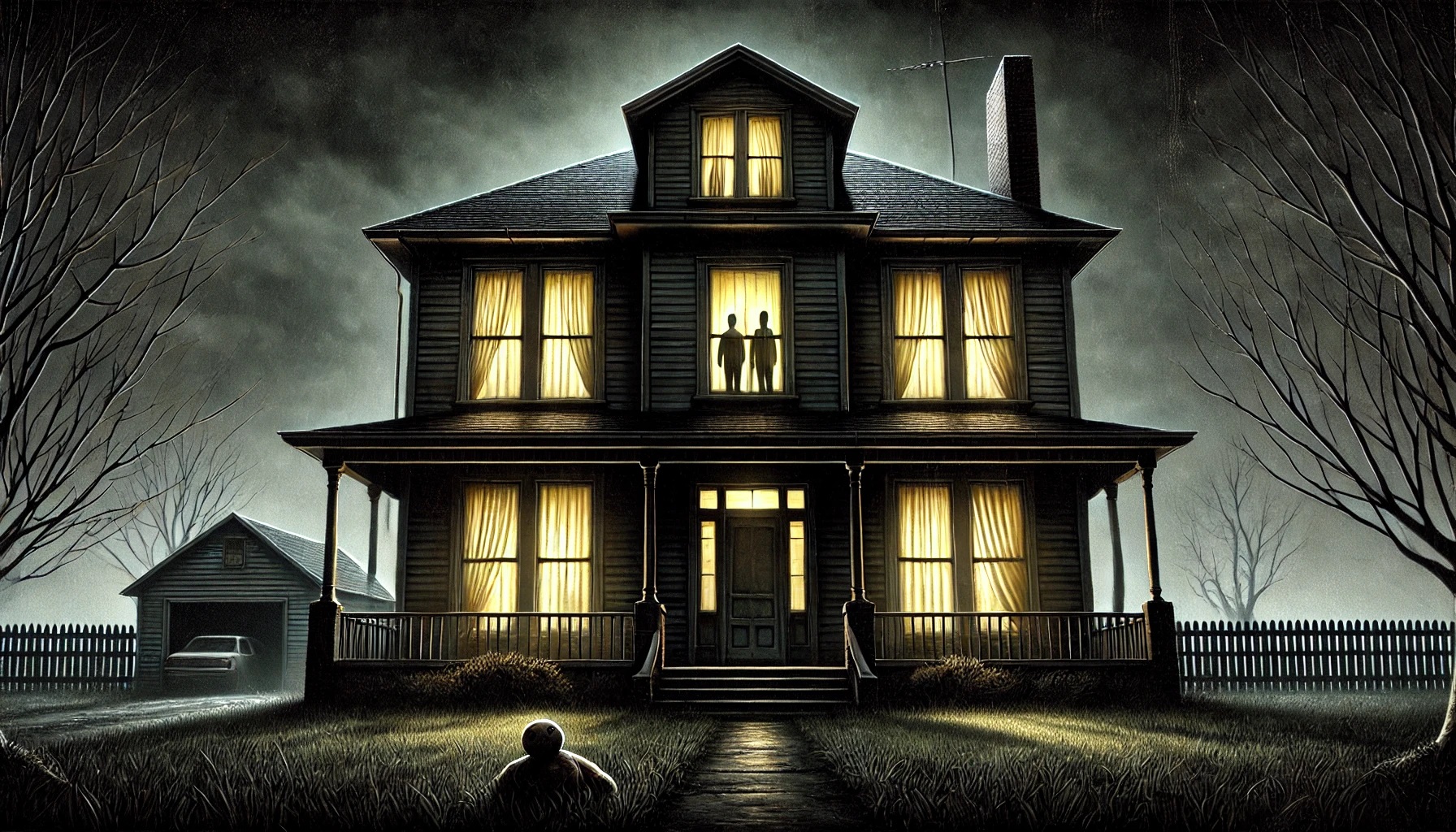
30 Aug Mr. and Mrs. Watterson Were Very Bad People
“Mr. and Mrs. Watterson Were Very Bad People”
Written by Adrienne O'Brien Edited by Craig Groshek Thumbnail Art by Craig Groshek Narrated by N/ACopyright Statement: Unless explicitly stated, all stories published on CreepypastaStories.com are the property of (and under copyright to) their respective authors, and may not be narrated or performed, adapted to film, television or audio mediums, republished in a print or electronic book, reposted on any other website, blog, or online platform, or otherwise monetized without the express written consent of its author(s).
🎧 Available Audio Adaptations: None Available
⏰ ESTIMATED READING TIME — 18 minutes
They arrived on a Wednesday morning with a rental truck that looked far too small. I watched from my porch with a mug of coffee and the kind of neighborly curiosity that passes for charity in my subdivision. He was tall, with a narrow head and tidy haircut that looked like it came straight out of an employee handbook. She wore a heavy sweater despite the heat and kept one hand tucked under her elbow, as if holding herself in place.
They waved before I did. He crossed the street first, steps measured, smile set. “We’re the Wattersons,” he said. “I’m Everett. This is my wife, Ruth.”
I gave my name and the usual caveats—I’m around if you need a socket set, trash day is Thursday, avoid parking under the maple when the birds are nesting, or you’ll have a mess to clean up in the morning, trust me. Ruth laughed politely but didn’t look at me when she did. Her eyes kept moving to their new front door, then to the windows, then back again.
They worked all day without any friends or family showing up to help. No delivery pizza. No boxes labeled “kitchen” or “garage.” No organization at all, really. By evening, the truck was gone. Lights burned in the front room and upstairs, but the rest of the windows were blind. By the weekend, curtains had appeared—heavy ones, the kind that don’t let you see so much as the suggestion of a lamp through the fabric. I noticed tacks in the hems when the wind pressed them against the glass. Someone had pinned them shut.
We crossed paths twice more. Once, while I was dragging my cans to the curb, Everett thanked me for the warning about the maple and asked about the neighborhood watch. He nodded when I told him we didn’t have one. The second time was on a Sunday morning. I was weeding, and Ruth came out to sweep a walkway that was already spotless. She mentioned their kids in a way that made me think I had misheard—when the kids visit, we’ll have to fence the backyard. Then she smiled, never once meeting my gaze, and went inside.
They were friendly, but something about their interactions was unsettling, like they were rehearsing lines. Each time I saw them, I had the sense I’d wandered into a scene that had already been blocked out. Everett stood where he needed to stand; Ruth watched the marks. I told myself that was unkind, that not everyone performs small talk the same way, and besides, moving is stressful. Perhaps their calm facades were the result of their best efforts to keep their panic from spilling over.
At night, I’ll admit that out of curiosity, I sometimes sat with the television muted and the living room blinds tilted just so, letting me see their porch and surveilling them. Their door opened and closed at hours that didn’t line up with office jobs or morning shifts. They didn’t linger outside. I never saw a grill or lawn chairs. Packages on their stoop disappeared within minutes of the delivery van driving off.
I’m telling you this so you’ll understand that I didn’t start with suspicion. It started with me paying attention. The difference matters. Attention is what we owe each other when we share a street. Suspicion grows when attention reveals too many anomalies.
I didn’t know it then, but Mr. and Mrs. Watterson were very, very bad people. I didn’t realize how bad until it was too late.
* * * * * *
The first strange sound came less than a week after they moved in. I was half-asleep on the couch when it floated across the street, thin and warbling, like someone trying to sing through a mouthful of cloth. It ended in a muffled thump. I sat up, waiting for another, but heard nothing but the hum of my refrigerator and the faint rush of cars on the highway two miles over.
I told myself it was the television, that I had nodded off with some crime drama running, and my mind had blurred the sounds into something it wasn’t. But when I rewound the episode the next day, there was no scene that matched what I thought I’d heard.
A few nights later, it happened again, different this time. That night, it took the form of scraping, drawn-out and metallic, followed by what I swear was a child crying. My windows were closed, yet I could hear it as if it came from just outside. By the time I opened the blinds, the Wattersons’ house looked dark and inert.
I started noticing things in daylight, too. Locks. Not just the standard deadbolts—though they had those—but chains, keyholes, and what looked like a sliding bar across the inside of their front door. I saw them when Everett opened up for a package. He closed it quickly, but the impression stuck: they were sealing something in, not keeping burglars out.
Their shed was another curiosity. Fresh lumber reinforced the doorframe, and a new padlock hung there, big enough to keep a biker gang’s stash safe, yet I never saw either of them go inside.
Then came the dog.
Mrs. Connolly, two houses down, had a terrier named Duke, notorious for yapping at falling leaves. One afternoon, Duke slipped his leash and went tearing through backyards. I saw him pause near the Wattersons’ fence, nose twitching like he’d caught the scent of steak. He started digging furiously at a patch of earth by their gate. By the time Mrs. Connolly waddled up shouting his name, Duke was gone, vanished as if the yard had swallowed him.
The Wattersons were polite about it. Everett even helped Mrs. Connolly search the block, walking beside her with his hands clasped behind his back, nodding gravely at every bush she peered into. But Duke never turned up.
That night, I couldn’t sleep. Around two in the morning, I stepped out for air and saw that their upstairs bathroom light was on. Through the gap in the curtain, I caught sight of Ruth bending over the sink, scrubbing at a bundle of fabric. The water in the basin swirled dark, something thick going down the drain. She lifted the fabric and wrung it out, her face expressionless. When she hung it over the shower rod, I saw it was a child-sized shirt.
I backed away from my window before she could glance out.
You might think I ran to the police then and there, but I didn’t. I convinced myself there had to be a rational explanation. Maybe the shirt belonged to a nephew, for example, or maybe the stain was paint. My mind worked overtime inventing excuses because the alternative—that my neighbors were hiding something vile—was harder to face.
Still, the oddities piled up. Scraping sounds. Crying. Locks on every door. A missing dog. A woman rinsing stains in the middle of the night.
Attention turns into suspicion incrementally, like a thermometer rising a single degree at a time. I was already past the point of pretending I hadn’t noticed.
And yet, when they finally invited me over, I said yes.
* * * * * *
The invitation came one Friday evening, just as the last rays of sun were bleeding into twilight behind the rooftops. I was on my porch, trimming a cigar, when Everett crossed the street with his hands folded neatly in front of him, like a man about to deliver condolences.
“Thought it might be nice to have you for supper,” he said with a smile. “Ruth makes an unforgettable roast.”
Every alarm bell in my head rang, but what could I do? Say no, and cement myself as the suspicious neighbor who’d been peeking through blinds since day one? Accept, and maybe learn something about what really went on in that house?
Curiosity beat out caution, and I agreed.
Their home smelled faintly of lemon-scented disinfectants and something metallic beneath it, like old coins rubbed warm in the hand. The air felt staged, too clean, as if no one actually lived there. The living room had a couch, a lamp, and a coffee table with a single decorative book stacked on it. I spotted nothing personal. There wasn’t a single photograph, no clutter, and no warmth.
Dinner was set in the dining room. The table was already arranged: plates, polished silverware, and crystal glasses filled with water. A roast sat in the center, flanked by bowls of potatoes and carrots. It was textbook perfection, the kind of meal you’d see in an advertisement for cookware.
Ruth motioned for me to take a seat. She never quite looked at me, not directly. Instead, her eyes skimmed past my shoulders. Everett did most of the talking. He asked where my parents lived, how often I visited them, whether I had brothers or sisters, and whether I’d ever been seriously ill. On their own, the questions were innocuous questions on the surface, but in sequence, they seemed too pointed. I felt as though I was being interrogated.
“Have you ever broken a bone?” he asked, carving a slab of meat and sliding it onto my plate.
“Nothing worse than a sprained ankle,” I said.
He nodded as if making a note. Ruth smiled faintly, finally meeting my eyes. Her gaze lingered a moment too long.
The food was fine—better than fine, honestly—but every bite tasted like I was swallowing unease. Midway through the meal, I excused myself to use the restroom. Everett pointed down the hall.
That’s when I saw the basement door—bolted shut from the outside. And not with a little latch, either; it was secured with an iron slide-bar across the frame, as though they expected something to claw its way up if it wasn’t restrained. I stood there a second too long, staring. From behind the door came the faintest scrape, followed by silence.
When I returned to the table, Ruth was waiting for me, smiling. Everett’s eyes measured me the way a butcher sizes up a cut of meat.
We finished dinner without incident, and they thanked me profusely for coming, pressing a foil pan of leftovers into my hands.
Back in my house, I set the container down untouched. I stood in my kitchen for a long time, trying to shake the sense that I hadn’t been invited to share a meal, but to see how far I’d go.
That night I dreamed of a door bolted from the outside, and of something waiting behind it.
* * * * * *
After that dinner, I couldn’t let it go. Every detail of their house stuck in my mind—the absence of family photographs, the surgical cleanliness, the basement door sealed like a tomb. I told myself I’d stop thinking about it, but by the next morning, I was already standing at my window, blinds cracked, watching their front yard like a hawk.
It didn’t take long.
The first thing I noticed was their lack of a schedule. Everett left at odd hours and never in work clothes. Sometimes he came back with boxes, heavy enough that he carried them pressed to his chest, though he never opened them outside. Ruth rarely left at all, but when she did, it was after dark, always returning empty-handed.
I started keeping notes, tracking dates, times, and patterns. At first, it felt like a game of deduction, but the more I wrote, the more it resembled evidence.
The strangest thing was the visitors, always arriving after midnight. A car would pull up—different makes and models each time, always with plates I didn’t recognize. Someone would get out, knock on the door, and slip inside. To my knowledge, no one ever left. The cars would vanish by morning.
One night, I saw Everett dragging something heavy across the yard. It was wrapped in a tarp, long and awkward, like a rolled carpet. He grunted with the effort, hauling it toward the shed. When he unlocked the padlock, the door swung wider than I expected, revealing only darkness inside. By the time he pulled the load in and shut the door, I was already scribbling notes with a hand that shook too much to read.
The next morning, I tried to tell another neighbor—Stan, who lived two houses down and prided himself on mowing his lawn diagonally for maximum curb appeal. He chuckled and clapped me on the shoulder. “You’ve been watching too many thrillers,” he said. “The Wattersons are fine people. Ruth even brought me some banana bread last week. Maybe get some rest, huh?”
Banana bread, I harrumphed. I couldn’t remember the last time I’d seen her at the store.
From then on, my thoughts tangled into something heavier—full-blown paranoia, maybe. But it didn’t feel baseless. It felt like staring at the corner of a puzzle picture, certain that the pieces belonged together even if no one else saw it.
And then there were the faces. I didn’t see them clearly at first, just flickers in the upstairs windows—shapes pressed against the glass, small and pale, like children watching from behind curtains. Then I’d blink, and the window would be empty. I told myself it was shadows, tricks of the streetlight. Except shadows don’t fog up glass, and one night, I swore I saw a hand press faintly against the pane before being yanked away.
When I crossed the street later that week, under the pretense of bringing back the foil pan they’d given me, I asked Everett casually if they had any kids. He smiled and said no, that it was just the two of them. His answer came too fast, like he’d rehearsed it.
* * * * * *
The smell was what finally broke through my excuses.
It started faint—sweet at first, then sour, then unmistakably rotten. I noticed it on a warm evening in early July, when the air hung heavy enough to trap every odor. At first, I thought something had died under my porch, maybe a raccoon or stray cat, but the closer I walked to the street, the more certain I became that it was coming from the Wattersons’ property.
I wasn’t the only one who noticed. Mrs. Connolly wrinkled her nose as she watered her begonias. Stan muttered about the sewer line. But no one knocked on the Wattersons’ door. Everyone shrugged it off, as if admitting where the stench came from would make them responsible for addressing it.
I called the non-emergency line. An officer stopped by that afternoon, stood on the sidewalk, sniffed once, and shrugged. He rapped lightly on their door. Everett answered, all polite smiles, and a minute later, the two of them were laughing like old friends. When the officer left, the smell was somehow stronger.
That night, I decided to investigate further. Around two in the morning, when the neighborhood was as quiet as it gets, I crept across the street. Their shed stood at the edge of the yard, secured with a padlock. Quietly, I pressed my face to the sliver of space between the door and the frame.
Inside, the beam of moonlight picked out just enough to make my stomach turn: restraints bolted into the wall. A narrow cot. A child’s shoe lying on its side. Something stained the floorboards near the corner, a blotch darker than dirt.
I pulled out my phone and tried to snap a picture. The screen flashed white as the shutter went off, too bright, too loud. Panic surged—I backed away, nearly tripping over the garden hose coiled by the steps.
That’s when I saw her. Ruth. She was standing motionless on the back porch, framed by the yellow glow of the kitchen light, grinning. Then, without a word, she turned and went back inside.
I ran.
Back in my house, I sat on the floor with my back to the door, phone in my hand, lungs burning. I looked at the photo. It showed nothing but darkness. The flash hadn’t caught the cot, or the shoe, or the stains, just a blur of wood grain. I had no proof.
I didn’t sleep that night. Every creak of my house sounded like a footstep approaching. Every car that passed was theirs, coming to shut me up.
By morning, the smell was gone, the air was clean, and their yard was freshly mowed. The Wattersons waved when they saw me leave for work, cheerful as ever. But the way Ruth’s smile lingered in my mind told me she knew. She knew exactly what I’d seen.
* * * * * *
After the night in their yard, I couldn’t pretend anymore. My notes had become pages of accusations: times, smells, faces in windows, the shed. I gathered them up, along with the useless photo on my phone, and marched into the police station.
I expected skepticism, but not outright dismissal. The desk sergeant glanced at the picture and slid the phone back as if it were a menu he didn’t care to order from. “Dark shed,” he said. “Could be anything.”
I insisted. I told them about the crying I’d heard, the dog that vanished, the restraints, and the bolted basement door. The officer finally sighed and agreed to send someone out.
When they arrived at the Wattersons’, I followed, heart thundering. Everett and Ruth opened the door like they’d been expecting guests. They welcomed the officers in with smiles. Five minutes later, everyone came back out laughing.
One of the officers clapped me on the shoulder. “They showed us around. There’s nothing out of the ordinary there. You should get some rest, neighbor. These folks are fine.”
I stood there, humiliated, while Ruth met my eyes over the officer’s shoulder. She didn’t blink.
No one ever checked the shed.
That night, I sat by the window with every light off. Around midnight, the noises started again, louder than before. I heard screams, cut off and muffled, as though someone had been gagged mid-breath. This was followed by a dragging scrape and the sounds of metal striking concrete.
I dialed 911 with shaking fingers. The operator recognized my address. Her tone carried that patient firmness reserved for repeat callers. “Sir, we’ve been out there already. Unless you have an immediate emergency—”
The line crackled as another cry cut through the dark, high and sharp. I hissed it into the phone. “That. You hear that?”
But she didn’t, or she pretended not to. After a pause too long to be anything but deliberate, the dispatcher sighed. “Sir, we’ve had officers out there. Unless you’re in immediate danger, there’s nothing further we can do tonight.” Her voice was tired, almost bored, as if I were wasting her time. Then the line went dead.
I stayed by the window, staring at their house. The curtains never moved. The porch light never flickered. All I heard was silence, stretching too long to ignore.
It was nearly three in the morning when I stood up. I don’t know if it was courage or stupidity, but I knew I couldn’t sit there another night while something happened across the street. If the police wouldn’t act, I would.
My hands shook as I opened the drawer by the sink. The biggest knife I owned—a heavy kitchen blade—gleamed under the light. I slipped it into my jacket pocket. It wasn’t much, but it was better than nothing. At least if the Wattersons caught me, I wouldn’t be walking in empty-handed.
I slipped on my shoes, flashlight in the other hand, and crossed the road. I was aware I’d be trespassing, breaking and entering—things I had no business doing, but I kept telling myself that if I didn’t, someone else was going to die in that house. I couldn’t live with that on my conscience.
When I arrived at their property, I noticed the front yard smelled faintly of bleach, like someone had scrubbed the grass itself. The curtains were still pinned. No light bled from inside.
I crept up the porch steps, heart hammering. I expected the front door to be locked, possibly with a chain. But there was nothing of the sort, and when I touched the knob, it turned with ease, with no resistance at all. It was as though they had been expecting me.
Cautiously and quietly, I stepped inside. Indoors, the air was still, cooler than the night outside. I hesitated in the entryway, every nerve in my body screaming at me to leave, to run. But then I saw the basement door, the same one I’d seen bolted shut during dinner. Now the iron bar was drawn back, the knob bare. It was unlocked.
And that was the moment I realized: they wanted me to come inside.
* * * * * *
I eased the door open. A staircase descended into darkness, the air thick with the scent of damp concrete and something coppery beneath it. I told myself I’d take one look, one photograph, then leave. My flashlight beam quivered against the wall as I stepped down.
The basement was far larger than I had expected, stretching beneath the entire house. The first thing the light touched was a set of chains bolted into the wall—old, but not unused. The links were rubbed shiny where wrists had struggled against them. Nearby stood a workbench laid out with tools—pliers, clamps, and a saw, all of which had been recently used.
On the floor, half-hidden beneath a tarp, lay children’s things. A plastic truck with one wheel missing. A pink sneaker no bigger than my hand. A stuffed rabbit whose ears had been torn nearly off. I thought of the faces I’d seen pressed against the upstairs glass, and my stomach lurched.
Then I heard it. A voice, papery and weak:
“Help.”
I swung the light and nearly dropped it. Against the far wall, chained low to the floor, was a girl no older than fifteen. Her hair was matted, her skin pale, her eyes hollow but burning with desperation. She tried to lift an arm, but the shackle dragged it back.
“Please,” she whispered, “help me, before they come back.”
I rushed forward, fumbling with the lock. It was heavy and corroded, with no key in sight. My phone trembled in my hand as I tried to snap a picture, anything to prove what I was seeing.
That’s when the steps creaked above.
Everett’s voice floated down, calm as if calling for tea. “You’ve really gone and done it now.”
I spun toward the stairs. Everett descended slowly, hands behind his back, posture too casual for the scene. Ruth followed a moment later, holding a lantern.
“You think you’ve discovered something,” Everett said, “but we opened the door for you. We wanted you here.”
I backed toward the girl. “She needs help. She’s dying.”
Everett tilted his head, studying me the way a farmer studies livestock. “The world doesn’t care for the weak. We give them purpose. Their pain makes them useful.”
The girl whimpered. Ruth crouched, stroking her hair with a tenderness that made the gesture seem obscene. “Shh,” she murmured. “Almost finished.”
I lunged. This time it wasn’t just the flashlight in my grip—I slashed out with the kitchen knife I’d brought, catching Everett across the forearm as he moved to block me. His grunt was low, surprised more than pained, but the sight of blood proved he could be hurt.
His other hand shot out, clamping my wrist with shocking strength. He leaned close enough that I felt his breath. “You’ll make a fine addition,” he said.
The girl screamed, not loudly—her throat was too raw—but enough to pierce. In the struggle, Ruth drew a blade from her apron pocket. She pressed it against the girl’s throat.
“Please!” I gasped. “Don’t—”
But she did, swiftly and efficiently, the sound wet and final.
The girl went still.
I froze, horror rooting me where I stood. Everett’s smile widened, as though this was all he’d wanted—for me to witness the casual ending of a life, and to feel complicit in it.
They might have finished me then, too, if not for instinct. I drove the knife up again, this time burying it shallowly into Everett’s side before wrenching free. He roared, staggering back into the workbench. Tools clattered to the floor. That’s when Ruth lunged at me, her blade flashing. I hurled the flashlight into her face, the blow cracking against her cheek. She shrieked, dropping the lantern. Shadows whipped wildly across the walls as the light swung.
I bolted for the stairs, clutching the bloody knife, every step fueled by terror.
I careened up the stairs two at a time, lungs searing, heart clawing at my ribs. Behind me, laughter rose, following me all the way to my front door.
* * * * * *
I didn’t sleep that night.
I slammed my own door shut, locked it, wedged a chair beneath the knob, and sat there shaking, waiting for them to pursue me. Every car that passed threw shadows across my walls that made me lurch for the phone again.
When dawn came, I called the police again. My voice cracked, and I barely made sense, but I told them everything: about the basement, the girl, the chains, the blood. Two cruisers arrived within half an hour. I watched from my porch as they knocked. The Wattersons answered, bright-eyed and smiling, as though they’d just been woken from a wholesome dream. They welcomed the officers inside.
I sat there, fists clenched, for twenty minutes. When the cops finally came out, one walked over to me. He told me there was no basement. Said he’d toured the whole house. Storage closets, laundry nook, pantry. There were no stairs, no bolted door, just tidy rooms and a cheerful couple who were “very understanding about my concerns.”
I laughed in his face.
“Maybe take some time off,” the officer suggested. “Stress does things to the mind.”
When they left, the Wattersons stood in their yard and waved at me. Ruth even called across, “We’ll have to have you over again sometime!” Her tone was syrupy, and her eyes never left mine.
That night, their house was dark. The lights stayed off, and everything remained quiet, as though the home had been abandoned. But I knew better. I’d seen too much to believe it.
* * * * * *
Days passed. Then a week. I tried to live normally. I went to work, bought groceries, and made small talk with Stan about lawn care, but the tension built in me. I kept my notebook hidden under my mattress, terrified they’d somehow slip inside and take it.
Then, as quickly as they’d come, the Wattersons were gone. No trucks, no “for sale” sign, no goodbyes. Their windows went dark one night and stayed that way.
What unnerved me most wasn’t their vanishing—it was the way everyone else reacted. Or rather, the way they didn’t. Stan waved at me while mowing diagonally, never once mentioning the neighbors who’d baked him banana bread. Mrs. Connolly went on watering her flowers as though Duke hadn’t disappeared scratching at their fence. If I brought up the Wattersons, people looked at me blankly. Within days, it was as though the couple had never existed at all.
I tried to anchor myself in proof, but the more I searched, the less there was. Old conversations vanished. My notebook, pages filled with dates and times, now looked like the ramblings of a shut-in staring out a window too long.
Then came the posters. Missing children’s faces taped to the glass of the grocery store, the bulletin board at the gas station. One of them was hers—the girl from the basement, the one I saw die. According to the flyer, she’d vanished a week earlier. No body. No trace. No suspects. No leads.
I made one last effort. I brought the flyer to the police, explained what I’d seen, and where she had been kept. They listened politely, and when I became agitated at their outright dismissal, they begrudgingly pulled the blueprints for the Wattersons’ house, to prove to me that there was no basement, and that there never had been one.
And as for the shed?
“Sir,” they told me, “that property’s always been bare. Just a lawn and a few maples.”
I left in a daze, walked back across the street to see for myself—and it was true. The shed was gone, as if it had never stood there. The locks, the padlock scars, the dirt Duke had dug, were all gone. And through their front windows, I could see that the outline of the basement door was missing, the plaster smooth and untouched where there should have been a gaping hole in the wall.
The house itself was empty, a sign in the yard reading For Sale. Online listings showed it had been on the market continuously for over a year, ever since the family before the Wattersons moved away. There was no record of Ruth or Everett. No photos. No paper trail. It was as if they’d been erased from reality, but not from my memory.
Despite the rest of the evidence disappearing, I knew I wasn’t crazy, because the posters remained. The girl was still missing. Others, too. And when I started looking through missing persons reports in neighboring counties, I found more—too many, a rash of disappearances that seemed to pick up right after the Wattersons vanished from here. Different towns, different names, but the same pattern.
That’s when it hit me. They didn’t disappear. They just relocated.
And me? I’ve run out of courage.
I thought about reaching out to the dead girl’s parents, but reconsidered. I’m finished risking my life trying to prove what no one wants to see. I won’t chase them, not anymore. If I do, I suspect I’ll end up just like that yougn woman in the basement, and the world will move on as if I never existed.
But I can warn you.
If a man with a narrow face and a too-perfect smile moves in across the street, if a woman in a sweater too warm for the season avoids your eyes while she laughs, be on guard. Don’t take their food. Don’t accept an invitation inside. Don’t wait for proof. Don’t make excuses for the noises or the smells. Call the police, burn their house to the ground, do whatever it takes—anything but sit there, watching from your window, waiting for more children to disappear.
I don’t know who or what they really are, or if they’re even human. But I know what I saw, and I know this:
Mr. and Mrs. Watterson are very, very bad people.
🎧 Available Audio Adaptations: None Available
Written by Adrienne O'Brien Edited by Craig Groshek Thumbnail Art by Craig Groshek Narrated by N/A🔔 More stories from author: Adrienne O'Brien
Publisher's Notes: N/A Author's Notes: N/AMore Stories from Author Adrienne O'Brien:
Related Stories:
You Might Also Enjoy:




Recommended Reading:




Copyright Statement: Unless explicitly stated, all stories published on CreepypastaStories.com are the property of (and under copyright to) their respective authors, and may not be narrated or performed, adapted to film, television or audio mediums, republished in a print or electronic book, reposted on any other website, blog, or online platform, or otherwise monetized without the express written consent of its author(s).