

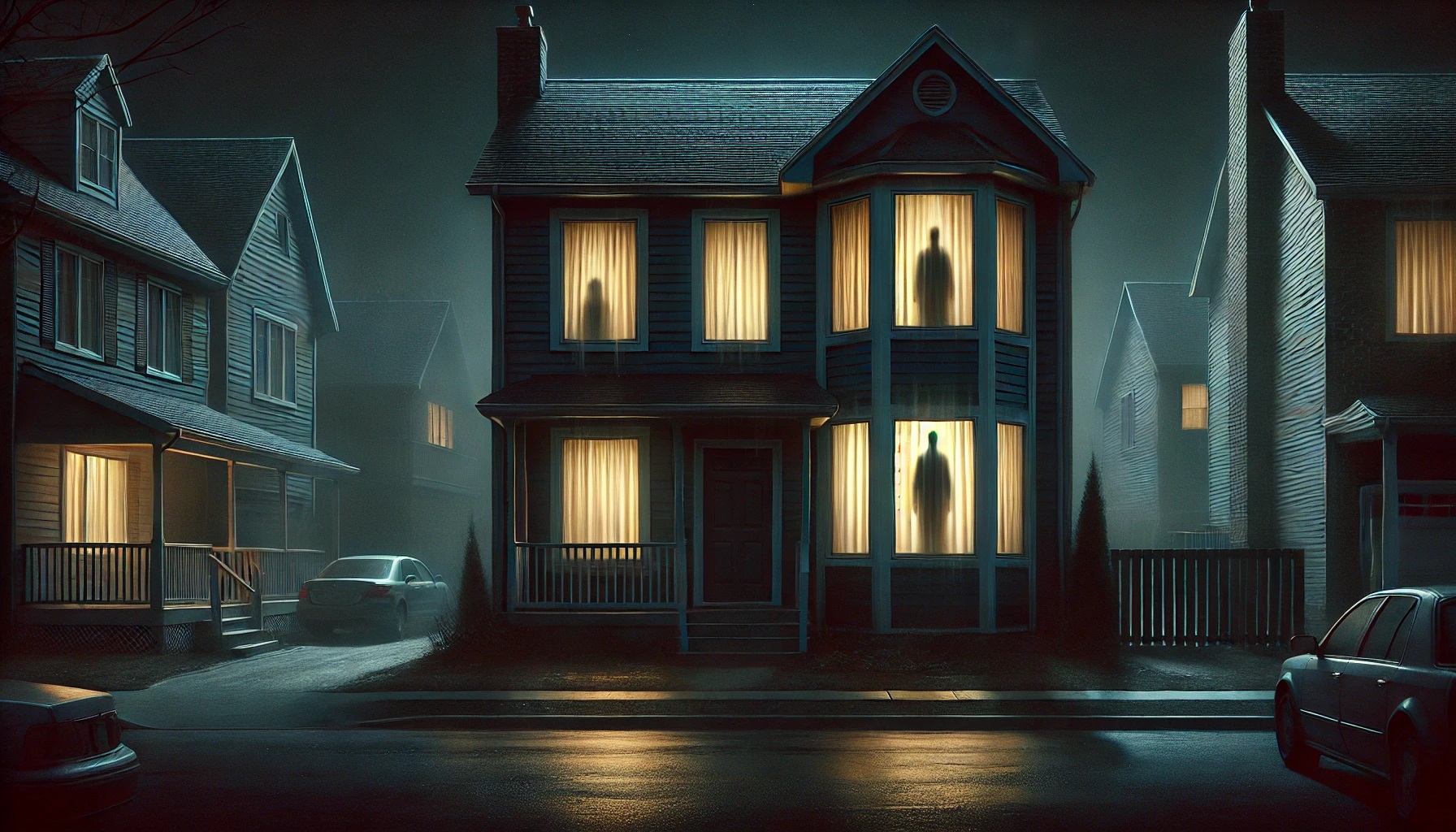
17 Sep Faces in the Window
“Faces in the Window”
Written by Nathaniel Kearse Edited by Craig Groshek Thumbnail Art by Craig Groshek Narrated by N/ACopyright Statement: Unless explicitly stated, all stories published on CreepypastaStories.com are the property of (and under copyright to) their respective authors, and may not be narrated or performed, adapted to film, television or audio mediums, republished in a print or electronic book, reposted on any other website, blog, or online platform, or otherwise monetized without the express written consent of its author(s).
🎧 Available Audio Adaptations: None Available
⏰ ESTIMATED READING TIME — 15 minutes
I live on a cul-de-sac where the loudest thing most nights is the sprinklers. We have the kind of neighbors who wave when they remember and duck inside when they don’t. If you asked me to describe our block a month ago, I would’ve said it was the kind of place where nothing weird ever happens, unless you count trash cans left out until Tuesday or the occasional raccoon wrestling with a plastic bag.
My desk faces the front window. I work late—paperwork, invoices, things that feel important until morning. Across the street is the Wycliffe place. It’s older than the rest of the houses, two stories, with a pitched roof, and original wood trim. If someone told me it came from a different town and was set here one night by mistake, I’d believe them. Mr. Wycliffe lives alone, as far as I know. He cuts his grass exactly once a week, always in the same direction. He brings his trash to the curb the second the sun goes down on Sunday, never before. If you wave, he’ll return it a beat late, like he needed a second to remember how.
It was after midnight when I first saw them.
I’d stood to stretch and refill my water. The upstairs window of the Wycliffe house was dark, a square of deeper shade above the garage. As I turned back to my desk, the curtains there lifted just enough that I saw… faces. There were two, small and close to the glass, pressed side by side the way kids crowd a display case, trying to see everything at once, only the proportions were wrong. Their eyes were too wide, set too far apart, with noses pinched like someone had drawn them and then erased half the line. Their mouths were closed in an expression that read as a smile until you looked a bit longer and realized it was something else entirely.
I stood still with the glass in my hand. The ice shifted and knocked against itself. I told myself I was seeing reflections. Headlights from the corner, maybe. Or perhaps a pair of porch lights mirrored in the pane. When I glanced up again, the curtains had fallen, and the window was a blank square.
I didn’t sleep well that night. It wasn’t terror, not exactly, but I was certainly unsettled. Every time I closed my eyes, that not-quite-smile hovered in the room like a sticker you can’t peel off.
The next evening, I wasn’t thinking about the Wycliffe house at all. I was doing battle with a spreadsheet and losing. When I leaned back and rubbed my eyes, I found myself looking out automatically, the way you might glance nervously at a clock when a deadline is rapidly approaching.
There they were again. This time, there were three. One was higher than the others, a shape behind them like someone craning from the back of a school photo. I spied no movement, no fog on the glass to prove there were lungs to go with the faces. The curtains framed them perfectly. It felt staged, like an exhibit in a museum.
I lowered myself into the chair without looking away. If you’ve ever tried to pretend you’re not staring at something, you know the games your mind plays. The itch in your cheek you suddenly have to scratch. The urge to check your phone. The kitchen light that must be turned off right now. I did none of that. I sat and I watched until a car rolled past the intersection and swept its headlights over the street. When the light touched Wycliffe’s house, the curtains fell again.
I told myself a better story than the truth. Maybe he had relatives visiting, or a niece was having a sleepover. Maybe they’d hired a babysitter, or someone had been watching late-night cartoons on the TV upstairs that threw odd shadows. It was easier to pick any of those than to say what I thought I’d seen.
The following afternoon, I took the recycling out. The sun was still up, and kids were biking in circles near the cul-de-sac bulb. One of them, a boy with a white helmet and a gap in his front teeth, waved as he looped by. His mother called him back before he reached the end of my driveway. I could hear a dog two doors down giving a piece of lawn furniture a lecture it didn’t deserve. Everything was objectively normal-looking. I looked up at the Wycliffe house and told myself to get over it.
* * * * * *
That night, the faces were back before ten.
I hadn’t touched my blinds. I was tired of pretending I didn’t care. I set my phone on the desk with the camera ready, because that’s what people do now: we save things so we can prove them later. I waited. The window across the street held steady above the empty garage.
A minute passed, then five, before the curtain finally parted as though a hand had pinched the fabric from the inside. First one face appeared, then another. Both were unnaturally pale and smooth, as if the skin had grown over something that used to be mouth and cheeks. In an instant, their eyes locked onto mine.
I took a picture. The phone clicked and dimmed. I fumbled it awake and looked. The image was only a smear of dark, with no definition, and no faces. I tried again, and got the same result.
When I looked up from the screen, there was a third face in the window, smaller than the others. The eyes on that one were startlingly bright. The curtain trembled even though there was no breeze.
I turned off my desk lamp and let the room go dim, thinking it might help the camera. In the glass of my own window, my reflection gathered. I could see the Wycliffe house beyond it, my shape superimposed over the pane upstairs. I raised the phone and lowered it. I didn’t take another picture.
By the time the clock read 11:04, the curtains had closed again, the windows across the street were blank, and the house looked like any other on our block. I stood at the window for a long time anyway, the way you stand at a door after you’ve locked it, palm pressed to the wood to make sure.
I told myself I’d mention it to Marissa in the morning. I told myself a lot of things, to be honest. But none of them were as convincing as the memory of those eyes finding me in the dark.
* * * * * *
I didn’t tell Marissa right away. She works early shifts, and I didn’t want to wake her with something that sounded like the setup to a bad campfire story. But I couldn’t shake it, either. The next night, I found myself back at the desk, blinds open, staring at that upstairs window like I was waiting for a bus.
At first, I saw nothing but a black square. My eyes drifted back to the screen in front of me, but some instinct tugged, and when I looked again, the curtain was parted.
There were two faces this time, each with the same strange proportions, the eyes oversized and too fixed. They weren’t doing anything but watching, but that was enough. The hair on my arms rose like static was crawling through the room.
I tried taking another photo. I’d even dimmed the screen brightness, thinking maybe that would help, without luck. All I managed to capture was a blurry rectangle, sans detail. Nothing even close to evidence. If I wanted proof, I’d need someone else to see them with me.
The next morning, I mentioned it over coffee.
“Faces?” Marissa asked. She was scrolling on her phone, half-listening.
“Yeah. Kids, maybe. But something’s off.”
After a moment, she finally glanced up. “So, either the old guy’s got family over, or you need more sleep. You’ve been staying up past two every night, after all.”
She wasn’t wrong. I laughed it off, but I noticed the way she eyed me over the rim of her mug, gauging whether I actually believed what I was saying.
That evening, I asked a couple of neighbors in passing—people walking their dogs, bringing trash bins back from the curb. Not one of them had seen kids in Wycliffe’s house. Most of them thought he lived alone. When I pressed, they shrugged. “Maybe grandkids visiting?” one woman suggested, tugging her dachshund along before I could ask more.
That night, I kept my desk lamp off and sat in the dark. It felt like I was fishing, line cast, waiting for a bite.
I didn’t have to wait long.
As expected, the curtain lifted and four faces pressed into the space—each of them pale and bunched together like they were competing for the same inch of glass. One of them tilted slightly, as though curious. Another blinked, a single slow shutter.
And then, movement. A hand, small and thin, came up and tapped once against the glass. The sound shouldn’t have carried across the street, but I swear I heard it: a brittle tink, like claws against porcelain.
I dropped into the chair, heart rattling. When I peeked back up, the faces were still there, crowding against the glass, unblinking.
I shut the blinds. For the first time in years, I locked my office door before bed.
* * * * * *
Over the next week, I tried not to look, but you can only tell yourself not to think about something so many times before it’s the only thing you can think about.
I’d pass through the living room and feel the itch of eyes on me. I’d carry laundry upstairs and find myself drifting toward the front windows, just to make sure the curtains across the street were still closed.
When I confessed as much to Marissa, she sighed and said, “This is becoming an obsession. You need to stop watching that house. It’s like feeding a stray cat—keep it up, and it’ll never go away.”
She didn’t get it. It wasn’t that I wanted to keep looking. It was that not looking felt worse, like giving something permission to creep closer while my back was turned.
I started keeping the curtains in my own office drawn, but that only made me more aware of the shapes behind them. I’d imagine faint movement, the scrape of fabric brushing against glass, and the next thing I knew, my nerves were shot.
Then came the night I woke at three a.m. and caught myself standing in the dark hallway, staring through the crack in my blinds. I don’t remember getting up. I don’t remember opening the curtain. But there they were again: the faces, waiting like they knew I’d come.
That was when the feeling changed. It wasn’t random anymore. It wasn’t just me catching sight of something strange.
They were expecting me.
* * * * * *
The block party was supposed to prove I was being ridiculous. That’s what Marissa said, anyway. “You’ll see him in daylight, talk to him like a normal neighbor, and all this face-in-the-window crap will evaporate.”
It was a Saturday in early June. Plastic tables lined the cul-de-sac with crockpots and paper plates, kids weaving between folding chairs with juice boxes, somebody’s Bluetooth speaker coughing out classic rock. I tried to play along. I ate a hamburger, nursed a beer, and nodded through small talk. But my eyes kept sliding toward the far end of the street where the Wycliffe house stood.
And then he appeared.
Mr. Wycliffe was taller than I expected, not stooped or frail in the least. He moved through the crowd with a practiced smile, like someone sliding between raindrops, never touching a shoulder, never brushing a sleeve.
When he drifted near our table, Marissa nudged me. “See? Totally normal.”
“Evening,” Wycliffe said. His voice was smooth, without a hint of a hitch or rasp. But he held my gaze too long. It wasn’t aggressive, necessarily, just… exact. Like he was memorizing me line by line.
“Evening,” I managed. “Didn’t realize you were coming out.”
“Couldn’t resist,” he said, and his lips stretched wider. His teeth were small and neat, almost like a child’s.
I asked the question before I could stop myself. “You got kids visiting lately?”
His face locked for a heartbeat, and then the smile returned, tighter. “No. Just me.”
I laughed nervously. “Oh, sorry. I thought I saw some shapes in the window the other night. Looked like…” I trailed off when I felt Marissa’s heel dig into my shoe under the table.
“Curtains,” Wycliffe said, his tone flat now. “They hang oddly. Drafty house.”
He excused himself after that, plate still empty, and moved on without looking back.
* * * * * *
A few nights later, I walked past his place on purpose. I told myself it was to prove nothing was wrong. It was just a house. Just windows.
The lawn smelled of fresh-cut grass. The driveway was empty. His blinds downstairs were drawn tight, but I could see the faint flicker of a television through the gaps.
I almost kept walking. Almost. But then I heard it.
Upstairs, a faint scratching sound emanated, like nails against wood. A burst of whispering came next, too high-pitched to make out, followed by a stifled giggle—not one giggle, but several, layered over each other like children hiding in a closet, trying not to laugh, and failing.
My throat tightened. I pulled my phone from my pocket, thumbed the recorder on, and held it up. The speaker hissed, then filled with static. The whispers cut off instantly.
I stood frozen on the sidewalk, my heart pounding against my ribs, staring up at the darkened window. Nothing moved, but the curtain seemed heavier and warped, like something inside was pressing it outward.
The static on my phone grew louder.
I turned and walked quickly back to my house, trying not to break into a run.
That night, I replayed the audio and heard nothing but static, not even the faintest hint of laughter. Marissa refused to listen, shaking her head.
“You need to stop this,” she said. “It’s eating you alive.”
I wanted to argue, but all I could see was that curtain—the way it bulged, as if a dozen small faces leaned against it, waiting for me to look. And I realized something that made my stomach twist:
They weren’t hiding anymore.
They were performing.
* * * * * *
I stopped pretending sleep was an option. Every night, I found myself at the desk, the blinds cracked just enough to see across the street. I told myself I wouldn’t look, that I’d keep my eyes on the screen, but they always drifted. Like a compass needle pulling north, my gaze returned to that upstairs window.
Sometimes nothing stirred. Other nights, the curtain would swell and sag, as if pressed by countless foreheads inside. Once, I thought I saw a mouth widen too far, stretching until the corners of the lips nearly touched the edges of the face. Another time, I counted five distinct shapes at the glass before the curtain fell shut all at once, as though something yanked them backward.
It was eroding me. My body buzzed with exhaustion, but my mind raced, unwilling to let go.
Marissa tried to intervene. One evening, she shut my laptop, forced me onto the couch, and said, “This isn’t normal. You need help.”
“They’re real,” I said, more sharply than I intended. “I’m not imagining them.”
Her face softened, but her voice didn’t. “Even if you did see something, you can’t live like this. You haven’t eaten right in days. You look sick.”
I wanted to reassure her, but I couldn’t, because even as she spoke, I was glancing past her shoulder to make sure the blinds were closed.
* * * * * *
I started researching Wycliffe. I looked into property records, newspaper archives, anything I could dig up online. His name barely left a trace. He had no family, no spouse, no social media. He’d bought the house fifteen years ago from an estate sale. Before that, the paper trail thinned into nothing.
But the house—that was different. It had history. It was built in the early 1900s, one of the first in the area, back when our neighborhood was still farmland. Every decade or so, its ownership changed hands abruptly. Families sold quickly, often at a loss. A string of obituaries matched the addresses: children gone missing, teenagers found drowned in adjacent Twilight Lake, even a fire that took a mother and her infant in the fifties.
The most disturbing was a series of small headlines in the seventies and eighties. Local child disappears on walk home. Police continue search for missing brothers. Each article mentioned the same vague location—last seen “near the old Wycliffe property.”
I stared at the dates until the numbers blurred.
When I showed Marissa, she pushed the laptop closed. “Coincidence. Old houses have stories. People exaggerate.”
“They all center on that house.”
“You’re cherry-picking.”
“No,” I said, louder this time. “This is a pattern.”
She didn’t reply. She just left the room, shaking her head.
That night, I woke to a sound I couldn’t place. When I opened my eyes, I saw the pale wash of moonlight across our bedroom wall. And Marissa.
She was standing at the window, hands on the sill, staring across the street.
“Marissa?” I said, my voice cracking.
She didn’t move or respond.
I swung my legs out of bed, the floor cold under my feet, and crossed the room. When I touched her shoulder, she turned with a start, eyes glassy.
“What are you doing?” I asked.
She blinked, as though just realizing where she was. “I… I don’t know.”
The blinds swayed slightly behind her, though the window was shut.
She crawled back into bed, muttering that she didn’t remember getting up. Soon her breathing slowed, steady and even.
I lay awake beside her, watching the ceiling, because I knew she hadn’t been alone at that window. She’d been watching the Wycliffe house.
And something inside had been watching her back.
* * * * * *
The morning after I found Marissa at the window, she acted like nothing had happened. She laughed at a video on her phone while we ate breakfast. She hummed along with the radio while she got ready for work. But something was wrong.
Her eyes didn’t linger on me when we talked. Her smile felt pasted on, as if the muscles remembered the motion but not the meaning. I told myself it was fatigue. Maybe she hadn’t slept as deeply as I thought. But every time she glanced toward the front of the house, I felt the knot in my stomach tighten.
That night, I woke to an empty bed. The sheets were still warm where she’d been lying. My chest locked as I stumbled into the hallway. The bathroom was dark, the kitchen empty. And then I saw it—our front door hanging open just enough for the night air to slip inside.
I ran outside barefoot.
Marissa was halfway across the street, walking in her nightclothes. Her hair moved in the wind, her arms hung slack at her sides. She didn’t turn when I called her name. Didn’t flinch. Didn’t slow.
The curtains in Wycliffe’s upstairs window stirred. A faint glow lit the glass from behind, pale and sickly. For a heartbeat, I saw shapes clustered there—small faces, pressed tight. And among them, there was one I recognized.
Marissa’s.
Her features blurred by the glass, her mouth frozen in that same almost-smile.
“Marissa!” I screamed, my voice tearing out of me raw.
I sprinted across the asphalt, gravel biting into my soles, and reached the porch just as the door of the Wycliffe house creaked open. She stepped inside without hesitation. I lunged after her, but the door slammed shut. The impact rattled the frame, sharp enough that dust drifted from the eaves. My fists pounded against the wood. There was no answer, no sound at all.
When the porch light flickered on, I froze. Wycliffe wasn’t standing behind the glass, and neither was Marissa. No one was. All I saw was darkness, extending into every crevice of the place.
And then the curtains upstairs closed in unison, as if pulled by invisible hands.
Marissa was gone.
* * * * * *
I called the police. My voice was a rasp, broken with panic, but I got the words out: my girlfriend had just walked into the neighbor’s house and hadn’t come back out. They arrived within twenty minutes, lights flashing blue and red across the cul-de-sac, waking half the block.
Two officers knocked on Wycliffe’s door. He answered, dressed neatly, with his shirt buttoned and his hair combed, like he’d been expecting them. I couldn’t hear every word, but I caught enough: no girlfriend here… haven’t seen her… do a search if you want.
They did. I watched them disappear inside with flashlights, my body buzzing like a live wire. Minutes dragged. Finally, they came back out, their faces unreadable.
“Nothing,” one of them told me. “We searched every room. There’s no sign of anyone else.”
I nearly screamed at him. “She went in there! I saw her! She’s not the type to just… walk away!”
The officer’s eyes softened slightly, but his tone stayed flat. “We’ll file a missing persons report, but unless we get more evidence, there’s not much else we can do.”
Wycliffe stood behind them in the doorway, hands folded. He didn’t look at me, or at anyone for that matter. His gaze stayed fixed somewhere just above the officers’ shoulders, as if waiting for a signal only he could see.
The police left. The neighbors whispered in knots of twos and threes, side-eying me like maybe I’d cracked under pressure, or that maybe Marissa had left me. Perhaps, they thought, this was all some domestic spat gone bad.
By the next morning, rumors had spread.
* * * * * *
I need someone—anyone—to believe me. Not my neighbors, not the police. You. Strangers. People who don’t already think I’ve lost it.
Because the faces are back.
Every night, without fail, they return to that window. They don’t hide anymore. They crowd the glass, dozens of them now. Some look like children. Some look like adults. Their features are warped, their skin waxy, their mouths never moving.
And one of them looks exactly like Marissa.
Her eyes are blank, her lips closed in that wrong almost-smile. But it’s her. I know it’s her.
Last night, when the curtain slid open, she was pressed against the glass at the center. The others crowded around her like they were propping her up, holding her in place.
I couldn’t look away. I knew she saw me.
* * * * * *
I haven’t slept in three days. Not really. Every time I close my eyes, I feel them staring, and the moment I drift off, I wake up at the window. I don’t even remember getting out of bed anymore. I just arrive there, palms pressed against the glass, face tilted toward the Wycliffe house.
Last night, something changed.
I’d been sitting in the dark, watching as usual, my phone clutched in one hand, when the curtains in Wycliffe’s house stirred. It wasn’t just one window this time, but all of them. Every curtain on both floors slid aside in unison, like a command had been given.
Behind the glass, dozens of faces pressed forward. Rows upon rows, pale and distorted. Children. Adults. Marissa. Their features mashed together by the pane, lips sealed, eyes wide and fixed on me.
And in the middle of them stood Wycliffe himself. He wasn’t hiding upstairs anymore. He wasn’t pretending to live alone. He stood shoulder to shoulder with the faces, his own mouth curved in that too-wide smile, his eyes glowing with recognition.
The figures the faces belonged to didn’t blink or breathe. They only leaned closer, their features warping against the glass as if trying to push through.
I should have closed my blinds, called someone—anyone—and run for my life. Instead, I stood there until my legs ached, unable to look away.
And then, for the first time, the faces moved. Their mouths opened in unison, wide and silent. They didn’t scream or utter so much as a word—just a gaping void of flesh and teeth pressed against the glass. The sound never reached me, but I could feel it, a vibration in the air, a pressure crawling beneath my skin.
Then, suddenly, they vanished.
Perplexed, I strained my eyes to see where they had gone, but saw nothing. That’s when I noticed, to my dismay, that the reflection in my own window was wrong. My office, my desk, the glow of my monitor—everything was there. But behind me, filling the room, were small, pale, warped faces, pressed so close their skin blurred together.
They were no longer watching me from inside his house. They were watching me from inside mine.
I dropped the phone.
I don’t know how long I stood there, paralyzed in fear, before the reflection began to move on its own, and I ran like I’ve never run before.
I don’t remember exiting my office, rushing down the stairs, grabbing my car keys, or rushing out the door. I don’t remember the miles it took to reach my brother’s home hours away, or what I told him when I first arrived, gibbering like a madman. All I know is I got away, and that Marissa didn’t. And that kills me.
If you ever see faces staring at you from a window across the street, don’t do what I did. Don’t look back.
You may very well be inviting them in.
🎧 Available Audio Adaptations: None Available
Written by Nathaniel Kearse Edited by Craig Groshek Thumbnail Art by Craig Groshek Narrated by N/A🔔 More stories from author: Nathaniel Kearse
Publisher's Notes: N/A Author's Notes: N/AMore Stories from Author Nathaniel Kearse:
Related Stories:
You Might Also Enjoy:


Recommended Reading:




Copyright Statement: Unless explicitly stated, all stories published on CreepypastaStories.com are the property of (and under copyright to) their respective authors, and may not be narrated or performed, adapted to film, television or audio mediums, republished in a print or electronic book, reposted on any other website, blog, or online platform, or otherwise monetized without the express written consent of its author(s).