

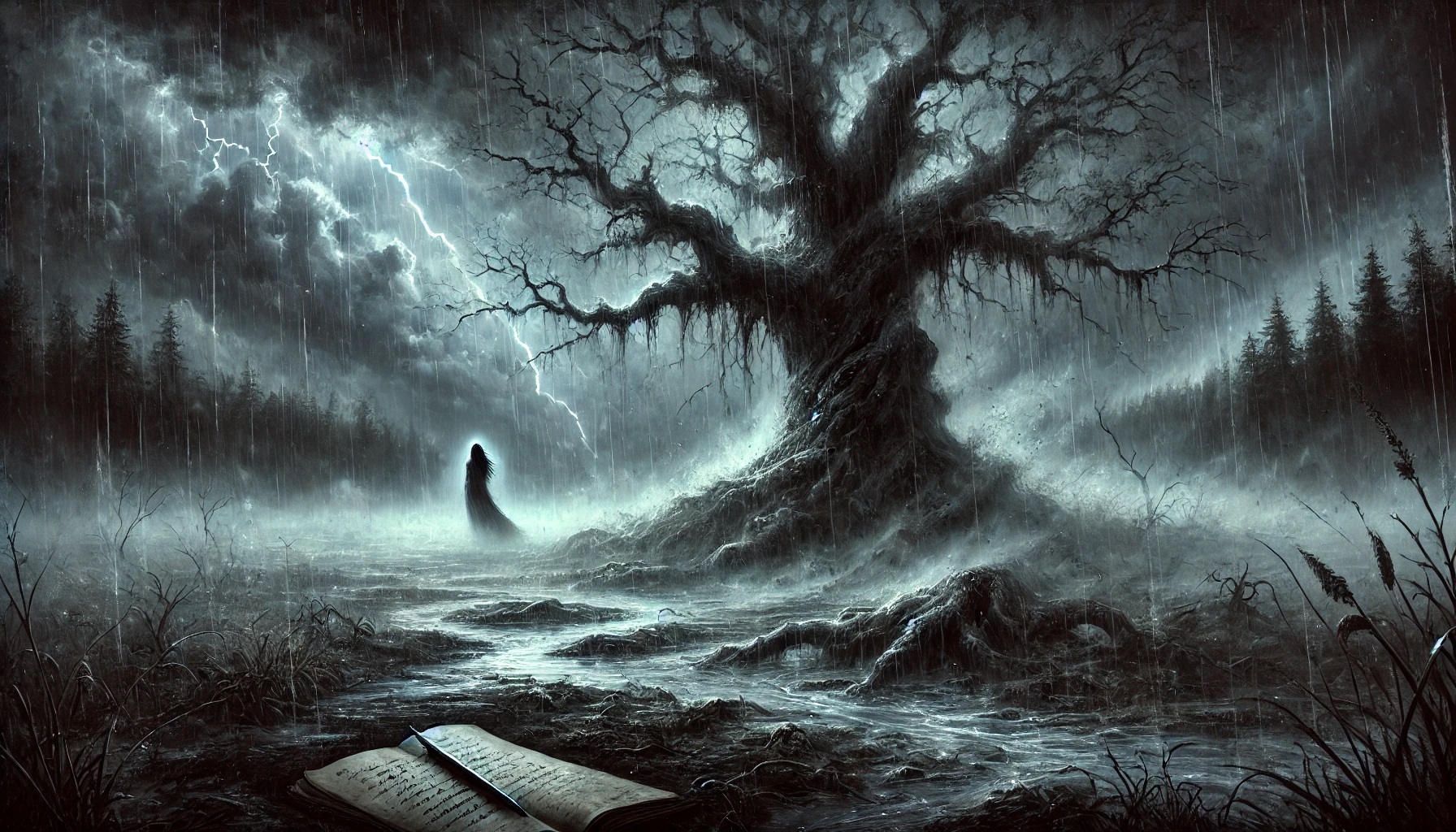
10 Oct Ghogoan
“Ghogoan”
Written by Craig Groshek Edited by Craig Groshek Thumbnail Art by Craig Groshek Narrated by N/ACopyright Statement: Unless explicitly stated, all stories published on CreepypastaStories.com are the property of (and under copyright to) their respective authors, and may not be narrated or performed, adapted to film, television or audio mediums, republished in a print or electronic book, reposted on any other website, blog, or online platform, or otherwise monetized without the express written consent of its author(s).
🎧 Available Audio Adaptations: None Available
⏰ ESTIMATED READING TIME — 18 minutes
Marshall Blake woke up at his desk again. He’d been finishing a logo draft, eyes burning from staring at the screen too long, and must’ve dozed off sometime after midnight. His coffee was cold. His monitor was still glowing.
He rubbed his face, reached for his phone to check the time, then noticed something on the notepad next to his keyboard. Two lines written in black ink.
The first read: Star.
Under it, a second word, which didn’t appear to be in English: ghogoan.
The pen was capped.
He blinked, waiting for his brain to catch up. He didn’t remember writing anything after ten o’clock. He picked up the pen, uncapped it, and tried to match the handwriting. His own letters leaned right, quick and sloppy. These sat straight, deliberate, and evenly spaced.
He pressed his thumb against the ink. It left a faint smudge. Still fresh.
He looked around the room, listening. The only sound was the faint hum of his computer’s cooling fan.
He spoke out loud, mostly to steady himself. “You probably wrote it half-asleep.”
No reason to think otherwise. Still, the thought didn’t feel right.
He snapped a picture with his phone and texted it to his friend Dylan.
Marshall: Woke up to this. Not my handwriting.
Dylan: Sleepwriting. Happens to geniuses and lunatics.
Marshall: Pen was capped.
Dylan: Then your ghost’s got manners.
Marshall shook his head, but the message made him smile. That helped. He closed the chat and took another look at the notepad. The word didn’t look random. It looked like someone had written it slowly, trying to make it clear.
He sounded it out under his breath. “Gho-go-an.”
It didn’t sound right, either.
He opened his browser and typed it in.
Google asked if he meant shogun. Everything else was junk. Forum posts about “sky lights,” half-dead blogs, a couple of threads arguing about strange words that showed up in old field journals. One half-sentence stood out: “The shogoan light falls on those who look too long.”
He closed the window. Enough internet for one night.
* * * * * *
Morning didn’t make it any less strange.
He sat with his coffee, looking at the two words. The farmhouse was quiet except for the heater clicking on and off. The quiet was part of why he’d moved here — cheap rent, plenty of space to work, and no traffic. But lately it had started to feel too quiet.
He opened a new document on his laptop and tried to get back to work, but his eyes kept sliding toward the notepad. It sat just beside his mouse, easy to glance at without meaning to. Every time he looked, he expected the ink to have faded. It never did.
He got through his morning emails, forced himself to finish a draft for a client, and finally shut everything down by midafternoon. The rain had stopped, but the sky was still the color of wet concrete. He thought about taking a walk, maybe introducing himself to one of the neighbors.
He put on his jacket, opened the front door, and changed his mind. The yard was slick with mud, and the air smelled musty. He went back inside.
He made a sandwich, turned on the radio for background noise, and ate standing at the counter. The news droned on about a wreck on Highway 18 and the forecast for more rain. The signal crackled and dropped for a few seconds before coming back.
When the house went quiet again, he caught himself listening for movement. There was none.
He walked through each room anyway, checking windows and doors, then returned to the desk. The page looked exactly the same. Star on top, ghogoan below.
He tore it off the pad and held it up to the lamp. The ink caught the light just enough to show faint pressure lines beneath each stroke — like someone pressing harder than they needed to.
He set it down again. “You did this,” he muttered. “You just don’t remember it.”
With a sigh, he powered down the computer, then remembered the small webcam in the drawer — a cheap one he used for recording time-lapses of his design work. He clipped it to the monitor and pointed it at the notepad. The green light blinked on.
“If you move again,” he said quietly, “I’ll see it.”
* * * * * *
He woke up sometime after three. The heater had shut off. The only sound was the rain ticking against the windows. The faint green LED from the webcam was still glowing.
He reached forward and stopped the recording. When the screen came alive, the notepad was still in frame. Except there was now another word beneath the first two:
Find.
He glanced at the corner of the screen. The recording had stopped twenty minutes ago.
He scrolled through the footage. For the first hour, there was nothing. Then static, a flicker, and a few seconds of distortion.
A shape leaned into frame — a blurred figure bending over the desk. One arm moved. The image froze.
Marshall’s breath caught. He skipped forward a few frames. The figure was gone.
He stared at the screen until it dimmed back to black.
He considered the words on the page again.
Star.
Ghogoan.
Find.
He shut off the camera, closed the laptop, and left the page where it was. He poured another cup of coffee and watched the first bit of daylight push through the kitchen window.
He told himself there had to be a reason—there was always a reason—but he couldn’t think of one that made sense.
* * * * * *
By the time the sky cleared the next morning, Marshall had convinced himself it was a trick of fatigue. Stress, isolation, imagination—any explanation that didn’t involve the impossible. But that conviction didn’t last long.
After a shower, he stepped out into a fogged mirror and froze. Through the steam, he saw the faint outline of letters drawn into the glass. The same word materialized again.
Ghogoan.
He wiped the mirror hard with his towel. The glass cleared, but for a split second, the letters seemed to stay. He turned away before they could come back.
He told himself it was muscle memory. He’d written the word himself, maybe while half-awake. Perhaps he’d even doodled it in the mirror before realizing it. People did weird things when they weren’t sleeping well.
He got dressed, made coffee, and avoided looking at the notepad on his desk.
By late morning, he’d forced himself out of the house for the first time in days. The gravel road was soft from last night’s rain, and the ditches still held puddles that mirrored the gray sky. He walked until he reached a split-rail fence and an open gate leading into a small pasture.
A woman in a denim jacket and rubber boots was tossing feed to chickens near a weathered shed. When she spotted him, she gave a friendly wave.
“You must be the new tenant,” she called.
“Yeah,” he said. “Marshall Blake.”
“Grace Connelly. I live next door—well, next field over.”
He stopped by the fence. “Didn’t realize anyone else was close.”
“Close enough,” she said. “That old house has been empty a while. You fixing it up?”
“Just renting. Needed some quiet for work.”
Grace nodded. “You’ll get that out here.” Her tone softened, almost hesitant. “You’re not the first to say that.”
He picked up on the shift. “Someone lived there before?”
“A young woman. Mara Ellison.”
The name landed oddly, like he should’ve recognized it. “She move away?”
Grace hesitated. “Something like that.”
Before he could ask more, one of the chickens flapped up onto the fence rail, startling them both. Grace laughed, the tension breaking, and said, “If you need anything—tools, company, whatever—you know where to find me.”
Marshall nodded, thanked her, and headed back home.
* * * * * *
That night, he set his phone on the desk, opened a new document, and tried to work, but found it impossible to focus. Every few minutes, his eyes drifted toward the notepad, waiting for something to happen. He told himself that if it stayed the same through the night, he’d stop thinking about it altogether.
He didn’t make it that long.
Sometime around midnight, the power flickered. The desk lamp went dark for a few seconds before buzzing back to life. His phone, lying face-down, lit up on its own. The flashlight was on.
He picked it up, expecting to see a notification or call, but the lock screen was blank. The light pointed directly at the notepad. He didn’t remember leaving it that way.
He turned the phone over. Another word had been written beneath the others. The handwriting was steady, confident, and unmistakable.
BENEATH.
Marshall’s hands went cold. He looked at the door and windows, scanning every corner of the room. Nothing moved.
The heater kicked on in the hallway, startling him with its sudden click.
He turned the phone camera on and snapped another photo, zooming in until the letters filled the screen. Then he shut off the flashlight and went to bed, leaving the pad exactly where it was.
When he woke, sunlight was leaking through the blinds, and the words were still there.
He poured himself coffee and sat staring at the page again. The same questions circled in his head. If someone was breaking in, they weren’t stealing anything. They weren’t leaving footprints. The camera hadn’t picked up movement since he’d turned it off.
He thought about calling Dylan, but he already knew how that would go.
Man, you’ve been cooped up too long. Go outside. Touch grass.
He walked to the window instead. The oak tree behind the house was slick from the rain, branches still heavy with water. Its roots jutted out of the ground in thick, gnarled ridges. For the first time since moving in, he noticed a patch of dirt beneath it that looked darker than the rest of the yard, as if it had been disturbed.
He turned away before the thought could finish forming.
* * * * * *
That evening, he opened his laptop and searched the name Grace had mentioned.
Mara Ellison, Kubrick Creek.
The first result was a five-year-old article. LOCAL WOMAN STILL MISSING.
He clicked it. The photo showed a smiling woman in her twenties with dark hair, standing in front of a house. His house.
The article said she’d been renting from the same property owner, and disappeared one night without a trace. There were no signs of foul play, and no leads.
He scrolled to the bottom and saw the name of the investigating officer: Deputy Owen Rourke.
Marshall read the article twice, then shut the laptop and sat there in the quiet.
He looked down at the notepad.
Star.
Ghogoan.
Find.
BENEATH.
He picked up the pen and wrote a word of his own underneath.
Why?
He set the pen down and waited.
For a while, nothing happened. Then, somewhere under the floor, he heard three soft knocks.
He stared at the floorboards, heart pounding, not sure if he’d actually heard it.
“Who’s there?” he said.
No answer.
Then, there came a single knock.
Marshall stood perfectly still, every muscle locked. The heater clicked again, breaking the silence.
He backed away from the desk, keeping his eyes on the floor, and grabbed his phone. He opened the camera app, switched it to record, and aimed it at the desk from across the room. He wasn’t sure what he expected to happen next, but whatever it was, he was done pretending it was just him.
Marshall didn’t go back to sleep that night. He sat at the kitchen table with his phone in front of him, watching the recording. The video showed what he’d already seen: the notepad in the dark, the steady blink of the webcam’s LED. It captured no movement, no tricks.
But the sound was there.
Three knocks. A pause. Then three more.
He turned up the volume. They were faint but distinct, like someone tapping a pipe with the back of a spoon. He could even hear himself whispering, “Who’s there?”—and then that single, answering knock.
He paused the video and sat there in silence. The heater came on, then shut off again, and the familiar quiet of the farmhouse returned.
He shut off the playback and decided to test something. He grabbed the flashlight, crouched, and pressed his ear to the floor. The boards were cold.
“Do that again,” he said softly.
He stayed there for almost a full minute, waiting for a reply, before standing back up, defeated.
* * * * * *
The next day, Marshall tried to focus on work, but the feeling of being watched made it impossible. Every time he glanced at the notepad, he expected to see another word.
By noon he gave up, shut the laptop, and went for a walk. The air was still damp from recent rain. The smell of wet dirt clung to everything.
Grace Connelly was outside again, tossing grain to her chickens. She waved when she saw him and called out, “You settling in?”
“Trying to,” he said, leaning on her fence.
“You look tired.”
He gave a small laugh. “I haven’t been sleeping much.”
“Too quiet for you?”
“You could say that.” He hesitated before asking, “Do you remember the woman who lived here before me?”
Her hands froze mid-motion. “Mara.”
“Yeah. You said she just left. Do you think that’s really what happened?”
Grace’s mouth tightened. “That’s what we were told. I don’t think anyone really believed it.”
“Why not?”
“She didn’t take her car. Her things were still there. She just… disappeared. Folks stopped talking about it after a while.” Grace wiped her palms on her jeans. “That house never felt right after that. I don’t mean ghosts or anything. Just… off.”
He nodded slowly. “You ever hear of someone named Owen Rourke?”
That made her look up fast. “Deputy Rourke.”
“Yeah.”
“He handled the case. You met him?”
“Not yet.”
Grace’s expression tightened again, guarded now. “Be careful if you do.”
“Why’s that?”
She looked at him for a long time before saying, “Because he doesn’t like people digging around in things that don’t concern them.”
* * * * * *
Back home, Marshall pulled up the article again. The photo of Mara bothered him. She was smiling, but it was the kind of smile people use when they’re forcing it, eyes trying to stay bright even though the rest of their face has already given up.
He closed the laptop, went to the pantry for a beer, and stood staring at the oak tree out back. The dark patch of soil beneath it still looked out of place, almost as if the ground had sunk.
He thought of the knocks under the floor.
He grabbed his flashlight and screwdriver.
The crawlspace hatch was in the hallway, a square panel held by four screws. The metal was rusted, but it came loose with a little effort. When he lifted the panel, a wave of cool, stale air drifted up. The smell reminded him of old basements—earth and dust and something faintly metallic.
He lay on his stomach and shone the flashlight inside. The beam caught splintered joists, cobwebs, and uneven soil. He swept it slowly side to side.
Something metallic glinted in the light. He reached in and pulled it out. It was a broken keyring with a single piece left, a small metal tag in the shape of a star. One edge was bent, as if it had been crushed.
Marshall sat back, staring at it in his palm. He didn’t know what it meant, but it felt like confirmation of something he hadn’t wanted to believe.
* * * * * *
That night, the knocks came again. Louder this time.
He pressed his ear to the floor and whispered, “Mara?”
The tapping stopped.
Then came a sound he couldn’t explain, like the muffled scrape of fingernails dragging across wood. It moved slowly, directly beneath him.
He jerked back and stayed perfectly still, waiting for it to start again. When nothing happened, he shut the crawlspace panel and dragged a heavy chair over it. Then he went back to the desk. On the notepad, a fresh word had appeared.
HOME.
The pen lay beside it, uncapped. Marshall’s throat went dry.
He whispered, “What do you want from me?”
There was no answer, only the faint hum of the heater kicking back on.
* * * * * *
By morning, the air inside the house smelled musty, like rain had leaked into the walls.
He didn’t bother trying to work. He spent most of the day reading through old online threads about unsolved disappearances and property histories. One forum mentioned the farmhouse by name, calling it “the Ellison place.” Someone in the comments claimed that the original owner had a bad habit of burying trash and unwanted junk near the oak tree.
That line stuck with him.
He stared out the kitchen window again, at that same patch of darker earth. He couldn’t see movement, but the longer he watched, the more he felt like something beneath that soil was aware of him.
He turned away.
That night, his phone buzzed as he received a new text from an unknown number.
BENEATH, it read.
He typed a reply before thinking twice.
Who is this?
Three dots appeared for several seconds, and then vanished. No further messages followed.
He waited, screen still glowing in the dark. Eventually he set the phone down, turned off the light, and tried to sleep on the couch instead of in the bedroom, but his efforts proved futile. Every time he closed his eyes, he saw the letters forming again—black ink, steady hand, patient strokes—until the word was finished.
Ghogoan.
And for the first time, he started to wonder if maybe that wasn’t the name of a thing at all. Maybe it was a command.
* * * * * *
By the next morning, Marshall had accepted something he couldn’t explain. No matter what he told himself, no matter how rational he tried to be, someone—or something—was trying to get his attention.
By that time, he hadn’t slept more than an hour. Every time his eyes closed, he heard that slow tapping again, like knuckles brushing the underside of the floor. When he finally gave up, he made coffee and sat at the table with the phone in his hand, staring at the recent text.
BENEATH.
He deleted it. The phone buzzed again before he could set it down.
Same number. Same word.
BENEATH.
That was enough. He grabbed his jacket and walked out into the gray morning air.
He found Grace sitting on her porch, wrapping string around a bundle of herbs. She looked up when he stopped at her gate.
“Morning,” she said. “You look awful.”
“Did you know her well?” he asked, cutting to the chase.
“Who?”
“Mara Ellison.”
Grace frowned. “What’s this all about?”
“I think she’s still there.”
That made her freeze. “What do you mean, ‘still there?’”
“In the house. Maybe under it. I don’t know.” He told her about the messages, the writing, the noises under the floor. Her expression shifted between disbelief and fear.
“Marshall, whatever’s happening in that house, you need to stop feeding it.”
“She’s trying to tell me something,” he said. “I can feel it.”
Grace shook her head. “You don’t know what you’re inviting. Let sleeping things stay that way.”
He almost left it at that, but something in her voice caught him. “You knew her, didn’t you?”
Grace hesitated. “We were friendly. Not close.” Grace looked away. “She rented that place before you. I used to check in on her. Bring eggs, things like that.”
“What happened to her?” he asked.
“Official story says she ran off. I don’t buy it. Rourke, he used to come by after dark.”
“Deputy Rourke, from the sheriff’s office?”
Grace nodded once. “They kept it quiet. He was married then. Folks around here don’t talk about it, but they know.”
“What happened the night she disappeared?”
Grace’s eyes hardened. “There was shouting. I heard it through my kitchen window. I should’ve gone over. I didn’t. That was the last time anyone saw her.”
Marshall let that sit for a long time. The wind moved through the grass with a low hiss.
“She’s not gone,” he said finally.
Grace looked at him like she wanted to say something, but couldn’t. “If you’re smart, you’ll leave it be.”
He turned and started back toward the house.
* * * * * *
By midafternoon, the sky had gone dark again, heavy with another storm.
Marshall couldn’t sit still. He kept replaying what Grace had said, trying to fit the pieces together. Mara. Rourke. The house. Beneath.
He ended up back at the crawlspace. The air inside was cold and still. He aimed the flashlight along the joists and swept the beam over the dirt. That glint of metal he’d seen earlier was still there, deeper now, half-buried.
He reached in, digging with his fingers until he freed it. It was a necklace this time. A small silver star hanging from a broken chain. The moment he touched it, the air seemed to change, growing colder and heavier. He swore the temperature had dropped ten degrees in a single breath.
He wiped the dirt away and turned it over. Two letters were engraved on the back. M.E.
Mara.
He took the necklace to the kitchen sink, rinsed it clean, and set it beside the notepad. The page still bore the same words, but the ink had bled slightly. The pen was lying next to it, uncapped again.
His phone buzzed. Another text from the same number.
STAR FALLS. BENEATH.
Marshall stood there for a few seconds before he realized his hands were shaking.
He typed back, Who is this?
As before, three dots appeared, and then vanished. He waited another minute, then another.
Lightning flashed outside, white enough to fill the kitchen. A low rumble followed, shaking the windowpanes.
He turned toward the backyard. Through the glass, he could see the oak tree thrashing in the wind, branches bending, leaves flying.
At its base, the patch of soil he’d noticed before looked darker than ever, the shape clearer now—circular, definitely sunken. He grabbed the flashlight, a shovel from the porch, and went out into the rain.
The storm was worse than it looked from inside. Wind ripped through the yard, bending the grass flat. The rain came in sheets, cold and hard enough to sting.
He stopped at the tree and pressed his boot into the soft dirt. The ground gave easily.
He set the flashlight down and drove the shovel in. The first few scoops turned up nothing but wet soil and roots. Then, about a foot down, the metal edge hit something solid. The sound was dull, not like stone—more like wood that had been buried for years.
He dropped to his knees, scraping with his hands. The dirt came away easily. Beneath it was a shape—a long, uneven board. A piece of fabric clung to one edge, soaked and rotted. He brushed at it and found something smooth underneath. Bone.
He sat back fast, nearly losing his footing in the mud. Rain ran down his face and collar, cold enough to make him gasp.
Lightning flashed again, and in that instant, he saw her—a woman’s figure, faint, standing across the yard. Hair plastered to her face, head tilted down, clothes clinging to her skin. Then the light faded, and she was gone.
He stood there in shock for a few moments, shovel in hand, rain hammering the ground, before stumbling back to the house, drenched and shaking. He slammed the door behind him, his hands trembling so badly he nearly dropped the flashlight.
When he turned back toward the kitchen table, the notepad had changed again.
The first four words were crossed out.
In their place was one new line, written neatly in wet ink.
You found me.
* * * * * *
Marshall stood there for a long time, staring at the words. The ink glistened faintly in the kitchen light, still wet. He could hear the storm outside, the steady hiss of rain against the siding, but in the house everything was silent.
He didn’t know what to do with what he’d found—or what he thought he’d seen out there. He told himself he’d call the police once the weather cleared. That was reasonable. But for now, he sat down at the table, dripping onto the floor, and tried to catch his breath.
The power flickered briefly before returning to normal.
Just then, his phone buzzed on the counter. He hesitated before checking it.
Another text. Same number.
Come back.
Marshall stared at it until the message blurred, then looked up at the window. The oak tree loomed in the dark, half-lit by the occasional flash of lightning.
He picked up the flashlight again.
When he stepped back outside, the rain had slowed to a steady drizzle. Mud pulled at his boots as he crossed the yard.
The hole waited where he’d left it. The flashlight beam found the edge of the wooden board again, the same patch of rotted fabric, the faint curve of bone beneath.
He crouched down, breath steadying now that the digging was over. He felt no fear, not anymore—just a grim sense of completion.
Then the crunch of gravel behind him cut through the rain. He turned. A vehicle’s headlights were crawling up the drive. The beam caught the uniform first. Deputy Owen Rourke stepped into the light, rain sheeting down his shoulders, flashlight already in hand.
“What the hell are you doing?” he called out.
Marshall stood. “I found her.”
Rourke came closer, shining his light into the pit. When he saw what was inside, his voice cracked. “Back away from that. Now.”
“You put her there, didn’t you?” Marshall demanded.
“Careful what you say.”
“You were seeing her. Grace told me. You fought the night she disappeared.”
Rourke stopped five feet away, gun still holstered, but his hand hovering near it. “You need to leave this alone.”
“Tell me what happened,” Marshall demanded.
Rourke’s jaw worked, but no sound came out. Rain trickled off the brim of his hat, his flashlight beam trembling where it hit the mud.
“You killed her,” Marshall said. “You buried her right here.”
“I didn’t mean to!” Rourke shouted. “We were arguing. She wanted me to leave. I told her I wasn’t done talking, and she told me—”
He stopped, swallowing hard.
“She told you what?”
Rourke’s voice dropped. “She kept saying it. Over and over. Go home, Owen. Go home. Wouldn’t stop.”
The rain hissed between them.
“I told her I was home,” he said. “That she was the one who didn’t belong here. She tried to push past me, and I grabbed her arm. She fell. Hit her head on one of the roots. Everything after that happened fast. Too fast.”
Marshall didn’t move. “You told the sheriff’s office she ran off.”
“She was already gone when I came back out here,” Rourke said. “I thought—hell, I don’t know what I thought. I buried her to make it go away. I told myself it was mercy.”
Marshall’s stomach turned as thoughts flooded suddenly into his mind, unbidden, as if coming from someone else.
Mara. He could feel her, inside him, leading him forward.
“She shouted something at you over and over again the night she died,” Marshall said. “Didn’t she?”
Rourke looked up sharply. “H-h-how the hell did you k-know that?”
“Just one phrase, repeatedly, but you wouldn’t listen, would you?” Marshall demanded, accusingly. “It’s been showing up all over this house. Her house. Ghogoan. Not English, right? That’s what I thought. But now I realize it’s what she was shouting at you! Go home. A scrambled version of it. She’s been trying to tell me this whole time! Ghogoan. Go home. The same thing she said repeatedly, before you killed her. Written by someone struggling at first to write with hands she no longer has, until she got the hang of it.”
Rourke’s face drained of color. The wind rose again, bending the trees. Rain ran in rivulets down Rourke’s face, and for a second his flashlight beam caught the open pit between them—the bones beneath the roots, pale against the dark earth.
“She knows what you did, and now I do, too,” Marshall said grimly.
Rourke took a slow step back, shaking his head. “No,” he said quietly. “No, that can’t—”
Lightning flashed. For a moment, both men were stark in the light—the hole between them. The wind kicked harder, carrying the smell of opened earth. Rourke flinched.
“What’s that smell?” he muttered.
“Rot,” Marshall said quietly. “Guilt.”
Rourke turned on him, reaching again for his gun. “You t-think this is funny? You think this is some g-ghost story?”
“No,” Marshall said. “I think she wanted to be found. And she wants justice.”
The ground shuddered beneath their feet—just a tremor, quick but sharp. Rourke stumbled back a step, eyes wide.
“Stay away from the hole!” he warned. But the edge of the pit was already giving way. Mud slid down, carrying water with it. Rourke tried to back up, slipped, and went down hard. The mud swallowed his legs, pulling him to his knees.
“Help me!” he shouted.
Marshall reached for him, but another section of ground collapsed. The deputy’s flashlight tumbled in, spinning end over end before landing beam-up at the bottom. It lit the bones in stark white.
Rourke’s face twisted. He let out one short, sharp cry, then the earth gave way completely and took him.
Marshall jumped back just in time. The sound of the collapse drowned everything else. Then it was quiet again.
He didn’t move for a long time. The ground where Rourke had fallen was smooth now, water filling what little remained of the pit, erasing the edges.
When he finally turned away, the flashlight beam caught the silver star pendant lying in the mud. He bent down, picked it up, and closed his hand around it.
Back inside, he washed the dirt from his hands, stripped off his soaked jacket, and sat at the kitchen table. The house was still.
The notepad lay open, exactly where he’d left it. The page with all the words—Star, Find, Beneath—was gone. Torn cleanly away.
In its place was a new page, bearing one freshly-penned line, written neatly in black ink.
Thank you.
Marshall stared at it until the letters stopped swimming. Then he set the pendant beside it and leaned back in the chair.
He stayed there until morning, considering the implications.
* * * * * *
When Grace Connelly came by the next afternoon, the front door was unlocked. She found Marshall asleep at the table, pale but breathing. The notepad was in front of him, the necklace beside it, cleaned and whole.
Grace picked up the necklace, turned it over, and saw the engraving. M.E.
She looked toward the yard through the kitchen window. The oak tree stood still, its branches heavy with rain.
She laid the pendant back down and noticed something new written on the pad beneath Thank you.
A single word.
Free.
Grace closed the notepad, left the house quietly, and walked home. She never said a word to anyone, and never would.
That night, when the rain started again, no one in Kubrick Creek could hear the tapping anymore.
From that day on, the ground behind the old farmhouse remained undisturbed.
And the word ghogoan never appeared again.
Mara could finally rest.
Mara had finally gone home.
🎧 Available Audio Adaptations: None Available
Written by Craig Groshek Edited by Craig Groshek Thumbnail Art by Craig Groshek Narrated by N/A🔔 More stories from author: Craig Groshek
Publisher's Notes: N/A Author's Notes: N/AMore Stories from Author Craig Groshek:




Related Stories:
You Might Also Enjoy:


Recommended Reading:



Copyright Statement: Unless explicitly stated, all stories published on CreepypastaStories.com are the property of (and under copyright to) their respective authors, and may not be narrated or performed, adapted to film, television or audio mediums, republished in a print or electronic book, reposted on any other website, blog, or online platform, or otherwise monetized without the express written consent of its author(s).