

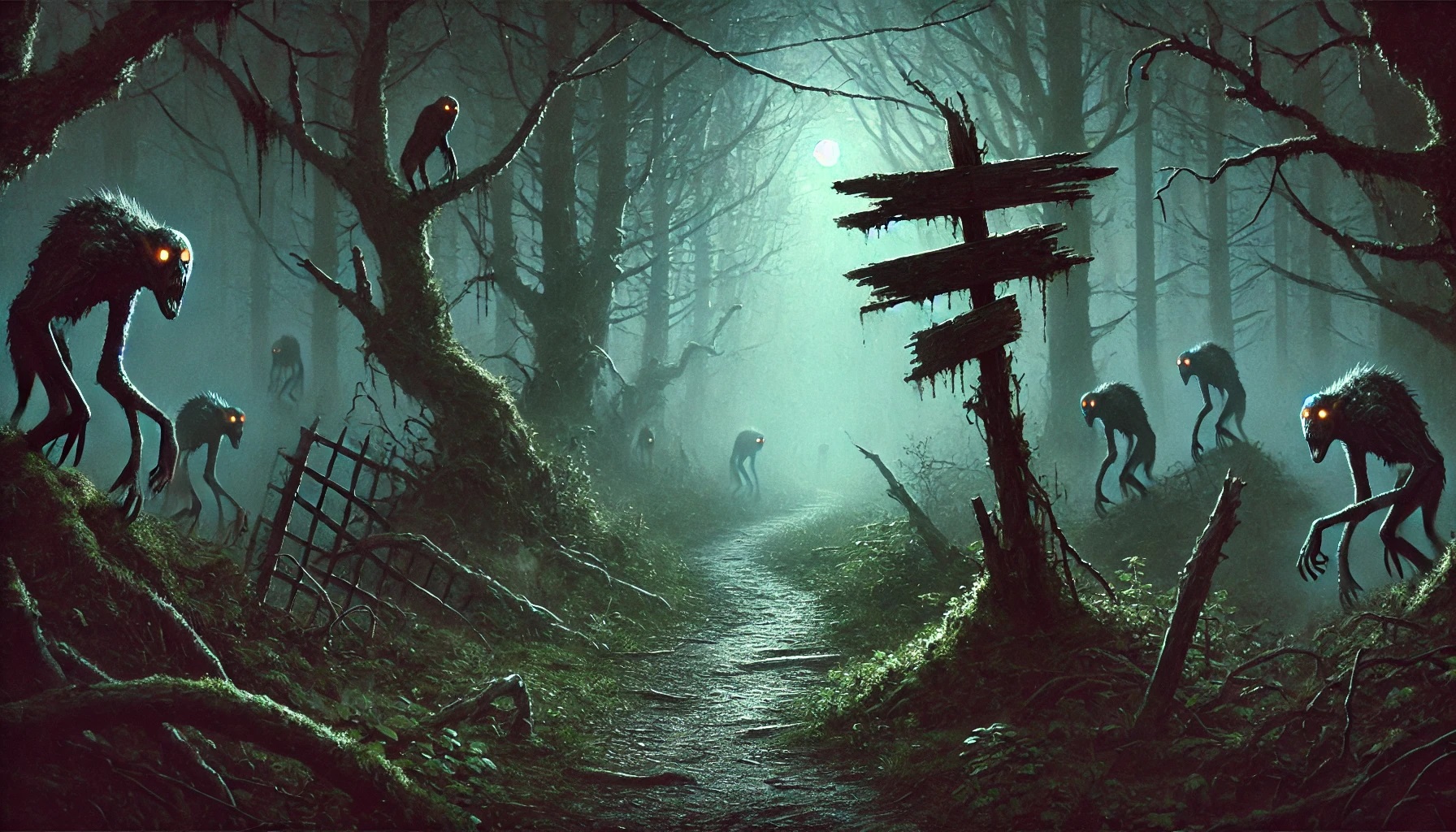
11 Oct Never Walk the Wolf Path at Night
“Never Walk the Wolf Path at Night”
Written by Craig Groshek Edited by Craig Groshek Thumbnail Art by Craig Groshek Narrated by N/ACopyright Statement: Unless explicitly stated, all stories published on CreepypastaStories.com are the property of (and under copyright to) their respective authors, and may not be narrated or performed, adapted to film, television or audio mediums, republished in a print or electronic book, reposted on any other website, blog, or online platform, or otherwise monetized without the express written consent of its author(s).
🎧 Available Audio Adaptations: None Available
⏰ ESTIMATED READING TIME — 20 minutes
I’m posting this because I need someone to tell me I didn’t fall asleep in my car and dream the whole thing. My name’s Logan Pritchard. I travel for work, the kind of work that makes people glaze over at parties—insurance claim assessments, photos, measurements, reports. On Tuesday I wrapped a roof inspection in a small Wisconsin town and had a few hours to kill before I hit the motel. There’s a little county park on the edge of town with a trail system; I’d seen it that afternoon and figured a walk would clear my head.
The visitor station was still open when I pulled in. The fluorescent light inside hummed. A single brochure rack leaned against the wall, half empty. Through the window, I could see a man in a tan shirt sorting maps. He had that sun-browned look and a face set in tired lines. I pushed the door, and it rattled like a screen door on a porch.
“Evening,” he said, like he’d been expecting me. “If you’re walking, keep it to the short loop. Bear Trail.”
“Sounds good,” I said. “How long is it?”
“Mile and a half,” he said. “Stays close to the river. The other one runs deeper.” He didn’t point, but his eyes slid past me, off toward the trees. “Don’t take Wolf Path at night.”
I thought he was kidding, or playing up local color for a bored traveler. “Why’s that?”
“Gets easy to lose your way,” he said. “Looks the same out there when it’s dark, and the markers aren’t reflective. Folks think they’re fine, then the dark gets deeper and they don’t realize how far they’ve gone.” He handed me a folded map. “Bear Trail’s the one you want.”
Outside, the last of the daylight showed through the canopy like thin paper. I started down the main gravel approach, the sound of my boots crunching beneath me. A wooden post stood at the first fork with two arrow boards bolted to it. The top one read Bear Trail. The bottom: Wolf Path. The letters were carved and painted a dull gold. I took a picture because the names felt like a punchline to the ranger’s warning.
The air had that late-summer smell of dry leaves and sandy soil. The river murmured somewhere off to the left, not loud, just enough to sit behind everything else. Mosquitoes whined and then lost interest once I got moving. My phone showed one bar, then none. It didn’t matter; the loop was simple, a lopsided figure eight on the map.
I went left, toward Bear Trail, because I’m not stupid and I didn’t feel like getting turned around by poor signage. The path narrowed to tamped dirt, soft with a layer of needles, and the trees closed in. It felt good to walk without thinking about the roof pitch of a craftsman bungalow or whether hail had hit on a diagonal. I kept a steady pace. The trail markers were little wooden diamonds on posts. Every hundred feet or so, one would show up, and I’d nod as though we had an understanding.
Ten minutes in, I heard an owl somewhere ahead. My headlamp stayed in my pocket because the dusk still held. The sky through the branches took on that slate color it gets just before it is truly night. I remember checking my watch and feeling fine about the time. I’d be back at the car by full dark. No drama.
Then I came to the sign again.
Same post. Same arrows, Bear Trail on top and Wolf Path below. Same shallow gouge across the W, the way someone might run a knife tip through fresh paint because they couldn’t help themselves. For a second I thought there must be another junction with a duplicate sign, but the ground around the post was disturbed in the same way—a wide scuff on the right, where the dirt had been kicked out, and a cigarette butt flattened into the soil off the left side. My footprints overlapped each other. I know because I wear cheap work boots with a chipped heel that prints a small half-moon at the back.
I stood there longer than I should have, doing that math in my head where you decide how embarrassed you’ll be if you turn around and the parking lot is thirty yards away. The woods didn’t feel threatening, just quiet. I told myself I’d looped a spur, or the map was wrong, or I’d cut back without realizing when I stepped around a fallen limb.
I pulled out the folded map. The ink had bled a little from sweat, but the lines were clear enough. I traced my route with a thumbnail and couldn’t find a way I could have hit the same split again. There was only the one trailhead sign.
“Fine,” I said, because sometimes you say it out loud just to cut off the thought. I took the top arrow again—Bear Trail—and walked with more attention. I picked a landmark this time, a birch with a missing strip of bark the size of a mailbox, and counted sixty paces past it. I pressed my thumbnail into a low branch as I went. The small, stupid things you do to prove you’re in control.
The river got louder, which helped. When the wind picked up, it carried a damp chill off the water. A bat cut across ahead of me, a fast, tight turn, then gone. It felt like the trail was pointing slightly uphill, which meant I should be moving away from the river bend, curling toward the thinning woods near the highway. The dark gathered under the trees. I took a breath and kept up the pace. I didn’t want to stop long enough to need the headlamp.
I saw the glint of the sign’s bolts before I recognized the shape.
Back at the split.
I walked a slow circle around it this time, as if the answer might be behind the post. The same cigarette butt. The same heel print. My thumbnail mark on the low branch from minutes earlier, except the branch stood on a different tree now, a few feet farther back. My landmarks hadn’t vanished, exactly; they’d shifted as if someone pulled the whole scene an inch to the left.
I don’t scare easily. I spend a lot of nights in towns where the only open place after eight is a gas station, and I’m used to getting lost on back roads with names like County B that roll over to County J without warning. But something about seeing the sign a second time got my attention. I wasn’t exactly alarmed, but I’d narrowed my focus in a way that cleared everything else away.
I told myself there was a simple solution. The sign was a hub; the trails spoked out and crossed. I’d kept left without noticing. The fix was to go the other way. I folded the map, shoved it into my pocket, and faced the lower arrow.
Wolf Path.
I didn’t choose it because I felt brave. I chose it because I was irritated and tired and wanted to prove the ranger was being dramatic. Fifteen minutes, I told myself. Take Wolf Path, cut right at the next post, and I’d see the visitor station lights through the trees. I could already picture the look on the ranger’s face when I told him his trails needed better markers.
I stepped onto Wolf Path and the dirt under my boots changed from packed to powdery, as if no one had used it in a long time. The trees grew closer together. The river sound fell away until I could hear only my footsteps and the soft brush of leaves. The sky above was the same flat slate, neither lighter nor darker. I checked my watch again and frowned. The minute hand hadn’t drifted at all.
I told myself it was the glow catching the needle wrong. I kept walking. Fifteen minutes, that was all. Then I’d decide whether to turn around.
Behind me, somewhere far back, a single owl called again. It answered itself a few seconds later from the other direction.
* * * * * *
I’ve tried to explain what happened next a hundred different ways, and none of them make sense in writing. What I know is that I followed Wolf Path long enough to lose track of everything else.
The first thing I noticed was how the sound changed. The forest was quiet before, but now it was empty. No river. No insects. Even my own footsteps seemed muted, as if the earth were padded beneath the dirt. I stopped a few times to listen, to check for the hum of the highway, but there was nothing—just a faint static in the air, like the woods were holding a frequency right below hearing range.
I thought maybe I’d veered off-trail, so I opened my phone. No service. The map app refused to load anything but a blank grid. The compass spun halfway around, then froze. I laughed under my breath. It was just one of those nights. I left a mark on a tree with my car key—a quick X—and kept going.
After what felt like twenty minutes, I should’ve been somewhere close to the river again. The grade of the trail looked familiar, but the trees didn’t. The trunks were spaced too evenly, as if someone had planted them in rows. The dirt looked disturbed in lines, not random scatter like normal.
I told myself it was erosion.
Then I saw the sign again. Same post. Same gouge across the “W.” My X mark on the tree was gone.
I walked past it, slowly this time, and circled behind the post. The ground there was trampled, as though boots had walked it in all directions—hundreds of times.
I muttered, “No way,” and retraced my steps the way I came. I kept my flashlight low, aimed at the ground so I could follow my own prints back. But when I looked again after ten or twelve paces, they’d filled in, perfectly smooth as if the dirt had never been disturbed.
I turned around, and the sign was thirty feet away again.
At this point, I wasn’t panicking, but something inside me started to tilt, like a compass losing its north. I thought maybe I’d crossed some looped trail intersection—some weird forest geometry trick—but when I checked my watch, the minute hand hadn’t moved since I left Bear Trail. I flicked the glass face. Nothing. The second hand ticked once, then froze mid-sweep.
That’s when I first heard it.
It wasn’t a howl. Not at first. It was more like a low exhale pushed through dry leaves—steady and long. It came from the trees ahead and slightly above me, too high to be an animal standing on the trail. My first thought was wind moving through branches, but the air was still.
Then I heard it again, closer this time. I raised the flashlight and swept the beam across the woods. The light didn’t seem to carry far; it just bled out into haze ten feet ahead. My shadow stretched wrong behind me, too sharp and angled, as if the light had hit from somewhere else.
A branch creaked, the sound deep and drawn out. I aimed the beam up—and saw nothing. There was no movement, just the shimmer of leaves trembling from a breeze that didn’t touch my skin.
I backed up toward the post. I didn’t want to, but I figured that if every trail led back here, this was as close to safe as anything. I stood at the junction again, breathing slow. The silence returned. Even my heartbeat sounded muffled.
I decided to take Bear Trail again, to see if maybe going back to where I started would reset whatever was happening.
The first few hundred feet looked normal enough. My flashlight flickered once, then steadied. The trees here had thicker trunks, the bark dark and cracked. I kept track of each landmark this time—the fallen log, the split birch, the stump that looked like a kneeling man. But when I turned to check behind me, I realized the path wasn’t there anymore. The trail just stopped, swallowed by grass and undergrowth.
I turned back toward where it should’ve led. The sign waited thirty feet ahead.
That was when my nerves broke. I shouted into the woods: “All right, joke’s over!”
My own voice came back a second later, distant but wrong—like an echo fed through a tunnel. “Joke’s over!”
I froze. It wasn’t my own pitch. It was lower.
The light dimmed slightly, as though a cloud passed over the moon—but when I looked up, the sky was the same gray-blue, unmoving. I aimed my flashlight straight upward. The trees seemed taller than before. Too tall. Their tops leaned inward, converging like ribs over a spine.
I tried the phone again. It was dead. I turned on the camera light just for a second to provide some illumination, but the screen glitched, splitting into green and white lines. When it came back, the photo app had taken a burst of images. Every single one showed the same thing: the trail sign, with faint shapes crouched in the treeline behind it.
At that point, I stopped trying to rationalize. I just walked. Not fast, but steady. Every few minutes, the sound came again—the dry, drawn-out exhale—and always from a new direction. Sometimes ahead, sometimes to my left. It never came from behind me, though I could feel something pacing there, out of rhythm with my own steps.
My flashlight dimmed again, and I smacked it against my leg to keep it alive.
The woods were wrong in subtle ways: the ground sloped uphill and downhill at once, depending on where I looked; the shadows beneath the trees didn’t align with the trunks; the air smelled like metal instead of dirt.
I finally broke into a small clearing, panting harder than I realized.
The sign was waiting there, but this time it was different. The boards looked rougher, the paint darker. The words Bear Trail and Wolf Path weren’t painted at all—they were carved, the edges sharp and raw. The gouge across the W looked fresh, the wood pale where it split. And nailed into the post, just beneath the arrows, was something new: a strip of paper.
I leaned in to read it.
The handwriting was jagged, smeared from moisture. Only five words.
Don’t walk it after dark.
There were fingerprints in the ink. Human.
I stood there, reading it over and over, until a sound rose behind me—quiet but distinct—like claws drawing slowly across wood.
That’s when I finally ran.
* * * * * *
When I first took off, I didn’t think about direction. I just wanted to put distance between me and that sound. The path blurred beneath the flashlight’s beam, roots snagging at my boots, branches scraping at my sleeves. Somewhere behind me, something broke — a heavy, wet snap like a log splitting in half. It echoed, or maybe repeated, farther to the right, then again ahead of me.
I stopped. My chest burned. My hands were shaking so hard I could see the light quiver. I listened for the river again, or even a car engine, anything human. There was nothing except the faint rustle of something moving above the canopy. It was absolutely not the wind. The treetops swayed in unison even though the air below them was still.
I forced myself to walk instead of run. Panic would get me nowhere, literally. The ground here had changed again — softer, damp, covered in a thin layer of moss that muffled my steps. Every tree trunk around me looked the same, tall and pale with peeling bark that caught the light and reflected it back in warped patterns. It reminded me of animal bones under skin.
Then I heard voices.
At first, it was one, low and conversational, coming from deeper in the woods. I thought maybe hikers had gotten stuck, too, and I called out, “Hey! Hello?”
The voice stopped.
A second later, it came again, only this time it was closer. And it said my name.
“Logan.”
I froze. My mouth went dry. It sounded exactly like the ranger from the visitor station, that same slow, tired tone.
“Logan!” it called again. “You’re going the wrong way!”
I lifted the flashlight toward the sound. It should’ve cut a beam through the trees, but it didn’t. The light just hung there in front of me, swallowed by the dark.
Then the voice came again, but this time it came from behind me.
“Logan!”
I turned so fast that the flashlight slipped from my grip and hit the dirt. The beam spun wildly before landing on a tree trunk five feet away. Something stood behind it—just a silhouette, low to the ground.
I took a step back. The shape didn’t move. It crouched there, its outline sharp where the light hit it, the head too narrow, the limbs too long. For a moment, I thought it was a wolf, but then I saw how it shifted its weight, not on paws, but on joints that bent in the wrong direction, like elbows folded backward.
The head tilted once, and two small, dull lights blinked where eyes should be. They didn’t reflect; they glowed faintly, yellow-white, pulsing with each blink.
I picked up the flashlight and aimed it fully, but the beam distorted, bending around the shape like heat shimmer. When I blinked, the thing was gone.
Leaves rustled above me. I raised the light toward the branches and caught another shape crouched overhead, clinging to the trunk with its limbs twisted around it like ropes. Its head snapped in my direction, eyes dimly lit from within.
I stumbled backward, tripped, and hit the ground hard. When I looked up again, it too was gone.
The forest around me had changed again. The trunks leaned inward, narrowing the space to a tunnel of wood and shadow. I thought I could hear breathing—not mine—coming from the spaces between the trees.
That’s when I noticed the footprints. They weren’t mine. They were much larger, spaced wider apart, sunk deep into the damp soil. Each one had the same pattern: long impressions, like claws dragging behind. They circled the path, looping around it in tight spirals before vanishing under a fallen log.
I don’t know why I did it, but I followed them. Maybe I thought they’d lead to something explainable — a large dog, a bear, anything normal. I stepped over the log, shining the light ahead.
There was a hole in the earth about six feet wide, like a burrow. The edges were clawed out, the dirt smooth and damp as if something massive had pushed through recently. The footprints led straight into it.
I crouched near the edge and aimed the flashlight down. The beam caught on something deep below—movement, a brief glint like wet fur turning over, then gone. The air that came out of that hole was cold and smelled like copper and decay.
Then, from inside, something exhaled.
I stepped back, tripped on a root, and scrambled up. The ground under my feet shivered, the dirt shifting slightly as though something was crawling just beneath it.
I ran again.
After a while, the path widened and the dirt grew firmer. My flashlight flickered but stayed on. The sound of the forest changed—a kind of dull hum now, a vibration in the air that buzzed at the edge of my hearing.
When I slowed down, I realized I was back at the clearing. The sign stood there again, but this time, it looked older. The wood was blackened, and the letters were uneven and jagged, as if someone had carved them deeply with a knife. The paper note was gone. In its place, nailed crookedly to the post, hung a flashlight.
My flashlight.
I still had mine in my hand. I turned it over, half expecting to find it gone, but it was there, complete with the same scuffs and scratches. I looked back at the one on the post and saw that it was identical, down to the same crack in the lens.
That’s when I realized how quiet it was again. The hum was gone.
I felt watched, though I couldn’t tell from where.
Then something dripped on my shoulder. I reached up, and my fingers came away dark. I tilted the light toward the trees.
There, hanging upside down from a branch just above me, was another one of them—but this one wasn’t still. It swayed slightly, head angled toward me, long jaws split open too far, rows of teeth glinting wet in the beam. It had hands. Not paws. Long, skeletal hands gripping the branch like hooks.
When I stumbled back, its head followed the movement. The mouth opened wider until the jaw cracked.
It dropped.
I turned and bolted into the trees, the light bouncing wildly. I didn’t hear it land, but I heard the thud of movement beside me, keeping pace—something slipping between the trunks, fast and silent. Then there was another, and another. I didn’t dare look.
I ran until the flashlight’s beam caught wood again—the signpost, now directly ahead.
No way. I’d gone the opposite direction.
The two arrows pointed into darkness. And this time, between them, someone had carved a new word into the wood, fresh and uneven:
Stay.
* * * * * *
I don’t remember deciding to stop running. One moment I was crashing through the trees, branches clawing at my jacket, and the next I was standing still in a place I didn’t recognize. The forest had opened into a clearing wider than before, the soil gray and packed hard, like ash pressed into the earth. The air was cold enough to bite.
I looked up, expecting dawn, or at least the faint shift of color that comes before it, but the moon hadn’t moved. It hung in the same patch of sky as when I’d first seen it, only now the stars were gone. Every few seconds, another one blinked out, like someone was snuffing candles one by one.
The quiet was absolute.
I checked my watch again. Same time. 9:47. It had been 9:47 for what felt like hours.
When I turned in a slow circle, my flashlight passed over something sticking up from the ground near a stump, a shape too square to be natural. I walked over and brushed away the thin crust of dirt covering it.
It was a backpack, molded and half-collapsed, its fabric slick with moisture. Inside was a half-rotted notebook. I opened it carefully, and a few of the pages peeled apart. The ink had bled to pale blue smears, but one line stood out, written in thicker pen:
Don’t follow the voices. They lie.
I froze. My throat tightened.
I flipped the next page and found more writing, faint and desperate, with the words crammed together, letters scrawled sideways in the margins:
If you see yourself, run.
I shut the book.
There was something else in the pack—a dead phone, a model from maybe ten years ago, with its battery corroded and its screen cracked. I set it down carefully and looked around. The clearing had several other shapes half-buried in the dirt: scraps of fabric, a boot, the corner of a rusted metal mug. I realized they weren’t scattered randomly. They formed a rough circle, centered around a small pile of stones, a fire ring long gone cold.
People had camped here.
I counted at least four separate sleeping bag remnants, all different colors, rotted into the ground. There were no bones or any other signs of what had happened to them.
When I stepped closer, my foot hit something solid beneath the dirt. I crouched and dug my fingers around it until I could pull it free. It was a headlamp, caked in mud, its band snapped. The name “J. CORBIN” was written across it in faded marker.
I didn’t know the name, but it didn’t matter. Someone else had walked this path and never made it out.
A low wind moved through the clearing then, the first I’d felt in hours, but it didn’t come from any direction. It just… appeared. The gust carried a faint shuffling sound, like someone moving through leaves nearby. I turned the flashlight toward the treeline.
A figure stood there, maybe twenty yards away. It was human-like in shape, standing stock-still with its arms at its sides. I called out before I could stop myself, “Hey! Over here!”
The figure didn’t respond.
I stepped forward. “Hey! Can you hear me?”
It moved, not toward me, but sideways. The motion was wrong, like a video stuttering, its limbs shifting without weight or continuity. The light caught its face for a fraction of a second. No, not a face—it wasn’t a face. The features were there—eyes, mouth, nose—but they were smeared, as though something had molded them from clay and forgotten to add details.
Then it was gone, replaced by trees.
I backed up until I hit the edge of the old campfire stones. My breath fogged in the cold air. I told myself it was exhaustion, that my mind was filling in gaps it couldn’t process. I just had to keep moving.
I picked a direction—any direction—and started walking. The woods closed in again, but at least it gave me something to do. The ground sloped downward, then leveled. I found another trail marker, older than the others, nailed to a tree and half-eaten by bark. Someone had carved below it in jagged lines:
Keep walking. Don’t stop. Don’t let it catch up.
I ran my thumb over the letters. The grooves were deep. Whoever wrote it hadn’t wanted it forgotten.
After that, I found more signs of others. A torn flannel sleeve caught on a branch. A rusted multitool wedged in a tree root. A name carved into the trunk: L. SAMPSON. Each artifact looked older than the last, as if the forest had been slowly swallowing them, piece by piece.
When I finally saw light ahead, I nearly cried. It was faint, white, and steady. Not a flashlight beam—something larger. I hurried toward it.
The trees thinned, and there it was: the signpost again. But the clearing was different this time. The ground around the post was churned to mud, as though dozens of people had stood there, pacing in circles. The sign itself was cracked down the middle, leaning slightly, the two arrows half-torn from their nails.
A third board had been added between them, freshly nailed, the letters burned in uneven strokes.
Home.
The path it pointed to wasn’t there before. It cut through a dense wall of trees that seemed to part just enough to reveal a faint glow, like highway lights through fog.
I didn’t hesitate. I took the path. At first, it felt like the others, with the same soft dirt, the same rhythm of footsteps. But as I walked, the light grew brighter and the air changed. I started to smell asphalt, motor oil, and pine smoke. Civilization.
I laughed out loud. My voice actually echoed. “Yes! Finally!”
The path sloped upward. I saw the glow ahead sharpen into distinct light, the telltale illumination of street lamps, shining pale against what looked like an open road.
I stepped faster. Then the flashlight beam hit something ahead, something wooden.
The signpost.
I was back at the same clearing again.
Only this time, I wasn’t alone.
Shapes stood in a wide ring around the post. They were too tall to be human, too still to be anything natural. There were dozens of them, all of them unmoving, their heads tilted in unison. Their eyes flickered faintly in the dark, the pale color of dying stars.
The frozen moon hung above, and one by one, the last few stars winked out until there was nothing left in the sky at all.
* * * * * *
They didn’t move at first. The ring of them stood so still that I thought they might not be alive—carved silhouettes or mirages born from exhaustion. The beam of my flashlight cut across their shapes: limbs like scaffolding, torsos too long, heads that twitched almost imperceptibly, as though tracking sound. Their skin, or whatever passed for it, looked wrong in the light, smooth in some places and matted in others, with faint seams like they had been sewn together without care for symmetry.
I took a cautious step back. The mud beneath my boot squelched loud enough to break the stillness.
That was when they all turned their heads at once.
The motion was silent, fluid, and perfect. Dozens of elongated muzzles now faced me, eyes burning with that faint inner glow. The light from my flashlight trembled as my hand began to shake.
I didn’t run right away. I wanted to. But part of me still clung to the idea that this had a rational explanation—that maybe it was an elaborate prank or a hallucination brought on by whatever gas leak or magnetic anomaly trapped me here. I raised my free hand and said, “I-I-I don’t want any trouble. I just w-want to go h-h-home.”
The nearest creature stepped forward. The sound it made wasn’t a growl. It was a voice—mine—speaking the same words I had just said.
“I-I-I don’t want any trouble. I just w-want to go h-h-home.”
Hearing my own voice thrown back at me in that rasping monotone broke something inside me. The others began to move then, their limbs folding and unfolding as they crept closer, circling tighter. The signpost stood behind them, half-tilted, like the center of a compass that no longer pointed anywhere.
I backed away slowly, keeping the light on them. The nearest one crouched low, claws digging into the dirt. Another clambered up the side of a tree, its body flexing in strange segments. It perched on a branch above me, jaws opening far too wide.
Then the ground to my right split open, and a pale arm burst from the soil—long, jointed wrong, ending in too many fingers—and another creature pulled itself free. The smell that came with it was one of rot and metal and ozone.
I turned and bolted. The forest responded instantly. The path beneath me stretched and bent, trees moving like they were sliding aside to make room for my flight. My flashlight flickered and then steadied again, and when it did, I caught glimpses of the things running with me—between trunks, above in the branches, crawling from burrows to join the chase. Every sound echoed twice: once from my mouth, once from somewhere else just behind me. I tripped over something hard and fell, my hand landing on a surface that wasn’t earth.
I looked down. It was the old campfire circle again. The artifacts of the people before me were scattered across the dirt: the backpack, the half-buried boot, the snapped headlamp. Only now there were more of them. Dozens more. I saw phones, notebooks, and wallets. A pair of glasses, crushed into the mud. And there, caught on the edge of the fire pit, was a bone that looked clean and fresh.
I pushed myself up and stumbled toward the opposite side of the clearing. The ring of creatures was closing in again, but something about the space near the center made them hesitate. They paced around it, heads jerking toward me, jaws flexing open and shut in unison.
I understood then what the campfire stones were. A barrier. Whatever ruled this place had left one small patch of earth untouched. For whatever reason, they couldn’t cross the line.
I stood inside the circle and aimed my flashlight outward. “What do you want?!” I yelled.
They froze. Every one of them looked up. Their eyes turned white and blank, as though reflecting something I couldn’t see. Then the moon flared, bright enough to burn the color from everything. The light washed through the trees, and for a heartbeat, I saw them clearly—hundreds of them, of all shapes and sizes, each one halfway through becoming something else. Some still had scraps of human clothing hanging from their frames. One wore a ranger’s uniform.
My knees buckled.
The light intensified until I had to cover my face. When it faded, the clearing was empty and the forest was still again.
I stood alone beside the signpost. The boards had changed back to the original ones: Bear Trail and Wolf Path. The Home plank was gone. My watch ticked again. The second hand moved.
I don’t know how long I stood there before I saw the faint headlights through the trees, of someone driving up the access road. I followed them, pushing through the underbrush, until I stumbled into the parking lot of the park. My car sat where I’d left it, clean, dry, and untouched. The sky above was pale gray. It was morning.
I don’t remember getting in. I just remember the sound of the engine starting, the relief so sharp it felt like pain.
I drove straight to the nearest gas station. When I went inside to pay for fuel, the clerk, a woman in her twenties, looked at me strangely and said, “Jesus, you look awful. Are you alright? You’re the second one to come through looking like that this month.”
“The second what?” I asked.
She frowned. “Guy from out of town, covered in mud. The last one said he got lost in the woods. Happened a few weeks ago. He said the trails kept changing.”
I didn’t respond.
When I got back in the car, I looked toward the tree line one last time. For a second, I could swear I saw a shape standing there by the trailhead, tall, unmoving, silently observing me. A moment later, however, morning light broke through the clouds, and it vanished.
I don’t take backroads anymore. And I’ve started noticing that when I check the time, sometimes my watch still reads 9:47. I have no idea why, but it worries me.
The worst part is that I keep dreaming I’m back in those woods, and it’s so realistic that I sometimes wonder if I never really made it out and if my watch is showing the real time.
I worry I never got out, and that the next time I close my eyes and open them, I’ll be right back where I was.
I worry that next time, the wolves will catch up, and that I’ll never be able to run fast enough.
If you ever come across a trail with something called the Wolf Path, and a ranger tells you not to walk it, listen to him.
Please.
🎧 Available Audio Adaptations: None Available
Written by Craig Groshek Edited by Craig Groshek Thumbnail Art by Craig Groshek Narrated by N/A🔔 More stories from author: Craig Groshek
Publisher's Notes: N/A Author's Notes: N/AMore Stories from Author Craig Groshek:




Related Stories:
You Might Also Enjoy:


Recommended Reading:




Copyright Statement: Unless explicitly stated, all stories published on CreepypastaStories.com are the property of (and under copyright to) their respective authors, and may not be narrated or performed, adapted to film, television or audio mediums, republished in a print or electronic book, reposted on any other website, blog, or online platform, or otherwise monetized without the express written consent of its author(s).