

27 Jan Shadow Mirror
“Shadow Mirror”
Written by Jonathan Ferro Edited by Craig Groshek Thumbnail Art by Craig Groshek Narrated by N/ACopyright Statement: Unless explicitly stated, all stories published on CreepypastaStories.com are the property of (and under copyright to) their respective authors, and may not be narrated or performed, adapted to film, television or audio mediums, republished in a print or electronic book, reposted on any other website, blog, or online platform, or otherwise monetized without the express written consent of its author(s).
🎧 Available Audio Adaptations: None Available
⏰ ESTIMATED READING TIME — 17 minutes
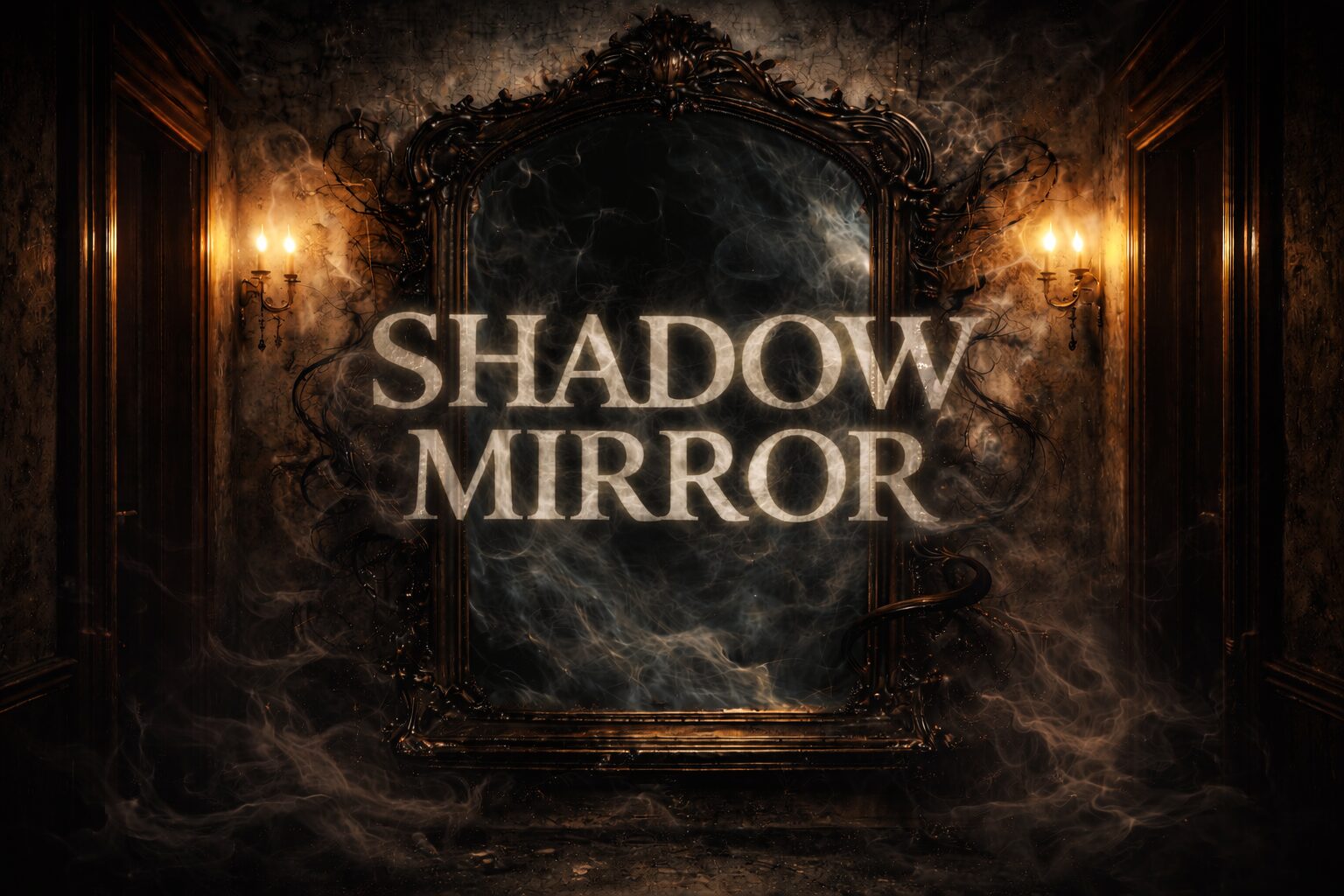
“It’s just a mirror”, that phrase echoed in Elisa Smith’s mind every time her gaze fell on the blackened glass hanging in the long hallway of her grandparents’ house. The mirror was nearly her height, its opaque surface barely reflecting the outlines of the room, while the carved wooden frame, with its twisted, knotted Gothic motifs, bore the marks of time and the dust accumulated over the years. No one, it seemed, had ever bothered to clean it.
Her grandmother, shortly before passing away, had left her only one enigmatic instruction, “Do not remove it. Ever. For no reason, and above all, do not look at it after sunset.” Elisa had never dared to ask why, and perhaps she would never have the courage to find out.
Now, with her grandparents gone and the decaying house inherited, Elisa was forced to live alongside that silent, unsettling presence. She spent her days between the desk and dusty shelves, restoring old books with the patience of someone who knows that every gesture matters, while the sun barely filtered through the darkened windows. The idea of staying there for a few months, just long enough to get everything in order and prepare the house for sale, didn’t disturb her, at least not yet.
The first week passed in an almost unreal silence, broken only by the creaks of the old wooden floors and the distant moans of rusty pipes. Tiny, almost imperceptible sounds, yet enough to fill the empty rooms with a constant echo. Elisa soon learned to ignore them, convinced they were merely the product of the house’s advanced age.
Yet, every night, when she had to pass the mirror in the hallway to reach the bathroom, something made her hesitate.
The reflection in the mirror moved with a slight delay, half a second perhaps, an imperceptible interval, yet enough to make her skin crawl. And in that suspended moment, her reflected face seemed to watch her, as if it were no longer a simple image, but a living presence trying to imitate her, or perhaps figure out how to do it.
Night after night, that feeling grew, creeping into Elisa’s thoughts and leaving a trail of unease that followed her until dawn.
One evening, driven by a sudden impulse, Elisa stopped in front of the mirror. She studied it carefully, trying to determine whether fatigue or her imagination was playing tricks on her.
Behind her, in the hallway, there was only the slightly open living room door, the small table with its chipped vase, and dust gathering in the corners, nothing unusual, at least in the real world.
But in the mirror, everything appeared different. The vase was intact, gleaming as if time had never touched it, and the flower she had thrown away two days earlier, wilted and lifeless, now bloomed colorful, its petals glossy and colors so vivid they seemed to radiate their own light. A shiver ran down her spine.
“It’s just your imagination”, she murmured aloud, trying to convince herself. Then she turned, walked slowly back to the bedroom, and closed the door behind her, trying to leave that vision behind. But that night, sleep betrayed her.
She dreamt of the hallway, the long hallway illuminated by the flickering lights of the dusty chandelier. The mirror stood before her, imposing and silent. But something had changed: her reflection was smiling, and she was not.
Her reflection’s mouth curved into a disturbing smile that did not belong to her. Elisa awoke with a start, her heart pounding, her skin covered in cold sweat, aware that something in the mirror was waiting, studying her.
Every night, the mirror changed, imperceptibly at first. Small details: the reflection seemed darker, the contours blurred as if a thin veil filtered the light, her face appeared slightly tilted, with features that did not fully belong to her.
Elisa tried to convince herself it was just fatigue, confused dreams, her mind playing tricks. But as the days passed, the alterations became more evident. Objects that did not exist in reality materialized in the mirror: an antique candelabrum with untouched candles, a carved piece of furniture in baroque lines that no one had ever owned in the house.
Every time she tried to touch them or check, the glass returned only the emptiness of the real hallway, leaving her with the sensation of being observed by something that did not belong to the normal world.
And then came the voices. Not understandable words, barely whispered, a melodic and disturbing flow, yet calling her, insinuating themselves into her thoughts and vibrating her nerves to the bone.
That night, exhausted from insomnia and with her nerves frayed, she could no longer hold back. Her hands trembling and voice broken with anguish, she shouted into the darkness of the hallway,
“What do you want from me?!”
The sound echoed off the peeling walls, and the mirror, motionless and impenetrable, did not answer. Yet she felt, more than ever, the weight of its gaze, a silent and insidious observation that seemed to dig into her mind.
For a moment, everything seemed to freeze. The very air seemed to hold its breath, and the hallway, shrouded in half-light, became strangely unreal. Then the glass of the mirror began to change: a thin, almost liquid mist slowly spread. The surface before her remained clear, cold, almost alive, as if breathing of its own accord.
With her hand trembling uncontrollably, Elisa approached and, almost instinctively, traced a word on the condensation: “Why?” Her breath condensed into tiny rivulets beneath her fingertips, and each letter seemed to dissolve as soon as it was formed.
On the other side of the glass, as if an invisible entity wanted to answer her, a word slowly appeared, clear and scratched into the mist: “MEMORIES.”
Elisa jumped, her heart hammering in her chest. She spun around, searching the room for any sign of presence, but everything was still.
From that moment, Elisa’s dreams became disturbingly vivid. They were no longer mere fragments of nocturnal thoughts, but parallel worlds seemingly built to confuse her. Rooms of the house that did not exist, endless corridors that led nowhere, doors sealed yet filtering a reddish light, warm and sinister at the same time.
And always, at the center of it all, the mirror. Motionless, dominant, as if observing her every move even in sleep.
One evening, returning from the bathroom, the flickering light of the hallway revealed something strangely familiar, yet deeply unsettling. The living room door, in the reflection of the mirror, was ajar.
She turned slowly, cautiously, her eyes scrutinizing every detail. In reality, the door was perfectly closed.
She stepped forward carefully, holding her breath, each step a precarious balance between courage and fear, as if the slightest mistake could bring everything crashing down. Her hand reached toward the glass, hesitant, trembling. As soon as her fingers brushed the surface, the mirror quivered under her touch, like water stirred by invisible hands.
And then, the impossible: her hand sank in. There was no solid wood behind the glass, no barrier. Only a liquid, cold, and unsettling resistance, pulling her inward, as if the mirror itself wanted to engulf her into a world beyond reality.
Elisa screamed, the sound choked by the fear tightening her throat, and withdrew her hand with desperate force. Her skin was icy, damp, and a sharp smell of sulfur clung to her nose and mouth, making her cough. She looked at her palm and arm: the skin was stained, covered in a black, viscous substance, as if something monstrous had spilled from a nightmare and left its mark on the real world.
The portal was open, and the mirror was no longer a mere object: it was a window into another dimension, alive and hostile, ready to invade her reality.
In the following days, Elisa tried in every way to ignore it. She barricaded the mirror with furniture, blankets, and tape, hoping to seal its power. She slept upstairs, surrounded by sheets and cushions, but the relief was short-lived. In her dreams, the mirror appeared again, more alive and menacing than ever. And then, on the seventh day… it happened.
A red light filtered through the glass of the mirror, pulsating and alive. It was not a reflection, not a trick of lamps or flickering lights: it was fire, primordial and untamable, illuminating the hallway with unsettling flashes and sudden heat.
The floor beneath Elisa’s feet began to vibrate, rippling slightly, as if the house itself were breathing heavily, an ancient organism awakening after centuries of silence.
The walls, once cold and stale, oozed moisture, black drops dripping slowly like diluted blood, leaving dark streaks on the cracked old plaster. The air was thick, laden with acrid, metallic smells.
The mirror opened.
No distinct being appeared, no defined figure. Something indefinable emerged, tall and thin, made of smoke, shadow, and darkness, as if the very air had condensed into a living form. Its contours were uncertain, blurred, dissolving into the surrounding environment like pulsating, dirty mist. Where eyes should have been, there were two white sockets, empty, cold, and devoid of any pupil or iris. Yet… they saw.
Elisa felt a gaze that penetrated beyond flesh, into the bones, scrutinizing every thought. The figure advanced slowly, silently, each step seeming to make the world around her vibrate, as if reality itself bent under the weight of its presence. The hallway felt narrow, the air heavy, and the smell of sulfur and smoke saturated every pore of her skin.
It spoke not, nor made any gesture. It moved with an unnatural calm, each silent step leaving the floor uncreaking, as if the house itself recognized it as part of its shadow. It passed slowly by Elisa, completely ignoring her, as if she did not exist. It entered the kitchen, sat in the chair nearest the window, and remained there, motionless, waiting, like a patient predator.
Driven by terror, Elisa finally found the strength to flee. She ran into the woods, screaming with all the voice she had, but the world seemed deaf: no one heard her. The silence around her was absolute, and the nocturnal sounds of nature seemed too distant to reassure her. Trembling and filthy, she took refuge among the trees until dawn.
When she returned to the house, the rising sun filtered through the branches, bringing a cold, uncertain light. The creature was gone, but the marks of its passage were clear and disturbing. On the mirror, written in blood, appeared a terrible phrase: ‘ONE HAS ENTERED. ANOTHER MUST LEAVE.’
Elisa approached, her breath ragged, and realized with horror that the reflection in the mirror was no longer her own. The figure watching her from the other side had changed, deformed, alive with a will of its own.
That night, terror gave way to a desperate decision. She could no longer run. She had to know, to understand what lay beyond that glass, even at the cost of her life.
She took a torch, a backpack with the essentials, and stepped into the hallway. The portal stood there, motionless and silent, like an ancient guardian waiting for centuries. Elisa drew a deep breath, gripped the torch with trembling hands, and prepared to cross the threshold between the world she knew… and the unknown.
‘One has entered, one must leave.’
Those words echoed in Elisa’s mind, a relentless, obsessive echo. Who had entered? Who had already crossed the threshold of that portal? She inhaled deeply, trying to control the trembling of her hands, and stretched her arm towards the surface of the mirror.
The glass reacted immediately. It rippled under her touch, warm and viscous, as if it were a living substance ready to swallow her. A sickly, nauseating smell burned her nostrils, seeping down her throat and forcing her to cough. With a hesitant step, she entered the portal, then another. Her heart pounded, her knees shook, yet she did not stop until her entire body was beyond the glass, immersed in a world she could never have imagined.
The dimension was a parody of reality: the house seemed familiar, yet everything was corrupted and twisted. The rooms she knew were ruined by centuries of decay, shrouded in a darkness that seemed to have a life of its own. The walls wept congealed blood, dripping in dark, foul-smelling rivulets; the floor was a macabre mosaic of broken bones and long, wet hair, as if the history of countless tragedies were etched into every inch.
On the walls, paintings that once would have decorated the house now showed screaming, deformed faces, twisted into expressions of terror and pain. Yet, among those tormented faces, Elisa recognised one in particular. It was hers… or at least a version of herself, contorted and distorted, with eyes that stared at her from within the canvas, watching her with an unsettling awareness.
A shiver ran down her spine. There was no longer any distinction between her and her reflection, between reality and horror. And the silence, so dense and suffocating, made her perceive every drop of congealed blood and every breath of the corrupted house, as if it were the very heartbeat of the world beyond the mirror.
In the living room, the creature sat in an armchair made of intertwined bodies, a grotesque, shapeless mass that seemed to breathe. The white, empty eyes, yet deeply aware, fixed on Elisa, and for a moment, the sensation of being observed in every fiber of her body paralyzed her. Then, as if in a gesture of macabre courtesy, the shape turned to her and offered a smile.
‘Welcome home,’ it said, the voice resonating in Elisa’s mind without passing through the creature’s lips.
She trembled, trying to gather enough courage to speak. ‘Who… who are you?’ Her voice came out broken, almost a shattered whisper.
‘It is not important who I am,’ the shape replied, its presence filled with unnatural calm. ‘What matters is who you are.’
‘I…’ Elisa stammered, her heart hammering in her chest. ‘I just want to go back… to how it was before.’
The creature tilted its head slowly, as if peering into the depths of her soul, reading every fear and desire. ‘Then choose.’
With a smooth, calm gesture of its hand, it indicated the mirror in the center of the room. Elisa approached hesitantly, her breath shallow, and looked inside: the real house was reflected, orderly and familiar, yet something was not as she remembered.
The rooms were the same, but the furniture appeared slightly distorted, and fleeting shadows moved along the walls. On the sofa, a figure sat motionless. It was her. Or at least, it seemed so.
The eyes were completely black, bottomless pits that sucked in the light and every trace of familiarity. A cruel smile twisted its lips, and in its hands it clutched a photograph: Elisa and her parents, frozen in a happy moment, now trapped in the horror of this distorted copy of reality.
‘If you return,’ the creature said, its voice resonating in Elisa’s mind, sharp as a razor, ‘you will take its place. And it will take yours. But know this: whoever leaves… never comes back.’
The world beyond the mirror did not obey the rules of reality. Time flowed distortedly: hours stretched into days, minutes shattered into eternity. Voices repeated in loops, always the same, like a chorus of ghosts trapped in an endless symphony. Each room had its own rules: the floor could turn to liquid, the walls pulse like lungs, the lights change in intensity and color for no reason. There was no logic, only the harrowing awareness that every action she took would be observed, judged, and manipulated.
Desperately, Elisa sought an anchor to reality. With hands dirty from dust and plaster, she wrote words and phrases on the walls, trying to tether herself to the real world: ‘It’s not real. It’s not real.’
She repeated the obsessive mantra, like a fragile prayer against the chaos surrounding her. But each word, each phrase painstakingly traced, slowly vanished into the wall, dissolving like mist under the sun.
In their place appeared new writings. Unknown phrases, written in languages Elisa had never studied, symbols and letters that seemed to live on their own. And yet… she understood them. The words flowed through her mind as if they were part of an ancestral knowledge, teaching her secrets she never wanted to know. Each sentence etched into her soul, making the thin barrier between reason and madness waver.
Then, one day, she saw it. In the corner of the dark hallway, curled up like a frightened child, there was… something. It was not human, yet not entirely alien either. Every time Elisa looked at it, the line between what was real and what belonged to the nightmare grew thinner, and her heart hammered in her temples.
The creature was thin and fragile, almost ethereal, with translucent skin that looked like melted wax left to cool in the sun. Through the pale surface, trembling veins and muscles were visible, an unsettling geography that spoke of suffering.
The face, vaguely human, was distorted by a horrific detail: its mouth was sewn shut with dark threads, pulled so deep into the cheeks that speech was impossible. Its breathing was uneven, labored, each inhalation an act of pain that made the air around it vibrate.
It made no sound, spoke no words. It merely raised a thin, cold hand toward her. In its palm lay a rusted, twisted key, encrusted and marked by years of neglect.
Elisa hesitated, her heart pounding so violently it felt as if it might burst. The key radiated a strange energy, a silent call that made her feel both terror and irresistible curiosity at once. Trembling, she reached out and took it.
The contact with the cold metal made her whole body shiver: the world around her seemed to pause, as if the hallway and the house itself were holding their breath, waiting for what was to come.
‘What… is this?’ Elisa asked, her voice broken by anxiety and fear.
The creature tilted its head and, with a slow, measured gesture, indicated the mirror she had seen on the first night, set in a frame that seemed alive, made of pulsating flesh and intertwined muscles.
Elisa immediately understood that she had a choice: she could cross it, perhaps find answers, perhaps save herself, yet the price was clear. If she returned, someone, someone else, would take her place. And perhaps it was not the first time this had happened.
The creature said nothing, but its empty, penetrating gaze was enough to plant doubts that chilled her: how many had been trapped? How many had seen their own reflection come to life and replace them, step by step, with no hope of escape?
She mustered her courage, inserted the key into the mirror, and stepped across the threshold. When she returned to the real world, everything seemed normal.
Yet something was off; the house was too clean. Every piece of furniture gleamed as if freshly polished, objects were out of place, and the photographs on the walls showed her alongside people she had never seen: a husband with familiar yet unknown features, two children smiling innocently, as if they had always been part of her life. A family that had never existed.
She went outside, trying to understand what was happening. Everything looked the same, yet different. People greeted her, but with names that were not hers: ‘Good morning, Mrs Calderon! How are the twins?’
Terror gripped her stomach. She ran back home and looked at the hallway mirror. And there she saw it. Herself, the real Elisa, on the other side of the glass. Trapped, screaming, clawing at the surface with desperate hands, but her voice could not pass through. She was sealed, imprisoned in that reflected reality, powerless.
And in front of her, the creature, now bearing her face, smiled. ‘One has left. Another has stayed.’
It reached a hand into the hallway, and with a silent gesture, it extinguished the light. In the darkness, the house seemed to hold its breath, as if the entire building were alive and aware. Then, slowly, the doors closed, the windows darkened, and everything drew in on itself.
The silence became absolute and oppressive. Reality and its reflection, once separate, were now two mirrored worlds, eternally bound, with one certainty: whoever enters the mirror never returns, and whoever leaves carries a secret they can never forget.
The following nights were an endless torment. Elisa, or rather, the creature that resembled her, began to speak to itself, but not with the voice of a living person. From its mouth came broken words, overlapping voices, sometimes in lost and forgotten languages, other times in distorted echoes from the world beyond the mirror. Sounds that seemed to vibrate in the skin and bones of anyone who listened, yet no one among the figures of her new life seemed to notice.
Her false children hugged her tenderly, unaware. Her husband kissed her, kind and affectionate, as if nothing had changed. Everything was immersed in a perfect, orderly performance, yet profoundly unsettling. But in the absolute silence, when the flickering light of the lamps went out and the noises ceased, someone, or something, wept behind the walls, a faint, desperate lament that seemed to come from the very soul of the house.
One night, driven by an inexplicable impulse, the false Elisa went down to the cellar. There, hidden in a corner, was a door she had never noticed, as if the house wanted to reveal a secret to her.
Behind it opened a small, ancient study, steeped in dust and the silence of centuries. The furniture was covered with yellowed sheets, shelves lined with dusty tomes, and in the center, atop a dark wooden desk, lay a leather-bound diary. The name engraved on it was clear: F. Calderon.
The diary gave off a sharp smell of leather and mold, as if it contained not only words, but trapped memories and forgotten lives.
Inside were dense notes, intricate drawings, and enigmatic formulas, scribbles that seemed to oscillate between science and magic. On every page, a recurring phrase: ‘Mirrors do not reflect. They wait.’
As the creature now inhabiting Elisa’s body leafed through it, it finally understood the truth: the mirror was not a simple portal. It was a sentinel. A gateway that opened cyclically, every twenty-five years, allowing one consciousness to replace another. But there was a dreadful condition: the original consciousness had to remain alive, trapped, condemned to watch its own life being supplanted by the shadow of another.
The story unfolded in terrible cycles: it had happened in 1897, in 1922, and again in 1947. Every twenty-five years the portal opened, but something was always out of place. Houses shifted by a few meters; names on gravestones changed, and some children were born with severe malformations.
The false Elisa snapped the diary shut. Her hands shook, but she was not alone. An invisible presence seemed to watch her, flipping through the pages with her. The sensation was palpable, a shiver running down her spine, making her perceive with horror that anyone who had crossed that portal was never truly alone.
And as the silence of the room grew dense, the creature realized that the cycle was far from over. Something was waiting for her, and she herself had now become part of that ancient, cruel game, between reality and reflection, between who she was and who she was meant to be.
A mirror on the wall began to tremble, its surface rippling like water stirred by invisible hands. The flickering light of the lamps reflected on the distorted reflections, and from the glass emerged a scream. The real Elisa shouted, and for the first time her voice was heard clearly, powerful like thunder tearing through the night: ‘IT IS NOT OVER!’
The following night, the sky turned red. It was not a sunset, but a warning. A blood-red hue spread across the clouds like a menacing veil, filling the air with an electric, palpable tension.
All the mirrors in the house began to bleed. The reflective surfaces, once still and silent, now oozed dark liquid, leaving trails on the floors and seeming to breathe as if alive. The children no longer slept. They remained motionless, eyes wide in the dark, staring into the void with unnatural awareness, as if they were seeing beyond reality, trapped between two worlds.
The creature’s husband began to lose pieces of skin, small strips falling like dust in the silence. Reality itself seemed to unravel around them, bending and corrupting under the weight of a cycle that had never truly stopped. And this time, it seemed to want more.
The real Elisa, trapped behind the glass, was growing. Every day her consciousness strengthened, adapting to that forced existence, until frustration and pain transformed into pure power. And now she was the one claiming what had been taken from her.
The false Elisa began to decay. First her hair fell in brittle black clumps, then her nails crumbled, cracked like dry bones, and finally her smile itself dissolved, leaving her face expressionless and gaunt. She tried to flee, but all the mirrors in the house had closed, sealed like prisons. There was no way back. One thing was certain: one had to leave, and one had to remain.
In the dead of night, a dense and oppressive silence enveloped the house. The real Elisa, with a strength no human body could hold, broke the glass from within. No hands or tools were needed: her will, fueled by pain and the injustice she had endured, was enough.
The false children, unchanged until that moment, screamed in a harrowing chorus and turned into statues of stone, motionless and silent. The creature’s husband exploded into a whirlwind of black butterflies that flew away like dark ash, leaving only emptiness. The walls tore open, revealing not brick or wood, but millions of wide-open eyes.
And then the silence, so deep it seemed to swallow every breath. The house, reality, the mirrors, all had stopped. Staying or leaving was no longer a choice: the cycle had ended.
By morning, the house was empty. No trace of the Calderon family remained, as if they had dissolved into nothingness. The only sign of their presence were the mirrors. Everywhere. In every room. Covered with black sheets, sealed with wax and blood, like cursed relics. All except one.
In the hallway, by the entrance, one mirror remained uncovered. The reflective surface gleamed in the morning light, still and silent. But inside, something moved. A figure. The real Elisa.
Years later, the house changed owners. No one ever learned anything about the Calderon family. Documents were confused, signatures erased by time. The new tenant was a young woman, passionate about antiques and full of naïve enthusiasm. She renovated every room: painted the walls, polished the floors, arranged the furniture. Everything. Except the mirror, which remained still, covered in dust, yet intact. And although the girl knew nothing, something in the glass was watching her. A faint smile, cold and knowing, waiting. Always.
Every time she passed the mirror, Marta felt uneasy. It was not just her reflection observing her: there was an echo, an imperceptible whisper, as if the sheet of glass breathed with her.
One evening, for fun, or perhaps driven by a curiosity that had begun to bother her, she traced a message with her finger on the dusty surface: ‘Who are you?’
The glass answered. Not with written letters, but with a sound that pierced Marta’s mind: ‘Once, I asked the same thing.’
From the depths of the mirror, a whisper turned into a laugh: soft, thin, and disturbing.
Months passed, and the girl began to notice small details. Subtleties she had previously ignored. Every now and then, her reflection in the hallway mirror seemed… wrong. A delayed movement, a blink that didn’t match hers, a gaze that lingered too long, as if the other presence were studying every gesture. And then that smile: almost identical to hers, yet slightly different.
One night she awoke in a cold sweat, her heart hammering in her chest. She was convinced she had heard a laugh coming from the corridor. Trembling, she got out of bed and went downstairs, trying to convince herself it was only her imagination.
But the reflection in the mirror was not alone. Behind her, trapped in the glossy pane, a faceless figure watched. Immobile, enormous, its contours blurred like dense smoke, yet terrifyingly real.
Marta held her breath. When she turned, the room was empty. No presence. Just cold air and suspended dust.
Yet, in the mirror, the figure raised a finger and pointed at her. A simple gesture, yet heavy with menace.
The next day, Marta decided the mirror had to disappear. She ordered its immediate removal. The workers arrived with chisels, hammers, diamond saws: nothing could scratch the surface of the glass. Every strike echoed through the room, yet the glass remained intact, as if made of living flesh and molten stone together.
That evening, one of the workers disappeared. The security footage clearly showed the man entering the room. He advanced hesitantly, as if sensing the presence of the glass before even seeing it.
He reached out his hand to the reflection, barely brushing it… and then vanished. No scream, no sign of struggle. Only a faint tremor in the glass, an echo of what had been: his face imprisoned, distorted by terror, pounding from the other side as if asking for help from a world he could not reach.
Now Marta no longer saw herself in any mirror. She walked through the house with every surface covered in dark sheets, windows blacked out, every reflection hidden or sealed. Each room was silent, yet the air was thick, charged with anticipation, and she knew it was only a matter of time.
Every night, punctually, she heard three sharp knocks: tap. tap. tap. Metallic beats that echoed through the corridor, through the heart of the house, like a drum marking the moment when the cycle would reopen. And, among the whispers of the shadow, a thin, icy voice from behind the glass spoke directly into her mind: ‘It’s your turn.’
🎧 Available Audio Adaptations: None Available
Written by Jonathan Ferro Edited by Craig Groshek Thumbnail Art by Craig Groshek Narrated by N/A🔔 More stories from author: Jonathan Ferro
Publisher's Notes: N/A Author's Notes: N/AMore Stories from Author Jonathan Ferro:

Related Stories:
You Might Also Enjoy:



Recommended Reading:

Copyright Statement: Unless explicitly stated, all stories published on CreepypastaStories.com are the property of (and under copyright to) their respective authors, and may not be narrated or performed, adapted to film, television or audio mediums, republished in a print or electronic book, reposted on any other website, blog, or online platform, or otherwise monetized without the express written consent of its author(s).