

29 Jan Undo
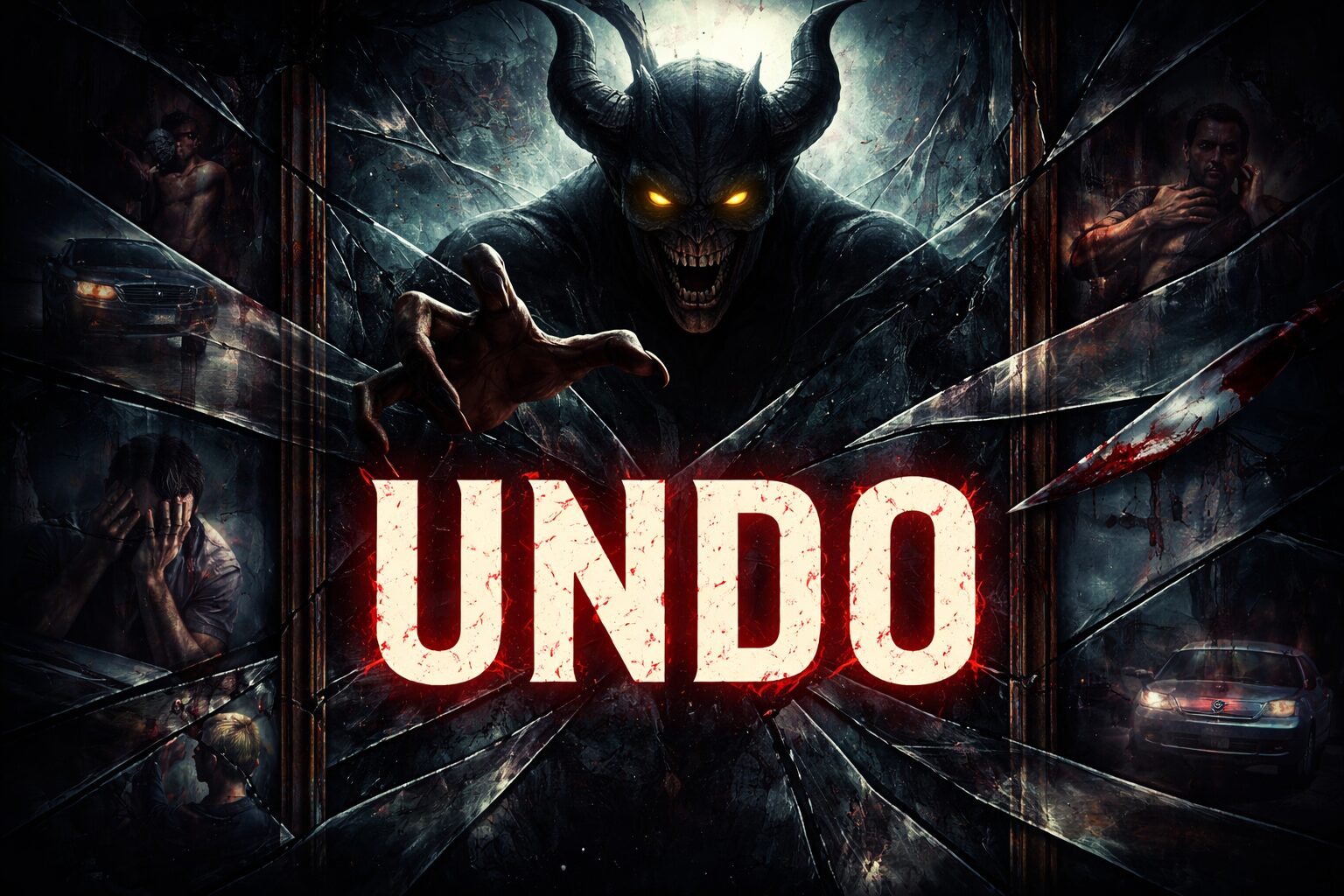
“Undo”
Written by Ian Dean Edited by Craig Groshek Thumbnail Art by Craig Groshek Narrated by N/ACopyright Statement: Unless explicitly stated, all stories published on CreepypastaStories.com are the property of (and under copyright to) their respective authors, and may not be narrated or performed, adapted to film, television or audio mediums, republished in a print or electronic book, reposted on any other website, blog, or online platform, or otherwise monetized without the express written consent of its author(s).
🎧 Available Audio Adaptations: None Available
⏰ ESTIMATED READING TIME — 38 minutes
When Irving Gibson first met me, he was on top of the world. His story was an interesting one, too. One of many I’ve found memorable, sure, but everyone is unique. Backgrounds, behaviors, choices and excuses—maybe I get overly invested in people, but I can’t help it. I shamelessly enjoy the drama, and seeing how one decision leads to the next.
Irving was born with the ability to rewind time by exactly one minute and forty-three seconds. No more, no less. He didn’t realize he had such a powerful gift at first, and was well into adulthood by the time he finally discovered he could send his mind far enough into the past to correct recent mistakes, or even the odds against cosmic misfortune for himself or others. Some blame God or some grand universal plan for the bad things that happen to them. Others see random chaos as the only thing that dictates where and how a place and time become “wrong.” A few accept everything that comes their way and subscribe to the belief that each failure or accident is a growth moment.
My friend Irving was… harder to define. He had only rage for the “bad” occurrences that stumbled into his existence. He’d never call himself entitled, since he didn’t ask for or expect much from life, and yet that’s all it ever really was, regardless of how he looked at it. He saw himself as a joke before his gift awakened, the dirt on the sole of a shoe, always being stepped on. Put in the world to be laughed at by forces he didn’t even truly believe in. Some occasional self-pity can be healthy as people grow, if it leads to self-improvement or a measured effort to respond or feel better. What’s always sad to see is a soul giving into jaded, cold cynicism, and the belief that nothing will ever change.
Irving was born in 1988, in Las Vegas, Nevada. He had seen some of the world, but had never moved from home, unlike the rest of his family. Being right in the middle of five children, he felt deprived of attention, praise, and love, despite receiving plenty of it considering the circumstances of growing up in a large household. For him, every slight was seen as an insult. Every inconvenience a blemish on his life’s story. Almost paradoxically, he also rarely complained, or called others out when they did genuinely do wrong by him. Being bumped into in the school hallway, having his grocery cart taken at the store by another customer, getting passed up on for a promotion at work—it just wasn’t in him to complain, or ask for better treatment. He took everything personally, and on the chin, adding it all to some hidden lifetime tally that only ever further validated his perceived place in the world. At some point, a part of his subconscious must have begun to enjoy every new excuse to feel worse about himself. And, over time, he got angrier, his soul grew blacker, and he no longer cared about anyone.
Shortly after he turned thirty-two, after a particularly bad day at his menial office job that he made no effort to leave or excel in, he got into a fender bender at an intersection, a few blocks from the main strip of the city where all the tourists and gamblers enjoyed themselves in their little bubbles.
If the accident hadn’t been his fault, he would’ve taken the insurance information, avoided calling the police, and felt like garbage back in his small apartment as he called up a company to begin the process. He wouldn’t have been too angry at the other driver; in fact, he’d find a way to blame himself.
But this is not how it goes. He had made a mistake while waiting in traffic, zoning out and not seeing when exactly the light had turned green. What transpires next is just something that happens, and is forgivable. But not to Irving, who does not possess the ability to forgive himself. Thinking he is about to get honked at, he hits the accelerator without realizing that the light has been green for only a second, and the person in front of him has not yet moved.
By the time he realizes his error, it’s too late to correct. He slams into the back of the next car, just hard enough to negate any protection the bumpers provide, and dents the victim’s trunk enough to pop it open.
“No!” he screams and pounds his steering wheel. “No, no!” he cries out, as if doing so can erase what has occurred and give him a second chance.
The man in the car gets out and approaches Irving non-aggressively. Some people are understandably more focused on their own anger after such an accident. Others’ first reaction is to show concern for the other driver, and will want to make sure they’re okay before any blame is doled out. Despite what you see in the media, very few try to escalate these matters or resort to a violent reaction. Not that there’s any harm in being considerate and careful, as to not provoke a stranger who might respond in such a way.
For non-confrontational and self-loathing Irving, however, this is already the new worst day in his long, painful life. He’d rather be dead as he sees the older man walking towards him. He’ll never live down this shame, and surely he’s about to lose his license and need to pay fines costing thousands of dollars. It’s always the worst-case scenario with him, and his fight or flight responses are triggering fiercely.
“Why?!” he shouts and slams his steering wheel some more—and this time the old man sees his panicked reaction and is himself the one to hesitate, and consider taking precautions before getting closer. “Why’s it always me? Why do I always have to be the piece of shit?”
Call it a psychotic break that has been in the works for thirty years, a desperate reach into something supernatural, or a need to escape to a world of fairy tales and magical thinking for just a moment, but he tries something new.
He thinks of the computer he toils away on from nine to five. It’s a joyless position, but one of the modern conveniences it has embedded into his psyche is the undo button. Or, to be more precise, the keyboard shortcut. Pity all those poor primitives who had to use typewriters, and the scribes before them. Their documents would have to be corrected and left forever imperfect, or scrapped and replaced entirely. But these days, any error can be eradicated like it never existed. A quick jump, or multiple jumps backward, can fix a poorly-worded sentence or a bad keystroke. It’s almost like a miniature form of time travel.
Why can’t real life have an undo button?
Look, he might reason, something bad happened. If I keep the memory, if I learned my lesson, why do I also need to be punished? If one of my younger siblings had ever been hit by a car as I walked them to school, why couldn’t the universe let me go back and save our family from the resulting life of pain? All I’d ask is a few seconds. Just let me go back. The hurt doesn’t need to happen. It serves no purpose. It’s meaningless agony that never should’ve been inflicted.
And so, in what one might call a “Hail Mary” move, Irving squeezes his eyes shut and tries to deny or reverse reality. “Undo,” he pleads. “Undo, undo, undo…” he continues, thinking about how many times the elegant little option has helped him before, at least while his toes were dipped in the digital realm.
Then, he is startled by a car honking.
“I know!” he snaps. “I know, God damn it! I just had an—”
He looks up from his steering wheel. There is no man about to knock at his window. There is no damaged car ahead of him, and in fact, the one he just rammed into is now a dozen meters away and in motion.
His immediate thought is that he’d just experienced some kind of reverse hit and run, and he tentatively, nervously taps on his accelerator before the vehicle behind him honks a second time. As he traverses the next block, he realizes something else. It hits him like déjà vu for a moment, as it would anyone who had just used such a power for the first time.
But after some blinks and a few seconds of looking around while he stays well under the speed limit, he is startled to realize that he really had just driven down this section of East Charleston Boulevard. And, like the prior time he had done so, the next light changes to red just before the car in front of him might’ve proceeded across the next intersection.
Now extra attentive to lights on his journey home, he keeps his eyes on the road at all times and drives carefully. He can perceive that he’s been given some kind of extra chance, but isn’t sure how, or what just happened. Some manner of foresight is what he settles on for now. A likely once-per-lifetime mulligan that prevented a single misfortune. He can’t explain it, but perhaps he’s earned it after all these years of suffering as a “cosmic joke.”
I find it a little funny, how he brushes off the possibility of one miracle by conjuring up another. Some people will come up with any excuse to deny the validity of wild new events in their life, whether they be good or bad.
But Irving can’t stop thinking about it on the rest of his way home, and he tries to use logic to convince himself that what just happened, did not.
When he gets into his apartment, he turns on his TV and has the local news play while he prepares a lonely man’s microwave dinner in the kitchen. As the anchors go on about all of the bad things happening in the world, he takes out a butter knife to jab holes into his meal’s plastic cover—and ends up dropping the piece of metal with his clumsy hands. It falls onto his bare foot and hurts enough to warrant a strong, reactive “God damn it!” from his mouth.
Instead of jumping right into another round of cursing his existence, he stares down at his foot and the knife lying on the kitchen tile. And he ponders.
There’s no way it will work twice, he thinks. Hell, it probably wasn’t even real the first time. But he chooses to try anyway, seeing as how the only person he can embarrass is himself, and he’s become quite used to that.
So, without placing any belief in his power, he whispers “undo.” Nothing happens. Why would it? People don’t get extraordinary gifts. If they did, there would be television interviews, and books and movies made about them. They wouldn’t just keep it to themselves and tell no one, he believes.
Despite these thoughts… He tries just once more. This time, he closes his eyes, concentrates on his desire to erase his pain and reverse his latest stupid mistake, and makes a wish like a kid blowing out the candles on a birthday cake. None of those ever came true for Irving, though, so why would this?
He opens his eyes, and he’s suddenly standing at his apartment door, which he’d just opened—so recently that it is still moving backward to the doorstop. He is shocked. His fingers open up and his keys drop to the floor. No way, he tells himself, reacting like most anyone would. This can’t be real.
To test the limits of his ability—and to see if it can be used three times in one day, at the risk of exhausting it—he performs a third “undo.”
He’s still standing in the doorway, but his keys are back in his hand. He’s beginning to understand. He can’t roll back past the first reversal of time. If he could, then what would stop him from seeing the beginning of the universe, via countless jumps that go backwards a couple of minutes at a time?
So, he’s not quite a god. He doesn’t have a count of seconds yet, but whatever it is, it’s certainly good enough to remove most mistakes he makes from that moment onward. His only immediate regret is that he hadn’t been awakened to this gift until now. He imagines using it in high school or college, and how many problems it could have solved. If he had undone any little thing at all that made him feel embarrassed or awkward, perhaps he would’ve found the confidence to make and keep friends. But, he had enough regrets in life.
Now, he believes, he’ll never have to experience them ever again.
He sits on his couch and watches the news while shoveling microwaved slop into his mouth that he barely tastes. His mind is active, and some dusty old corners of it wake up for the first time in years. He’s never thought so hard or in such creative ways for a long while; at his job, he’s seldom needed to. He had resigned himself to a life of going through the motions like a corporate zombie.
But now… the possibilities. So, so many possibilities.
He stares at the anchors behind the desk as they talk about the obesity epidemic in young children. He realizes how he’s never really liked them. They’re both so smarmy, their smiles bright and full of perfect teeth. The woman’s voice is grating, and the man’s grin seems unnatural. They always try to share a little anecdote or crack an easy joke to make themselves seem relatable to viewers, between their stories that focus on what is wrong in the world.
Irving eyes his phone on the cushion beside him. He finishes his food, tosses the tray onto the coffee table, and searches for information about the studio. He finds one of the building’s numbers, clears his throat, and dials.
Normally reluctant to talk to anyone, Irving says with a self-assurance he hasn’t felt in years, “Yeah, hi. I’ve been watching the six o’clock news forever, and I don’t really like how you do things. Uh-huh. Well, it’s all really depressing. I get that scaring people is what keeps your corporate sponsors happy, and you try to balance things out with a happy fluff piece at the end of the broadcast, but that doesn’t make up for the rest of it… Sure, but I’m not sorry I feel that way. Anyway, I broke into the studio last night and put a bomb under the desk. I’m surprised you guys haven’t found it yet. Oh, yeah—I’m dead serious. If you hurry, maybe you can get those two away from it before it goes off in about… thirty seconds. Good luck. I can’t wait to see the fireworks.”
His whole body trembling, he hangs up, chucks the phone back onto his couch, lets out a nervous laugh, and tries to settle in as he waits to see what happens. They won’t buy it, he tells himself. I didn’t even try to be convincing.
Around twenty seconds pass of the news continuing like normal. And then Irving perks up and leans forward when the anchors turn their gaze to people off screen, their smiles vanishing. They go from looking confused to worried within moments. Someone appears on the edge of the frame, gesturing to them frantically as he tries to convey urgency.
Irving lets out another anxious, disbelieving chuckle as the pair run off without having the time to address the audience, and nothing but an empty desk is shown to thousands of viewers.
Not yet knowing exactly how far he can go back, Irving cuts his amused reveling short, says the magic word more forcefully than before since he really doesn’t want to go to jail for making a bomb threat, and in an instant, finds that his phone is up to his ear again.
The woman on the other end asks, “Hello, sir? You were saying something about our corporate sponsors? Are you there?”
Realizing that he cut it way too close, Irving murmurs out, “Uh, nothing. Never mind.” Then adds, “Keep up the good work,” which makes him feel stupid.
This had all been some good fun, but he knows he needs to better comprehend his power before he does anything like it again.
He spends the rest of the evening learning and testing. Using his phone’s stopwatch, he narrows down the range of his “undo” after several experiments. One minute and forty-three seconds. No more, no less. He cannot go further back, no matter what he tries. At the risk of losing the gift through overuse, he checks if there is a limit to how many times he can do it in a row, and finds that there isn’t one.
Once he has a better grasp on things, he spends the rest of the night coming up with ideas. He first wants to take some time for his mind and thought processes to adapt to his new reality; one that feels filled with infinite potential.
Tomorrow is Friday, another day of work that already feels like a pointless endeavor with what he can do. Even so, he doesn’t want to rock the boat too much just yet. But the weekend is coming up, and it will offer him plenty of chances to change his life. He feels like a boy on Christmas Eve again, and sleep doesn’t come easily. Giving up on it by midnight, he leaves his apartment.
He walks over to the nearby 7-Eleven convenience store, where he is a frequent customer. At this hour, it’s manned by a single bored college-aged guy, more interested in social media on his phone than paying attention to any visitors. Irving wanders around listlessly at first, still thinking about what he wants to do, and grander ideas like anomalies and the nature of the universe.
He stops at the plastic box that holds the donuts. There aren’t many left at this time of day and they’re no longer very fresh, but he realizes how he can eat or taste-test anything he wants without getting full, or taking in the calories.
Without much hesitation, he reaches into the cabinet, removes one of the chocolate donuts, and takes a big bite. It’s so-so; he’s had better. He tosses it over his shoulder and onto the floor before trying a glazed one. After chucking it over the shelves, he bites into a cruller, and now feeling more playful, hurls it like a fastball into a rack of potato chips to see how many bags he can knock down. On impact, the pastry explodes into a satisfying little burst of fried dough, but fails to drop any chips to the floor.
“Dude, what the hell are you doing?” the employee snaps at him. “You have to pay for all those. And then you can get your drunk ass out of the store before I call the cops. I don’t care how much money you lost at a casino today.”
Irving looks at the young man, tries to come up with something witty to do or say as a follow-up, but all he can summon is an uncaring belch. The employee stares at him in disgust. Having amused himself, Irving jumps back to when he had just entered the store. For him, this is all harmless pranking so far; a way to blow off steam that has been building up in his gut for decades.
He ends up picking out some favorite junk food, and on his way over to pay for it, notices the scratch-off tickets. Even if Nevada did have a state-run lottery, it would be useless to him—but the instant winners had promise.
Then he thinks about the odds of actually winning anything worthwhile, and they aren’t good. Sure, he could keep buying different cards and scratching them as quickly as he could, but he knows he’d only get through maybe two at a time, three at most. So, he doesn’t bother.
After the employee rings up his meager total, Irving eyes the candy bars by the register. He impulsively grabs one, sticks it under his jacket during a brief moment where a pair of eyes isn’t on him, and pretending that it’s a gun, points it at the person who would never know he’d been toyed with tonight.
“Hey,” Irving says, “I’m taking these. Go ahead and empty the register, too.”
The guy behind the counter stares at him, barely giving his concealed candy bar weapon any consideration, and grumbles out, “Are you drunk, man? You can go to jail for doing shit like that, dumbass.” He adds in a low mutter, “I don’t get paid enough to deal with assholes like you.”
“You’re too young to be this cynical already,” Irving says from experience with a sigh and pulls out the candy bar. “Anyway. Guess what I can do.”
“What…?” the young man groans.
“I can rewind time and go back about a minute and a half. I’m serious.”
“I bet. Sure, you can.” And, likely assuming Irving is just another tourist, he adds, “You picked the right city to come to, then, didn’t you?”
Somehow, Irving hadn’t even considered this while making his plans. How did he miss something so obvious and right under his nose?
Remembering his time limit, he breaks out of his thoughts and goes back again. He pays for his empty calories, leaves the employee free from his abuse, and returns home, where he starts to envision an actual future for himself for the first time since he was young.
Work feels even more monotone and meaningless by the time lunch rolls around the next day. Irving barely does a thing at his desk. Why bother? What further use does slaving away in a cubicle serve for a person who can travel through time, if even just a little? The only thing he’s been looking forward to is his break, when he can “play” with his food a bit.
As he gets up to head to the elevator, he is stopped by his boss, right in the middle of the office. Tired, irritable, and with a rumbling stomach, Irving isn’t in the mood for any crap coming his way, and wonders what he did to deserve getting called out where half the company can see him.
“Mr. Gibson. We need to talk about your performance today,” the overpaid general manager tells him. “I’ve been waiting for some important expense reports, which I thought were going to be sent to me by ten at the latest. Now, I need you to return to your desk and delay your lunch until you get them to me, and at the end of the day, we’ll be having that talk.”
Irving stands there, listening to all of this but not taking in any of it, or caring. His boss in turn sees his disinterest, and his scowl deepens.
Every cell in Mr. Gibson’s body feels programed to not allow what happens next, and indeed, he hesitates for longer than he did before phoning in a bomb threat or tossing confections. But, remembering his time limit, he powers through the instinctive reluctance and does what was once unthinkable for poor, ignored, and unloved Irving Gibson. He makes a fist behind his back and, without any warning, launches a sucker punch that feels so very right and like a long-time coming the moment he makes contact with his boss’s jaw.
He hears a bone crack before the larger man hits the floor, but isn’t sure whose bone it is; there is noticeable pain in his knuckles, though the recipient has it much worse as he lies in a heap, disoriented and bleeding from his mouth. Irving stands over him, for once feeling triumphant over an obstacle. Some of his coworkers gasp. Most are staring at him like he’s lost his mind. A couple are already heading over to help their boss, giving Irving wary glances as they do so.
“What’d you just do?” the man chokes out, his mouth full of fluid. He spits out some blood—along with a tooth. “Are you crazy?!”
“What the hell, Irving?” the male coworker trying to assist the assault victim shouts from below. “Why would you screw up your life like that?”
Irving doesn’t gloat, or linger. This is brand new to him. He’s never been violent before, despite having harbored revenge fantasies over the years. Like any little fish in uncharted waters, he’s more scared than he expected to be. And it’s true; he is now living in a timeline where his life could be ruined. So, he runs away from it the moment he is clear-headed enough to say… ”Undo.”
He goes back to the point at which he just left his desk. Taking a moment to get his bearings, he spots his uninjured boss making the rounds, or on the hunt for him specifically. He takes a different route, and avoids his gaze. What he doesn’t know, as he gets into the hallway and heads towards the elevator, is that he’ll never return to his workplace. He hasn’t made the decision yet, though it was inevitable the moment he became aware of his ability. For now, as he presses the button to go down, he’s still trembling as a result of something he did in a reality that no longer exists.
It doesn’t matter that he believes he’s the only person in the universe to remember the attack. To him, it still happened, and is something he was capable of doing. He’d never felt such power before. It was like weakness had begun to leave his body, and he had the strength to break his way out of some ordained fate in which he remains a pathetic coward all of his life.
For lunch, he’s walked over to his favorite pizza place. It’s expensive, but he wants to treat himself. In the before times, he could only enjoy a slice once. In a much lighter display of his talents, he can savor a hundred bites of the high-quality tomato sauce and cheese. Or a thousand of them, if he wants. Punching out an annoying boss is a big win, but it’s good to enjoy the small things, too.
When he finally settles on the “perfect” version of consuming a piece of a pizza, Irving leaves the restaurant and has a decision to make. He could go left, and return to work. It’s a monotonous lot in life where he’s underappreciated, stepped on, and makes a pittance. Or, he can stop goofing around and start using his powers in a city where they’d make him a killing. Telling his boss how he really felt has boosted his confidence and made him a real go-getter, and the best part: no pesky punishment is in the way.
He walks a half-dozen blocks to reach the Strip—ignoring several calls from his employer on the trek—and goes into a random casino. Sad, he thinks to himself upon seeing the early-afternoon gamblers throwing their money away. But who am I to judge?
He ponders how best to handle a casino. Having grown up locally, he’s well-aware of how cheats tend to get treated, and if he gets unnaturally lucky at a long card game, he is liable to go beyond his time limit and get stopped no matter what upon leaving the table. On the other hand, sitting down for two or three rounds of blackjack and then leaving just as things started going his way, while seeming to be a sensible thing to do, could also be seen as suspicious and uncharacteristic. The house did always find a way to win, after all, and player streaks tended to be just brief illusions.
He has three options: high-stakes poker, putting everything on a single number in roulette, or the slots. Well, he was no good at poker or had the face for it, so even if he bumbled his way through a few bets before going big to add legitimacy to a game, it just wouldn’t look right on the security cameras. So, scratch that. Roulette, however, was not the kind of game that anyone could cheat at without somehow rigging the wheel. As long as he doesn’t get famous for walking up to a table, winning a single high payout, and then leaving, he should be able to get away with it, if it’s in moderation; he knows casinos are in contact with each other in order to weed out habitual drainers of their accounts.
But he’ll begin small. He goes up to the counter, requests a handful of tokens, walks over to the slot machines, and waits for a minute to pass as he pretends to study them like it’s some luck ritual. After a deep breath and some mental preparation for the road he’s about to go down, he proceeds to the first row of machines designed to look vintage, sticks in his tokens, and pulls the cranks one by one, not waiting for any to stop before trying the next. The two winners from the first batch provide meager rewards, not worth keeping.
He rewinds and tries another row. And then another. Few of the machines are occupied, and an older woman who must have spent much of her time at her “lucky” unit gives him a knowing grin as he tries out a whole row at once, as if he’s an admirable professional at something that requires no skill or talent.
Finally, in the last row of machines that he tries, he hits a jackpot. It’s exciting to win big for once in his life, but he only revels in it for a moment before going backwards. For this jump, he goes straight to that machine, pulls the crank, and scores the jackpot a second time. Done with this casino for the day, he untucks his shirt, turns it into a bucket, and scoops his winnings into it.
“Lucky day, sir?” the woman behind the counter says dryly as he puts his coins down one handful at a time. “Would you like these exchanged for chips? We’re famous for our blackjack. You could leave here feeling even better.”
“No,” Irving says clearly and sharply. “Just cash, please.”
With a subtle look of mild irritation, she opens her drawer of bills.
Irving leaves the casino with a nice little stack of cash, but what’s the harm in walking into the one next door? He could do “smash and grabs” at every establishment over the course of the day, rack up a tidy sum that would last him months, and the casinos would never know what hit them. It wasn’t like he’d ever gone into any, even after all these years. He wasn’t known, and there was no pattern for them to pick up on yet.
Just to be safe, though, he instead walks across the street. No sense in drawing even the slightest bit of attention to himself by going in a straight line down the Strip, hitting one venue after the next like he did the slot machines. He wants to make an effort to appear like he’s making random, unconnected stops.
As he waits at an intersection and then crosses with a group of noisy, obnoxious, and young tourists, he begins to consider shoving them into the oncoming traffic on their left. But, he decides not to. They’re happy, he’s happy, everyone’s having a good time.
Before he steps into another casino, he decides to take the latest call from his boss and get it over with, so that he can go about the rest of his day just focusing on making it big.
“Oh, hey, Mr. Coolidge. What’s up?” he asks casually, still wearing his work attire. “Where am I? Uh, well… Do you hear the traffic? I decided to come out to the Strip and do some gambling. You know, I’ve never really spent much time out here. Always felt too fake and gaudy, with intentions on full display. But I think it’s starting to grow on me. Hm, what’s that? Oh, ah, no, I don’t think I’ll be coming back in. Yeah, ever. Because it sucked, that’s why. No, Mr. Coolidge,” Irving laughs, “you can’t sue me for not giving two weeks’ notice. It just means I’m a jackass, that’s all. Well, same to you. Okay, then. Bye.”
Irving pockets his phone and exhales pleasantly, now really enjoying his day. Once he goes past his time limit and can no longer reverse the call, he feels even better… and like he’s now truly locked into his new life path.
He spends the day hitting every casino he can until exhaustion sets in, and then takes several thousand dollars home, where he plans his next moves. The slot machines and the excitement they’ve brought have already worn off. As he stares at his winnings spread across the coffee table, he knows that his reality has taken a turn and says a quiet farewell to everything he was before this moment. He won’t call old friends or family to tell them what he’s up to, or post anything on social media. He will keep his head down and avoid attracting attention—that aspect of his personality hasn’t changed.
The next morning, he steps into a more upscale casino he hadn’t hit the day prior, wearing a just-bought fancy suit to go along with his clean-shaven face, all to play the part of a legitimate high-roller with a mysterious background that blew into town. There are few people on the floor this early, which is just as well—though it does force him to wait at the roulette table until more players gather, as the croupier isn’t there to give Irving a private, one-man game.
Once three other tourists wake up and come down from the hotel above, the game begins, and our friend tries a few low-stakes random bets to make it look good, with no interest in what slot the ball lands in. He ignores the pointless banter from the other players, the congratulations and commiserations both. He just needs to play long enough to appear invested, and reach a certain length of time where one might naturally put it all on the table.
That moment arrives about ten minutes into the game. After he’s won and lost some pocket change, the ball lands on zero for the first time, and for Irving, used to feeling like one, the moment seems right. He goes back in time, ignores the next spin, and then drops every last one of his chips on the non-real-number portion of the table. The other players look at him like he’s nuts, or just a professional risk-taker.
“Looks like the quiet guy knows something,” one of the older gentlemen comments. “You got a good feeling on this one, son?”
Irving doesn’t dignify the remark with a response. He just keeps his eye on the ball and grips the wooden edge of the table tightly. He isn’t anxious about the result; he simply can’t believe how much money he’s about to make.
“And it’s zero,” the dealer announces, to a few gasps and some clapping from the players. “We got a big winner over here.”
Irving doesn’t push his non-existent luck, only following up by putting it all on black next. The winnings are more meager, but they still double what he has now, and he impresses the others even further.
“I’m good, thanks,” he says as he takes all his chips and steps away from the table, disappointing the others. “I know when to quit when I’m ahead.”
And, just like that, Irving leaves with a tidy sum after being in the casino for less than a half hour.
He does the same thing at two more, after which his nerves can’t take it any longer. Life feels like a dream, and he’s worried he’ll wake up or break a simulated universe if he goes any further so soon. He comes home, puts over a hundred grand on the table, stares at the bills until it finally feels real, and then at last, busts out a grin, laughter, and some slapping of his hands. He’d be set for at least a year if he stopped now.
The next day, he spends a chunk of his winnings on a luxury hotel room for some instant gratification, which beats the longer process of finding a better home. He then plays more roulette downstairs. And then at other casinos. He lasts into the evening this time, and begins to gather a flock of infuriating onlookers that cheer him on.
He takes his winnings to more casinos, and annoyingly, some of his fans follow. Drinks are ordered for him as if doing so will reward the buyers with a fragment of his “luck.” Beautiful women hit on him and make a guy who even now still has no self-confidence feel awkward. He drinks, and the dealers seem pleased, since alcohol consumption often leads to bad calls that return money to the house. Of course, that doesn’t happen, and Irving takes more of one casino’s money and runs off to another.
Sometimes, he’ll yell expletives at the people bugging him, or attack a few before rewinding. Doing so makes him feel better than winning big, which begins to lose its luster and becomes little more than a feeling of going through the motions. He loses track of how much he’s raking in.
At the end of the night, with his fancy clothes a mess, he returns to his hotel—playing one more round downstairs for the hell of it. Once back in the room, he tosses a stuffed briefcase onto his bed’s silk sheets. Before he has a chance to count it all, he runs into the bathroom and throws up, not from the booze but because his nerves are shot and adrenaline has been coursing through his veins the entire day.
Before he passes out on the bed, he finds that he now owns roughly three million dollars. In one day, he feels like he’s left a smoldering crater behind on the Las Vegas Strip. He’s become the casinos’ scourge, their worst nightmare. And now, he can afford to not enter one again for a long while.
As he tries to sleep, he imagines how far he could go, how much power he could wield if he chose to pursue it. He looks beyond just getting rich with his one minute and forty-three seconds. He could seek political aspirations. On that note, he thinks it’s a shame he couldn’t rewind much further, if only to check if his vote really does count in an election… or if the numbers were actually orchestrated by groups operating in the shadows.
But politicians are often hated by a sizable portion of the population, and what he really wants is to be is admired. So, why not become a famous creator of some kind instead? An actor, even. He does have infinite chances to get an audition just right, or later on, the perfect take on a film set.
Becoming a celebrity on the Vegas gambling circuit just doesn’t fit him. It’s given him some initial cash that’s opened up more possibilities, but he wants to go big in other ways that don’t feel quite so shallow.
It’s while he’s spending the next day in isolation and enjoying some room service that it comes to him, as he watches reruns of game shows on TV. Of course—how had the obvious eluded him again? Answering trivia questions, or flawlessly providing the questions in something more intelligent like Jeopardy! while appearing charming and knowledgeable would give him the chance to make a name for himself, and even leave an actual mark on history.
Over the next week, he gets a new car and picks out a more “modest” house that goes for a million dollars, since he doesn’t own enough to fill up a bigger place, nor does he want to pay for the maintenance or insurance on some small mansion. It will do, for now, and feels like a massive upgrade to his crappy apartment. He’s already decided to never go into a casino again unless absolutely necessary, if just to avoid the people they attract.
He schedules a tryout for a game show, passes the phone interview, and a month of taking it easy later, flies out to Los Angeles. He knows that if he can get a hot streak going, other productions might simultaneously be afraid of what he’s capable of, but also perhaps want to chase the viewership numbers he’d bring in for them. All he needs to do is get his foot in the door.
Unfortunately for Irving, he arrives at the studio without a clear understanding of what it takes to get past the next stage. He doesn’t know enough of the answers on the test to leave much of an impression, and it’s impossible to even cheat off of the other participants’ work in the closely-guarded room. His time-traveling can’t take him back far enough to make a difference, and his pleas of “I’ll do great on the show, you’ll see,” fall on deaf ears. He remains optimistic for a while and tries to get on other shows, easily imagining himself on set with a smile and nice clothing… but he just doesn’t have the talent they’re looking for.
After three months of trying, he returns to his lovely house feeling as bitter and resentful as he used to on a daily basis.
Now, you might be wondering by now when, exactly, I enter this story. I did tell you that Irving met me while he felt on top of the world, and if that point has yet to arrive, then when do we proverbially shake hands? It’s coming soon, I swear. Irving’s life is, after all, a series of highs and lows.
Resigned to the casino life, at least in the short-term, Irving makes his grand return to the Strip at about the same time they’ve all stopped keeping a watchful eye on him. He’ll study up during his free time and memorize pointless facts so that he can try the game shows again in a year, but until then, all he has to fill his resurgent emptiness is scoring big from gambling that is… no longer really gambling.
It doesn’t take him long until he stops reacting much at all to winning. He scoops up his chips, evoking little emotion to those cheering him on, and adds the cash to a safe at home that is quickly running out of space. He upgrades to an even better car, but it also brings little excitement past the first few times he takes it hot-rodding near Fremont Street.
One night, while researching if there are any secret methods to better one’s odds of getting on a game show, he comes across a discussion about many of them being reluctant to accept people who are already wealthy. The audiences tend to not like or root for them; they prefer rags to riches stories. Irving stares at his safe full of cash, realizing that, while not impossible to make his next dream come true, it’s certainly gotten harder. He angrily throws his laptop across the marble kitchen island, and doesn’t bother rewinding to fix its broken screen.
A few minutes later, he’s venting by tearing it up on the Strip in his Lamborghini. While it is tempting, he avoids running down pedestrians. When he pulls up alongside a cop car, however, he knows he can’t temper his behavior. He gives into the call of the void and answers those intrusive thoughts so many people have in passing on a daily basis… and rams the police cruiser.
It feels great, even though the violent impact causes his airbags to deploy. He laughs about it as the cop car skids along with its left side doors bent out of shape. The officer is so shocked at first that the flashing lights don’t come on until he’s made a complete stop. The rookie in blue manages to push open his door, and then yells at Irving upon seeing him giggling through a cracked windshield. All around them, tourists take pictures.
Irving goes back and does it again, this time performing his first-ever PIT maneuver, and surprisingly well for an amateur. The cop car swerves out of control into another vehicle, and then for good measure, our friend jumps the median and slams into an oncoming limousine on the other side of South Las Vegas Boulevard. The airbag smashes into his face, breaking his nose. He’s never felt more alive under the twinkling lights of the Strip.
He causes several more terrible accidents before he has his fill and goes home, still presumably punishment-free. He goes to bed feeling a little better about himself as some of his previous playful mojo returns.
The next morning, he takes a drive out to Hoover Dam. He thinks feeling weightless for a few seconds could be thrilling. As many attempts as he makes, though, he’s unable to pick up enough speed to break through the barriers on top of and around the tall hydroelectric dam. He only succeeds in getting semi-shocked reactions from sightseers, when what he wants to do is become famous, if just for a very fleeting moment.
As he’s about to give up and go home, he spots his lucky break: a small section of the road that’s under renovation. Some useless barricades block off a mound of excavated dirt and broken concrete that might just provide the elevation he needs to pull off his stunt.
He backs up, revs the engine loudly to get the attention of some of the people further along on the dam, and hits the pedal. With a screeching of tires and burning of rubber, he rockets ahead in his bright orange sports car, plows through the barricades, and roughly hits and climbs up the pile. He barely clears the guardrails, and the unevenness of the ramp causes his vehicle to spin as it leaps into the gorge, making the sight all the more spectacular.
Onlookers gasp, scream, and scramble to get a video recording going on their phones as he plummets towards the Colorado River. It’s exhilarating… but the spinning makes the drop confusing and reduces the sensation of the weightlessness he’s after, so he reverses time and does it again, and then twice more, at which point he gets it just right and experiences zero gravity all the way down to the rocks below—getting out his “undo” just a second before impact. After returning to safety, the thrill wears off, and he heads home.
Something has changed within Irving. It’s hard to feel excited anymore, and nothing feels new or interesting. He’s becoming desensitized to fear, chaos, and even violence, yes, but he’s also grown numb, as if few things matter anymore. One minute and forty-three seconds; that small amount of time in which anything is possible is all it takes to feel this way.
As he navigates the desert on the way back, Irving wonders about the real nature of reality, and if he’s creating branching timelines or alternate universes every time he rewinds. He imagines using his ability to study things like determinism, chaos theory, and fate. He sees a chance to observe how moments can be altered, if just in small time frames, by adjusting the tiniest of physical attributes around it. And what if some things happen differently with every jump, even without any alterations? He isn’t smart enough to know much about quantum physics, but he understands the concept of pure randomness. Perhaps he could become a famous scientist.
It would be a much more noble pursuit than whatever he’s doing now. But it’d mean going back to college, achieving high marks, publishing papers, getting noticed. All things his gift won’t help him with. It’s a miraculous power, but it’s just not enough. Outside of winning at casinos, and at most, maybe saving a loved one from an accident at an opportune moment, if he’s nearby… what good is it for? Besides, his family all got tired of Las Vegas and split up over the years. They moved on, and he’s still stuck, because in his mind, he never tried, chased anything, or took risks. He’s already begun to revert back into his old, sorry self, and he knows no amount of money will change his self-image.
He thinks about all of this, and gets angrier on the drive. But also, fearful. I haven’t mentioned this yet, but ever since his ability awakened, Irving began to have what seemed like an irrational fear of mirrors. He already seldom liked to look at himself, but now he actively keeps his eyes off of them, from any angle. It’s almost like something just beyond sight is lingering in their reflections. He gives his side views a glance, only to perform his daily check if they still frighten him in an indescribable way, and then ignores them. He doesn’t need mirrors anymore, anyway. He can pull out an “undo” the moment he makes impact with another car; it’s muscle memory at this point.
On a whim, he takes a detour through the old suburb where he grew up to see what remains of his childhood home, now long abandoned and unsold for a decade or more. The streets are neglected and in poor shape, and after he looks at the last place where he truly felt happy at all, back when he was a child, he sees something else familiar past the next intersection: a loose dog, not mangy enough to be a stray.
People letting their dogs run wild—that always pissed him off while growing up in this corner of the city, and the tradition continued even now. He didn’t hate dogs, or in fact had ever hurt an animal bigger than an insect before, but seeing the mutt roaming the streets is what finally sets him off in ways he hadn’t felt since he attacked his boss. It’s another reminder that nothing ever truly changes or gets better, and it’s other people that don’t learn lessons.
He grips the wheel, and then notices another mammal over on the next block: the young girl watching the dog sniff around the street, safely behind her yard’s chain-link fence. She seems entertained by the beast that, for all anyone knows, had mauled someone’s grandma just minutes ago. It was time for a learning opportunity about dealing with nuisances. It’d be one she’d forget, true, but at least Irving would remember teaching the lesson.
After waiting for the dog to begin crossing the empty street, Irving floors it, hitting sixty-miles an hour in seconds, and leads the animal’s path like he’s riding on a bullet. The poor thing has no time to react as the powerful car comes barreling down on it, and Irving hits the brakes at just the right moment to impact the lost pet without also running it over, sending it flying into the air. It’s dead before it hits the street, where it crumples into a broken, bloody, hairy mess. The nearby girl is completely shocked for a few seconds, then breaks out into tears, and, not knowing what else to do, calls for her dad.
Leaving the engine running, Irving gets out of his death machine and saunters up to the child. Paralyzed by bewilderment, she just stands at the fence and glares at him through her wet eyes.
“You killed the dog!” she splutters and sobs. “Why did you do that?!”
“Oh, is that what I hit? I thought it was a coyote. Sorry, kid,” Irving says cruelly, and twists his lips into a smirk. “Guess that’s going to mess you up for a while, huh? But it was pretty cool how far it flew, wasn’t it?”
“What’s wrong with you?!” she wails, and runs off towards her father, who had just opened the front door.
The man stares at Irving, then looks at his vehicle, the blood on the front bumper, and what remains of the dog. Irving expects him to say something. He’s looking forward to it. But the girl’s dad just shakes his head and goes back inside, not wanting to get into it with someone who seems like a psychopath. Disappointed, Irving lets out the magic word and returns to his car, back when it was parked in front of his childhood home.
He studies the dog for a moment and considers doing it again. It might be funny to try and hit it in such a way that it flies into the girl’s yard. But now that thrill is gone, too, so he peels out and gives the neighborhood a wordless goodbye.
Later, he lies awake in his expensive bed, thinking about people and how annoying they are. All he can do is win money, and attract them like flies. They’ll congratulate him, ask for playing tips, want to be like him, and hope his good fortune is contagious. His old job was thankless, but had the benefit of letting him usually be left alone. At his new workplace, he’d always eventually earn a reputation and the fans that came with it.
People… Obnoxious, loud, simple-minded people, coming from all over. All saps, fooled by local propaganda into believing the city would make their dreams come true. Even those that only visited to see the other attractions or shows were equally as bad. Their smiles, their revelry with friends or family… They came here, messed up traffic, made him late for work, played their loud music, got drunk and rowdy, and treated the city like one big amusement park instead of the functioning metropolis that the locals needed it to be.
Maybe it’s finally time to show them his real talent.
He resists his darkest urges for a little while longer as he spends the next week at the casinos, pointlessly adding to his bank account. It’s now the height of the tourist season, and they’re on his nerves like never before as they crowd the streets with endless debauchery.
On the day he at last gives into the growing madness brought about the gift that has cursed him yet he’d never want to be rid of, he’s leaving a casino and tries to shove his way past a group of incoming college frat guys wearing Hawaiian t-shirts in Las Vegas of all places. He smells the alcohol on their breath as they bump into him, sending his latest winnings to the floor.
“Bro, watch where you’re going,” one of them snaps, and then he and the guys look at the bills scattered on the carpet. “Shit, dude, you’re loaded!”
That was it. Irving, after having waited for an excuse, feels so violated by their presence that he takes out his father’s old hunting knife he’d concealed under his jacket and rams the small blade into the young man’s stomach. Irving barely flinches, and the twenty-something doesn’t realize what’s happened until he looks down and sees the red blossoming around the knife planted in his belly. He needs a moment more to process it, and then lets out a panicked scream as his buddies yelp and holler.
“What the fuck, man?!” the more muscular of the guys yells at Irving as some people rush over to help and an employee dials emergency services. “You stabbed him, you god damn psycho!”
It feels so very right, and like a long-time coming for Irving. It’s as if he’s stabbed himself, too, only in his case instead of blood, he’s relieved the pressure he’s built up over the last month. He smiles, and is promptly tackled to the floor by two of the frat guys. He laughs as they keep him pinned, and then jumps backward in time, the smell of drunkenness still in his nostrils.
He doesn’t let them off easily during their second meeting. Instead of getting himself bumped into, Irving takes the initiative and charges at them as soon as they come through the door, slashing and hacking wildly. They cry out and put their arms up defensively, which Irving cuts long crimson lines into. He’s used to injuries where blood takes a moment to rise to the surface; inflicting wounds that instantly draw it in dense jewels feels so… exotic.
Once he’s satisfied with the trio after a half dozen attacks, he avoids them entirely and takes his bit of fun out into the Strip. Anyone whose clothing choices offends him experiences messy wild strikes from his knife. He goes after those who are having too much fun, or are too loud. He leaps into the open window of a car passing by that is playing booming music and slashes at the driver, causing the vehicle to lose control and run over bystanders.
Others, he just gives a little poke when they least expect it. He studies how quickly or slowly certain people react, and the sounds they make when they realize a crazy man has jammed a knife into their sides, from anywhere between a few centimeters to all four inches of its cold, sharp metal. At one point, he even attacks somebody in a mascot suit, right in front of the families being entertained by the character. They’re knocked to the ground and brutalized by Irving, their screams muffled by their big fur-covered head.
Irving says “Undo” so much that the word loses all meaning. He’s never felt so alive, so powerful. The impotence he’s known most of his life drains out of him, and he gets lost in the moment. He’s yet to actually kill anyone—and most humans can survive for at least two minutes after anything other than the worst of stabbings—but he has no interest in murder. Not yet, at least. It’s just reactions and putting on a show of surprise terror that he’s after.
After attacking over fifty people across a greater number of temporary realities, he finally feels like he’s gone too far once he nearly forgets to “undo” in time, and his last jump returns him to the point where he’s mere inches away from sinking his blade into an annoying woman’s back. No one has seen what he’s about to do, so he’s able to pocket the weapon and sneak away without incident.
His body trembling as he sweats profusely and waits for the effects of a major “hit” to fade, Irving sits on a public bench and tries to calm down. He still can’t believe he was capable of the now forgotten rampages. He looks around at the people on the Strip going by, a good many of them having been his victims at one point. He thinks himself a monster… but one free of consequences. Someone able to infinitely get away with it.
He knows this is his last chance to change course. But he also realizes he’ll never forget the things he’s done, and will be the only person in the world who witnessed his actions. He can’t see himself stopping. Maybe his rising bloodlust was sated for a month, or a year, but it’ll always come back, and the temptation will be there eternally, as a deep itch he can’t scratch.
His story reaches its foregone conclusion the moment he sets foot into an establishment that sells firearms. Knives are dull now. He’s had his fill with them, cutting more people than most serial killers ever have. Now it’s time to escalate and chase after that ever-more-elusive high.
The clerk behind the counter that’s full of self-defense items lacking a firing pin looks up from the form Irving filled out, and makes an easy judgment call. This potential customer has the shakes, his eyes are distant, and it’s like he’s in the middle of a long comedown from some narcotic. But he doesn’t even need to bring any of that up to give an excuse for denying a sale.
“You’re not getting a weapon from here, man,” he states.
“Why not?” Irving asks meekly, like he’s back in his pre-undo days again. “Did I screw something up? I’ll pass the background check, no problem.”
“On your reason for needing a firearm, you wrote, ‘I’m bored.’ What self-respecting gun store owner would sell to you after reading that?”
“Can’t you take a joke?” Irving says with a nervous laugh.
“Get out of here, man. You got a scary look in your eyes.”
Irving grumbles and rewinds, ending up at the point where he’s already about to hand over the form. He looks at it, the words “I’m bored” sticking out right away. Not his greatest idea, but then again, he does acknowledge that he wouldn’t sell a gun to someone who looks like him right now, either. Tired and empty inside, he leaves the store and tosses his paperwork into a trashcan out front. He’ll try again tomorrow, after getting some sleep.
When he gets to his empty house, he showers, throws on a bathrobe, and sits in his new armchair with a full bottle of whiskey in hand. He eyes the large mirror that hangs by his mounted television. He wants it gone, but it’s bolted to the wall and is beyond his ability to remove on his own.
He takes two shots of liquor, relaxes in his chair, and will doubtlessly drink until he falls asleep. He reflects on his earlier frenzy, and smiles. He can’t wait to one-up himself tomorrow, and starts coming up with new ideas.
And that’s when he finally meets me.
He screams when I make my sudden appearance in his home, more fearfully than anyone he attacked today.
It’s understandable. After all, I am pretty ugly, and humans tend to be disturbed by the two pairs of horns protruding from my face. They also have a difficult time accepting that my kind emerges from mirrors.
“Okay, Mr. Gibson. I think you’ve had your fun,” I tell him as nicely as I can. “We both know that things will only get worse from here.”
He stares at me with wide eyes, and the bottle of alcohol falls from his hand as he stammers out, “W-what the hell are you?!”
“You’d have difficulty pronouncing both my name and that of my kind, so let’s stay focused on you, Irving. We keep people like you in check. We don’t know why certain humans acquire the gift you’ve been abusing. It’s happened for millennia, and the words used to activate it change over time. I’ve seen some of your kind able to only go back a few seconds. Once, I met a man who could jump back an entire hour. You are… a bit below average by comparison. But the length of time hardly makes a difference; it always eventually leads to the same thing. And in that regard, I am even less impressed. You let it corrupt you much faster than the norm. It was flagrant and purposeful from nearly the start.”
“Oooh… Hell no—screw this… Undo,” Irving blurts out, and time rewinds.
But I go with him.
“Undo! Undo, undo!” Irving pleads, now going back about a second with each attempt.
“That won’t work on me,” I tell him with a sigh.
“Look, I’m sorry. I had a bad day—a bad life! I’ll stop, okay?”
“Oh, Mr. Gibson. I’ve been watching you for a while now. And I can pick up your very loud thoughts. I know what you enjoy, and what you want to do. But in this universe, everything has a consequence. It remembers the things you’ve done in ways your simple minds cannot perceive. You’ve left a wound in time itself and the reality beyond that only my kind can heal.”
“But… but it’s not fair…” Irving blubbers. “I didn’t ask for this gift! Why didn’t you appear when I first realized what I could do, to warn me?”
“You’re an adult. You shouldn’t need the rules explained to you. You were tested, and you failed. If it makes you feel any better, so far… everyone with your ability has eventually gone down this path. The gift seems incompatible with your species’ nature. Even so, my kind always gives yours a chance, and we hope to one day see it used selflessly. I gave you more than enough opportunities, but I need to be going now. There’s a man in Portugal that I’ve just been assigned to. Maybe he’ll show more promise than you ever did. But, at the risk of sounding like a cynic… I doubt it.”
“Fuck you, you sanctimonious demonic son of a bitch!” Irving stands from his chair and approaches all eight feet of me, showing how little fear there is left in him. “What are you going to do, take away my power? Make my life shit again? You’re just like everyone else who ever laughed at me!”
I grumble out like a disappointed parent, “Well. That’s not very polite. You did have some good in you, Irving. But, like it has so many others, this gift proved too much. To be honest, I do feel sorry for you. But that’s all the consolation I can offer.”
“Then go ahead and punish me, you giant freak. I’m used to it. I can take it. Whatever you are, and wherever you came from, the human race—”
I don’t know what kind of speech Irving is planning to prattle off to me, but I really don’t have the time for it. I’ve said what I needed to do, and must get back to the daily grind. I let out a tiring groan over his ranting, and say one word that comes out in a thundering boom and rattles the entire house.
“Undo.”
The process takes about three seconds, and Irving feels agony for some small portion of it. Just long enough to help him realize how badly he messed up. First, his skin is blasted away. And then his muscles and circulatory system are shredded into thin, wispy ribbons that fleetingly float off into the air. For a brief instant, he’s nothing but a standing cluster of sturdier bones. But even those don’t last long before dissolving into dust that takes to the air like snow flurries and then vanishes entirely, leaving nothing behind.
The fancy residence’s lights turn off, and it goes back on the market. In the darkness, I move through the mirror and return to my lowly work.
Maybe I shouldn’t complain so much. If humans stopped being born with powers that violate reality, I’m not sure what I’d be doing to stay busy.
And that’s my story about the time I met Irving. You wouldn’t know him.
The Gibson family only ever had four children.
🎧 Available Audio Adaptations: None Available
Written by Ian Dean Edited by Craig Groshek Thumbnail Art by Craig Groshek Narrated by N/A🔔 More stories from author: Ian Dean
Publisher's Notes: N/A Author's Notes: N/AMore Stories from Author Ian Dean:

Related Stories:
You Might Also Enjoy:


Recommended Reading:


Copyright Statement: Unless explicitly stated, all stories published on CreepypastaStories.com are the property of (and under copyright to) their respective authors, and may not be narrated or performed, adapted to film, television or audio mediums, republished in a print or electronic book, reposted on any other website, blog, or online platform, or otherwise monetized without the express written consent of its author(s).