

09 Aug Mickey’s Not So Scary
“Mickey’s Not So Scary”
Written by Craig Groshek Edited by Craig Groshek Thumbnail Art by Craig Groshek Narrated by N/ACopyright Statement: Unless explicitly stated, all stories published on CreepypastaStories.com are the property of (and under copyright to) their respective authors, and may not be narrated or performed, adapted to film, television or audio mediums, republished in a print or electronic book, reposted on any other website, blog, or online platform, or otherwise monetized without the express written consent of its author(s).
🎧 Available Audio Adaptations: None Available
⏰ ESTIMATED READING TIME — 23 minutes
If you see the posters, don’t go.
That’s all I should have to say. But I know if you’re like me, if you’re curious or skeptical or just bored in a small town, you’ll want more than that. So fine. I’ll tell you what happened. But please, if this starts to sound familiar—if it’s already started in your town—don’t go. Burn the posters. Break your phone. Chain yourself to your damn bed if you have to.
Just don’t let them sing to you.
It started for me three weeks ago, right here in Wabeno, Minnesota. I was walking home from the gas station after a late shift, nursing a bag of sour gummy worms and half-watching the sky for northern lights when I saw it. A big poster was stapled to the electrical pole at the corner of Birch and Elk Street.
The colors hit first—neon orange, slime green, deep black. Cartoonish, like something for kids. The words looked like they’d been painted by hand:
ONE NIGHT ONLY! THE HALLOWEEN SPECTACLE OF THE CENTURY!
SPOOKY PARADE! STAGE SHOWS! HYPNOTISM! COSTUME CONTEST!
DANCE PARTY & FIREWORKS FINALE!
FEATURING MICKEY!
And then there was the picture.
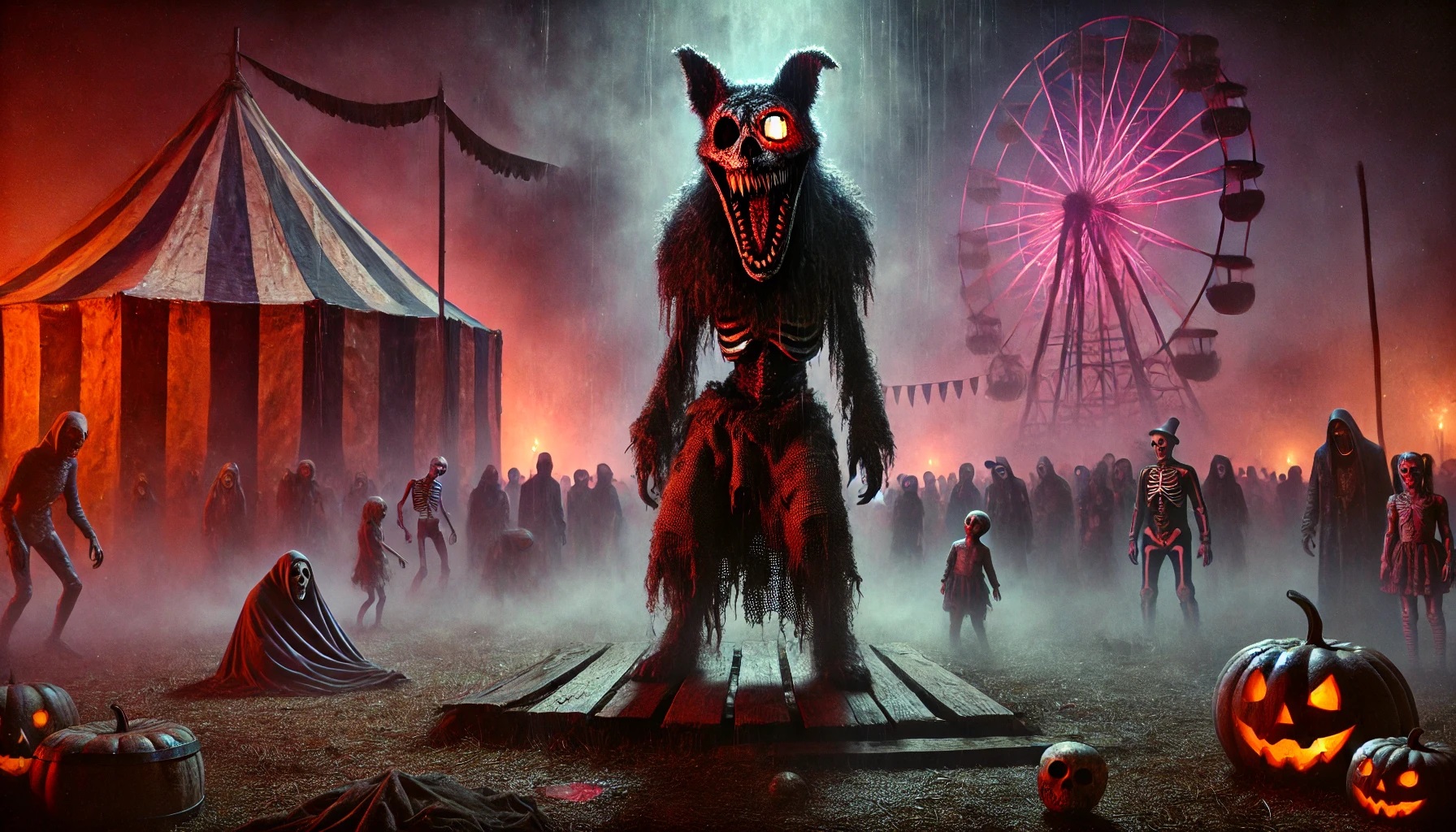
He looked like a mascot—maybe. I thought it was a costume at first, but something about the proportions was off. “Mickey” was a wolf-like humanoid thing standing upright, all black fur and burlap rags, like he’d clawed his way out of a garbage dump in the middle of a circus. His mouth was stretched wide, showing yellow teeth that caught the light in a way that made them look wet. One of his eyes was bulging out of the socket like it had been glued on wrong. The other stared straight into the camera.
Into me.
I remember feeling sick, like that static you feel when you stand too close to a CRT TV.
I tore the poster down, thinking maybe it was a prank. But the next day, there were more, all over town. They were everywhere, plastered to light posts, stop signs, even taped to the windows of the hardware store. It was always the same image and words, the same awful feeling every time I saw that damn wolf.
I asked around, but no one seemed to know who was organizing it. The town council hadn’t approved anything, but suddenly there were flyers in the mail, radio ads, even a segment on our local station. Everyone was buzzing. They said it was the biggest thing to hit Wabeno since the snowmobile derby in ‘98. And when I told people it felt wrong, that the mascot creeped me out, that something was off about the whole thing, they just smiled. Shrugged. Or worse—laughed.
“Mickey’s not so scary,” they’d say.
It became a kind of joke. My girlfriend Lindsey said it first, when I showed her the poster I’d pulled off the light pole. “You’re such a wuss, Jon. Mickey’s not so scary.” Then my sister Katie chimed in, calling me a buzzkill. Travis laughed and said I was just pissed that I didn’t think of a creepy Halloween pop-up first.
The worst part was, even though I felt dread clawing at the back of my neck every time I saw Mickey’s face, I couldn’t stop looking. I kept the poster in my backpack for days, taking it out at night like some sort of cursed totem.
Then I started dreaming about him. Not in some poetic, subconscious metaphorical way, either. Literal dreams, of Mickey standing in the middle of a crowd, arms outstretched, with smoke and lights behind him. Around him, people were dancing, laughing, and clapping in rhythm. His mouth opened wide and he started to sing—but not in English, or in any language I recognized, but in long, guttural tones that made me ill.
And everyone clapped. Everyone smiled. Everyone watched.
Except me. I couldn’t move.
I’d wake up soaked in sweat, heart pounding, and the exact same phrase would echo in my head—Mickey’s not so scary.
But I knew he was. I knew.
And the worst part? Even knowing that, some part of me still wanted to go.
* * * * * *
The posters didn’t stop. They multiplied.
By the following week, they weren’t just on lamp posts and storefronts anymore—they were in mailboxes, under windshield wipers, and slid through the slots of apartment doors. Mickey’s grin was everywhere. It got to the point where I didn’t even want to walk down Main Street.
Then came the billboards. I’m not joking. One morning, I drove out to the quarry where Travis and I used to go shooting, and there it was—a freshly planted billboard in the middle of a soybean field. Bright orange background. Sparkling Halloween letters. And right in the center, that same photo of Mickey, arms outstretched like he was welcoming you to hell.
Only now, he had company. There were other figures in the background. Performers, maybe. Carnival folk. Their faces were blurred, but I swear I recognized one of them, a lanky silhouette with a crooked stance. It looked just like the guy from the hypnotism poster on the high school bulletin board—only older and paler. And Mickey looked worse somehow. Wetter.
Even the gas pumps started showing Mickey’s face—glitchy little animations on the payment screens. And I’m not talking about a company-sponsored ad. This thing looked like someone had hacked the station’s digital feed itself. It would flash for half a second, then vanish. But I saw it.
And the town kept buzzing. Like, freakishly excited. Everyone had an opinion about what costume they were gonna wear. People started talking like this was some annual tradition, even though none of us had ever heard of it before. They were trading stories, like, “Oh yeah, I remember Mickey came through when I was a kid,” or “They did something like this back in ‘92, I think.”
No, they didn’t. That never happened. But now it was all anyone could talk about.
I started keeping notes, documenting what I saw. I even recorded myself one night in bed, trying to fall asleep, because the same dreams kept coming, of Mickey on a stage, fog machines pouring out violet mist, and people dancing in perfect sync. No one ever blinked or looked away.
And the song. God, the song.
It wasn’t music. It was noise, but not music. It sounded like someone trying to imitate singing without understanding what it is—long, drawn-out vowels that shouldn’t have fit together but did. Every time I heard it in the dream, my mouth watered and my eyes stung, and I’d wake up gasping with the taste of rust in my throat.
Travis thought it was hilarious and kept sending me memes—edited Mickey pics with glowing red eyes, labeled “Not So Scary, My Ass.” One had Mickey Photoshopped holding a bloody axe, with Katie behind him, screaming.
Katie thought it was hilarious, too. “You’re making this way weirder than it is,” she told me.
Lindsey wasn’t much better. She rolled her eyes every time I brought it up. “You need to calm down, Jon,” she said one night on FaceTime. “You’re taking this too seriously. It’s a Halloween thing. People love Halloween. Let them have fun.”
I asked her if she thought the mascot looked real. Like, too real. She squinted at the poster I held up to the screen and shrugged. “It’s probably CGI or something. All those party companies do that kind of viral stuff now. It’s smart marketing. Mickey’s not so scary. Chill out.”
There it was again. That damn phrase.
It wasn’t just Lindsey, either. Everyone said it. The teachers, the old guys at the diner, even Pastor Paul when I passed him outside the rec center. He clapped me on the shoulder and said, “You better come to the event, Jon! Mickey’s not so scary!”
Every time someone said it, it sounded less like a comment and more like a reflex, like they had to say it.
The atmosphere in town felt increasingly charged as the event got closer. People were walking faster, talking louder. I watched a group of elementary kids chant Mickey’s name while jumping rope. They didn’t even seem to realize they were doing it.
I started sleeping at Travis’s place a couple of nights a week, just to avoid being alone. But even there, I could hear things through the wall. Scratching, whispering, Mickey’s voice, humming just under the static of my buddy’s cheap Bluetooth speaker.
And I still couldn’t stop thinking about the show. I wanted to go. Even though I was terrified, even though every part of my brain was screaming don’t, something in me kept trying to rationalize it.
It’s just one night. Just a party. Just a dumb show with some lights and music and candy.
I told myself I’d stay outside the whole time, that I wouldn’t go near the stage. That I wouldn’t even get close to Mickey. I just wanted to see it, just to know.
I don’t know if that part of me was still me. Or if the singing had already started working.
* * * * * *
The thing about small towns is, you notice change. We’re used to slow days, the same storefronts, the same gas station clerk asking about your uncle’s knee surgery. So when something new shows up—especially something big—it’s impossible to ignore.
That Friday morning, it was like the whole football field had been replaced overnight.
I drove past the high school just before dawn on my way to grab coffee, and where the field had been yesterday, there were now tents—massive black-and-orange structures rising like crooked teeth out of the frost. Strings of bulbs hung between them, some still flickering in the pale light. A giant archway shaped like bones curved over the main entrance, its letters reading:
MICKEY’S NOT SO SCARY
ONE NIGHT ONLY – TONIGHT!
Mickey’s face was printed in glossy vinyl across the arch. I don’t know what kind of printer could make something that big without pixelation, but there it was—every strand of fur, every glisten on those teeth. His eyes followed me as I drove past.
By mid-morning, the whole town was electric. People left work early. Parents pulled their kids out of school “for the experience.” You could hear the generators from blocks away, the low hum vibrating in your ribs.
I told myself I wouldn’t go. And I meant it, too.
That is, until Lindsey called.
She was already with Katie and Travis, all three of them in costume. They were outside the field gates, music pounding in the background, and they wanted me there now.
“Come on, Jon!” Lindsey said over the noise. “It’s one night. You’ll regret missing it forever.”
Katie grabbed the phone from her and yelled, “You’re being a loser! Mickey’s not so scary!”
Then Travis added, “Seriously, man, you’re not scared of the Big Bad Wolf scare, are you? Get down here, dude!”
I should have hung up. I should have stayed home. But instead, half an hour later, I was parking my car three blocks from the school, listening to the muffled thump of bass and the occasional shriek of laughter.
The second I stepped through the gates, the smell hit me—sweet, almost rotten, like fruit left in the sun. I thought maybe it was the caramel corn stand.
Lights swept across the crowd, and for a moment I thought the place was packed shoulder-to-shoulder. But the way people were moving…it wasn’t normal. They weren’t milling around like you’d expect at a fair. They were flowing, all in the same general direction, toward the main stage at the far end of the field.
Elsewhere, the parade was already underway. Performers in tattered costumes marched past on stilts, twirling ribbons and breathing fire, but their movements were jerky, like puppets on invisible strings. One woman in a cracked porcelain mask waved at me as she passed, and her hand didn’t stop waving—it kept going long after she’d moved on, like the motion had been programmed on a loop.
All around me, the crowd cheered.
I found my friends near the stage. Katie looked amazing in her vampire dress. Lindsey’s witch hat sparkled under the lights. Travis had fake blood smeared across his zombie makeup. They were all laughing, swaying to the music.
It wasn’t music I recognized. The rhythm was strange; I swear it sounded like something being played in reverse. The melody kept sliding into tones that didn’t feel right, notes that didn’t belong together but still somehow lured you in.
The parade ended, and the lights cut out. The crowd erupted.
And then Mickey walked on stage.
He was bigger than I expected—at least seven feet tall, broad-shouldered, with fur that looked matted and damp. His rags hung off him in strips. The way he moved…God, it wasn’t human. His steps were too long, too fluid, like there weren’t bones under there at all.
He didn’t speak. He just stood there for a moment, head turning slowly as if he was sniffing us out.
Then he started to sing.
There were no words, just deep, guttural sounds that rolled in your chest like muffled thunder. The tones made my stomach twist, and my vision blurred around the edges.
Around me, everyone else swayed, eyes half-lidded, smiles curling on their faces.
I told myself to move, to leave, but my feet wouldn’t listen.
From the corner of my eye, I saw Mickey step to the edge of the stage and reach for someone in the front row—a boy, maybe ten years old. Mickey sniffed him once, twice, then gestured for him to follow. The boy climbed onto the stage without hesitation.
No one screamed or shouted. They just kept swaying.
Katie laughed beside me, her eyes fixed on Mickey. Then he turned our way.
He was close enough now that I could see the moisture on his teeth. He leaned down toward Travis, sniffed him, and smiled.
Travis stepped forward.
I tried to grab him, but my arms felt like they were underwater. Before I could do anything, he was already gone, disappearing behind the curtain at the back of the stage.
The crowd roared as the lights shifted to a new color.
I couldn’t tell if they were cheering for the music—or for the ones Mickey had chosen.
* * * * * *
After Travis vanished backstage, I waited for someone—anyone—to notice, but nothing happened. The music kept going, that slow, off-kilter rhythm wrapping tighter around my head. Lights swirled over the crowd, purples and reds bleeding into each other until I couldn’t tell where one ended and the other began.
Katie was still smiling. Lindsey, too. They didn’t even glance toward where Travis had gone.
My mouth felt dry. I tried to say something, but my voice came out flat, swallowed by the bass.
Across the stage, Mickey prowled, the fog curling around his legs. He bent toward the front row again, sniffed a woman in a scarecrow costume, and she climbed onto the stage like she’d been waiting for the invitation all night. He took her hand in his massive paw, led her to the curtain, and disappeared with her.
The crowd cheered.
I counted three more people taken in less than five minutes. Every time it happened, I expected the spell to break—parents to scream, friends to shove through the crowd to get their loved ones back. But no one reacted. They just shifted to fill the empty space, still swaying and smiling.
I caught movement to my right. Katie’s gaze was fixed on Mickey like she’d never seen anything more beautiful. Her head tilted slightly, like she was listening for something under the music. When Mickey’s eyes swept across the crowd, she stood a little straighter.
“No—” I tried to say, but the word stuck.
Mickey stopped in front of her.
He leaned down and inhaled deeply, twice. His head turned toward me for the briefest second, and his good eye locked with mine. I swear his smile grew even wider.
Then Katie stepped forward.
I lunged, but my body still wasn’t mine. My hands brushed her sleeve before she slipped away into the curtain’s shadow.
The music swelled. It wasn’t just the sound anymore—it was pressure, pushing down through my chest, vibrating in the roots of my teeth.
I forced myself to look at Lindsey. She hadn’t moved yet, but her eyes were glassy. Her fingers tapped in time with the music, over and over, the same three beats.
When Mickey came back out again, I knew. He didn’t even have to sniff her. She was already moving toward him before he reached the edge of the stage. He took her hand, and she followed.
Suddenly, she was gone, just like the others.
The crowd didn’t notice. The lights kept flashing, the music kept going. More people were taken. I tried to keep count in my head, even though it was impossible to keep up. A man in a pumpkin mask. A girl dressed as a black cat. A teenager with fairy wings. Whole friend groups vanished, plucked out one by one.
By the time the finale began, the gaps in the crowd were everywhere.
Then the fireworks started—loud, blinding bursts that lit up the tents in gold. For a moment, the music cut out. It was so abrupt that my knees nearly buckled from the sudden silence.
When my vision cleared, I realized I could move again.
The stage was empty.
I spun around, searching for my friends. There were strangers beside me now, faces I didn’t recognize. I called for Katie, Lindsey, and Travis, my voice cracking, but no one even turned to look.
I grabbed the shoulder of the guy next to me. “Where’s my sister? Where’s Katie?”
He frowned. “Who?”
I said her name again.
“You alone, man? Want to get a drink?” He turned away before I could answer.
I pushed through the crowd, shouting their names, asking anyone I could grab. Most people just laughed, confused. A few got irritated.
One woman told me she’d been standing beside me all night and that I’d come here alone. She said there was no Lindsey, no Katie, no Travis.
The fireworks thundered overhead.
And when I looked back at the stage, Mickey was standing there again, just for a moment, watching me. His mouth was open. I couldn’t hear him over the noise, but I saw the shape of the words.
You’ll come around.
Then the lights went out.
* * * * * *
I didn’t sleep that night. I don’t think anyone did, but for different reasons. People streamed out of the field, laughing, comparing selfies, and arguing about who should have won the costume contest that never actually happened. I wandered the lanes between the tents looking for a security booth, a lost-and-found table, any sign of staff who might point me toward the backstage area. It was hopeless. Every path curved back to the midway or emptied me into the grass in front of the stage. By the time the final embers of the fireworks faded, the generators wound down to a low drone, and the bulbs over the gates dimmed one by one. The show was finished, and the message was clear: we could go now.
I refused to leave without my friends. I stood outside the curtain where I’d seen them vanish until a performer in a cracked half-mask stepped out and gestured for me to move along. He didn’t speak; he just tilted his head, and I felt that same pressure in my chest ease me sideways. When I tried to push past him, a row of performers materialized at the edge of the stage—stilt-walkers and ribbon dancers who hadn’t been there a second earlier—forming a polite line with smiles that didn’t waver. I asked where the volunteers went. One of them clapped twice and pointed toward the exit, the way you might helpfully direct a tourist to the parking lot.
I walked home in the cold with the taste of smoke in my mouth, telling myself I’d go back at dawn and tear through that curtain if I had to. I set alarms for every hour, just to make sure I wouldn’t slip into dreams, but they still came in bits and flashes whenever I blinked too long: Lindsey on a catwalk above a stage, expression blank and serene; Travis painted white from neck to ankle, learning a new kind of smile; Katie turning slowly under violet light like she was being adjusted on a display.
When the first alarm for sunrise went off, I was already putting on my boots. I drove to the high school with my fingers tight on the wheel, rehearsing what I’d say to the police if I needed them to open the tents. I turned onto Elk Street, passed the diner and the empty bus stop, and braced for the arch, the bones, and the vinyl grin stretched twenty feet across.
There was nothing on the field.
Not a tent stake. Not a power cord. The grass lay flat in strips where heavy equipment had rolled across it, but that was the only proof that anything had ever been there. Even the trash was gone. There were no popcorn bags or glow stick wrappers, no footprints in the muddy patch near the visitor bleachers where I’d stood for an hour calling their names. The place looked as if it had been mowed and raked overnight.
I parked half on the curb and jogged the length of the sideline anyway, scanning for a zipper tab, a seam, or a scrap of fabric. A janitor pushing a cart unlocked the north gate and told me I couldn’t be there. I asked him if he’d seen the crews take everything down. He looked confused and then amused, like I’d told a joke that didn’t land.
“What crews?” he said. “Field’s closed for re-sodding next week. You a player or something?”
I called Lindsey. Her number rang three times and then corrected itself into a friendly recorded voice telling me the line wasn’t in service. I called again immediately in case I’d misdialed, and got the same message. I scrolled my recent calls to tap the thread at the top, the same thread I’d used last night when she begged me to come down, and found a blank space where it should have been. My call log jumped from a spam risk yesterday afternoon to a local pizza place back on Monday. No Lindsey. No late-night FaceTimes. No photos I knew I had taken.
I checked for Travis. The thread was there, but it opened to a single text from two months ago asking if I wanted to hit the quarry. Everything else—the memes, the trash talk, the stupid YouTube shorts—was gone. I opened the Photos app and searched for “Katie.” The tag brought up two pictures from a Christmas three years ago and one of a girl in a letterman jacket I didn’t recognize. My sister wasn’t in any of them. The three images I’d taken last night, of Katie’s vampire fangs, Lindsey’s glittering hat, and Travis’s smudged zombie, had vanished. The folder for “Last Night” existed, but it displayed an empty gray square with a broken thumbnail icon, as if the phone were apologizing for the inconvenience.
I drove to my mom’s place. She was standing in the driveway with a grocery list and a coffee, chatting with Mrs. Cline from next door. I didn’t waste time with a greeting. I asked where Katie was. Mom furrowed her brow.
“Katie who?” she asked. “I don’t know any Katie.” She saw the grave expression on my face and reached for my arm like she thought I’d collapse. “Are you alright, Jonathan? I think you’ve been spending too much time online.”
I told her I was talking about my sister, her daughter. I gave her details: her birthday, her favorite cereal, how she’d sworn she would get a bat tattoo the moment she turned eighteen. My mom squeezed my arm again and asked if I wanted to sit down. Mrs. Cline suggested I see a doctor.
I left before I said something I couldn’t take back. At the police station, I tried to make a report. The desk sergeant asked for the full names of the missing parties. I gave him all three. He typed for a while, then turned the monitor so I could see. Empty search results. There was no driver’s license for a Katie under my mom’s last name. No Lindsey matching the photo I found in my head. The system had Travis, but as a guy who’d moved to Duluth last year, according to a file stamped in April. There was even an address I knew wasn’t his. The sergeant printed it anyway and told me to drive up and check, then shrugged at the distance. “I’m sorry I couldn’t be more helpful,” he said. “If you think of anything else, please let us know. In the meantime, maybe get yourself checked out, kid. You look like you’ve had a long night.”
I wanted to grab him and shake him until he understood, but the thought of touching anyone made my skin crawl. There was a residue from last night that clung to everything in town—the radio station’s morning show, the chitchat at the pharmacy, the checkout guy who hummed a tune that should not have had any place inside his mouth. It wasn’t a melody you could pin down. It was instantly unsettling, and I never wanted to hear it again.
Somewhere between lunch and dinner, the story congealed. The pop-up had been a rumor. The field had been empty. The music drifting across town had been someone’s backyard speakers. Drones had caused the lights. This is what everyone agreed to remember. I watched the consensus build in real time at the diner, table by table, nod by nod. By evening, the last person still unsure of the details laughed and conceded they must have misremembered.
I didn’t go home. Instead, I drove loops around town and then parked near the quarry to stare at the soybean billboard that wasn’t there anymore. A new ad, of a smiling couple promoting an insurance company, had replaced it overnight. There were no wolves in sight. When the sky turned that steely blue it gets just before full dark, I finally gave in and returned to my apartment, locking the door behind me and dragging the kitchen chair under the knob even though I knew it wouldn’t help.
The dreams came as soon as I let my eyes close. Not a full dream, just a slide show in rapid cuts: a hand in a burlap sleeve laying out black cords; a circle of kids practicing a clap on two and four without knowing why; Lindsey in a line with other vocalists, leaning toward a microphone; Travis kneeling while someone painted a stripe across his ribs and then pressed a palm to it as if setting mortar; Katie on a raised platform, eyes bright, listening for a cue I couldn’t hear.
I woke to the faintest vibration in the wall. At first, I thought it was the fridge cycling on, but the pattern held too steady for that. It resembled a low pulse, followed by a rest, and then another pulse. It resolved into something like footfalls and then into something like a tempo count. My apartment shares a cinderblock wall with the unit next door, which had been empty all summer. I pressed my ear to it. The sound was not coming from the hallway. It was inside the wall itself, traveling through the structure. I followed it to the window and lifted the blinds. Out on the street, three teenagers I didn’t know were chalking a curved symbol into the asphalt. They finished the arc, stepped back, considered, and then redrew the line two inches to the left as if a voice had politely corrected them.
I closed the blinds and sat on the floor with my back against the couch. I scrolled every local Facebook group, every community page, every rumor board. People were tagging friends in St. Cloud, Little Falls, and Anoka, posting pictures of orange flyers that weren’t quite in frame, as if their phones couldn’t decide where to focus. The captions were all the same tone I’d heard here a week ago, jokey and eager: Anyone know if this is legit? Looks fun for the kids. Mickey’s not so scary lol.
They were already moving on.
I tried one more time to pull proof from my phone. I opened the voice memos I’d made the week before. The file I’d titled “HUM AT NIGHT” now played back an hour of refrigerator white noise. The note where I’d written down the billboard’s wording had been autocorrected into a grocery list: milk, bread, carrots. The poster I’d kept in my backpack through the first week, crumpled and greasy from handling, was gone. I hadn’t thrown it out. I knew I hadn’t. The zipper pocket where I’d stashed it still lay open and empty, smelling faintly of that sweet rot from the fairgrounds.
Late, long after midnight, I thought I saw movement on the sidewalk. A tall shape paused under the streetlight and tilted its head toward my window. The shape wasn’t that of a person, but vaguely human in form. It held itself like someone wearing something too heavy around their shoulders. I didn’t go to the glass to check. I stayed where I was and counted the spaces between passing cars until the figure moved on.
By morning, the flyers had begun to appear in the neighboring town. The same cartoon letters. The same promise of a parade, a hypnotist, and fireworks. The same photo of the thing that might be a costume and might not be. A nearby radio station ran a cheerful spot about “that fun Halloween pop-up you’ve been DM’ing us about,” and the DJ chuckled when he said the line everybody says now, like it’s been ingrained for decades: “Mickey’s not so scary.”
He is. He absolutely is.
And I think Katie knows how to work the spotlight now. I think Lindsey is learning to mimic the tones during the “musical” performance. I think Travis will be the one who pats you on the shoulder and points you toward the exit while you smile and move your feet where the tempo tells you to go, making sure you leave your friends and family behind.
But those people aren’t gone. They’ve been chosen. And if you ever have the chance to see them again, I suspect you’ll barely recognize them, and even if you manage to, there’s a good chance they won’t remember you.
* * * * * *
I know how this sounds. I know what it looks like when someone shows up with a long story and a warning stapled to the end. You can call it grief, paranoia, or attention-seeking. You can call it a late-night spiral where I connected dots that weren’t there. Call it anything you want. Just don’t call it harmless.
If you live within a couple of hours of central Minnesota, start paying attention today. People in Sauk Centre, Little Falls, St. Cloud, Foley, Monticello, Princeton, Brainerd, and Anoka are already posting about “the coolest Halloween pop-up ever” with a parade, a hypnotist, a dance party, and fireworks. The flyers will look handmade yet strangely perfect—bright orange and black, with letters that have little drips and curls. The photo at the bottom will be the same: a wolf-shaped monstrosity in filthy rags, with one eye bulging and glistening teeth.
They’ll tell you it’s a one-night-only event. They’ll promise it’s family-friendly. They’ll say Mickey’s great with kids.
By the time the tents go up, it’ll be too late to convince anyone. That’s part of the design. You’ll notice how fast it happens. You’ll notice that nobody knows who rented the field, who approved the permit, or who’s in charge, yet somehow the lights are hung, the sound checks are finished, and the entry gate is already in place when you wake up. You’ll smell something sweet near the entrance—like fruit that sat on a windowsill a day too long. You’ll think the parade feels a little off, like the performers are keeping time with a rhythm you can’t hear. You’ll tell yourself it’s just nerves.
Then Mickey will walk out and stand there. He won’t have to say a word. The singing doesn’t begin with language. It begins with tone. You’ll feel it in your jaw first, then in the space behind your eyes, then in the muscles along your spine. It will reorganize your attention so that whatever you meant to do becomes less urgent. The people beside you will smile. Your shoulders will loosen against your will. You’ll think, I’ll just stay for a minute. I’ll keep to the back. I won’t get close to the stage.
This is the part where you say you’re different, that you can’t be hypnotized. I told myself that, too. I’m telling you: it doesn’t matter what you believe about yourself. It matters what the sound does to you. It matters that the lights sweep in a pattern designed to complement the tone. It matters that the fog snagged at your jeans on the way in and put something in the air you can taste but can’t name. It matters that the phrase everyone says—“Mickey’s not so scary”—has been repeated to you enough times to lay its own track in your head, so when the fear hits it slides neatly into that groove and gets carried away from the part of you that would have turned and walked out.
You’ll hardly notice when people go missing. That’s the trick. They won’t be dragged. There won’t be a struggle. Mickey will step to the edge of the stage and sniff, and the ones he wants will feel chosen. He’ll crook a finger, or not even that—he’ll just incline his head—and they’ll follow the line backstage the way you follow a host to a table at a restaurant, calm and expectant. No one will block their path. No one will ask where they’re going. If you try to raise your voice, the music will swell. If you try to step forward, your legs will refuse to cooperate.
When it’s over and the fireworks begin, the spell will thin. You’ll look around and see spaces where people used to be. You’ll count the absences. You’ll call names. The faces nearest you will be kind and baffled. They’ll assume you’re drunk or overtired or playing a prank. They’ll distract you with small talk. And if you can still make your voice work, you’ll swear that fifteen percent of the field dissolved in front of you and nobody noticed.
The next morning, you’ll have less to hold onto. Photos will refuse to load or will show the wrong angles. Call logs will be incomplete. Threads will be edited backward by some quiet hand. At the station, a tired officer will turn a monitor and show you there’s no record of the people you lost, or that those people live somewhere else now and always have. Family will lay a hand on your arm and change the subject. Neighbors will remember an empty field the previous night and a rumor that got out of hand. Everyone will be relieved when the story settles into the version that asks nothing from them.
I don’t want relief. I want my people back.
If you see the posters, don’t engage. Don’t take a selfie with one. Don’t scan any QR code. Don’t talk about it like it’s a given that you’ll go. Curiosity is part of the net. If it’s already set up, keep moving. Don’t stand in the sound or face the stage. If the music starts, cover your ears before you tell yourself it’s silly to do that. If your friends laugh and say “Mickey’s not so scary,” let them laugh and be the one who leaves. It’s better to be teased for a month than the alternative.
If you’re one of the people who can do more than leave—if you work for the city or the county, if you’ve got keys to gates or the authority to redirect a crew—lock the field before nightfall. If you can cut power to the grounds, do it. If you can salt the earth, do that, too. You may think I’m leaning into drama, but I’m not. I watched a stage empty a town and then erase the evidence. Whatever you can do to break the sequence before the first tone hits the crowd will save people who won’t even know they were in danger.
If you’re a parent and you hear that a “safe, spooky parade” is coming through, plan a movie night instead. Pull out the old DVDs. Maybe tell your kids they can stay up late and eat the candy you’d have bought for the fair. Keep them in your house, where the sound has to travel through walls, and you can turn on every fan you own to create white noise until the tempo outside loses its grip.
Most of you will never hear this. Of the ones who do, most will dismiss it, shake their head, and tell themselves it’s a story. That’s fine. I’m telling this to the few who feel the hairs on their arms rise when a certain ad slides past, who catch themselves humming a bar of nothing, who smell overripe fruit in a place it doesn’t belong. You are the ones who can still choose.
If you go anyway, and you see him—if he turns his head and that good eye settles on you—don’t wait for the invitation. Don’t be polite or look for your friends to go first. Turn your back and walk away. If you can’t walk, crawl. If you can’t crawl, fall and make a scene big enough to yank your nervous system out of alignment with the tone. People will stare. Let them.
I’m telling this because the show is moving now. The chatter online says Sauk Centre for the weekend and then Little Falls. Someone in Anoka posted a blurry picture of a tent pole near a park and then deleted it. The schedule isn’t public, but the pattern feels familiar: smaller town, then bigger, then bigger, then interstate, and repeat. If you’re two or three stops down the line, you have a window. Use it.
If you see them—my friends, my sister—please, I’m begging you, tell them I didn’t forget. My sister answers to Katie even when she pretends she doesn’t. My girlfriend is Lindsey, and she has a way of tilting her head when she’s listening. My best friend is Travis, who can’t hold a straight face for five seconds if you mention the quarry. They might be wearing makeup now. They might be standing under a light, rehearsing. They might look through you. Say their names anyway. Tell them I’m here, and that I’m trying. God, I’m trying.
And if by chance you can get close enough to the tents before the music starts, and you have a way to ruin the setup—wires, generators, stakes—do it. Don’t wait for others to take action first. Don’t wait for consensus. There won’t be one. There never is.
Mickey’s not so scary, they’ll say.
But he is.
He’s the reason I’m asking strangers to be brave in places I’ll never see.
Watch the posters. Watch the lights. Watch each other. And if, despite the odds, you somehow make it through the night with everyone you brought still standing beside you, write down their names when you get home, and put the list on your fridge. Take a photo of it and print the photo. Tape a copy under the sink. Hide another in the glove box. Start a trail that can’t be edited, that can’t be erased.
And whatever you do, if you see Mickey—if you hear him—don’t stare, and don’t listen.
He said I’d come around. I want to believe that’s not true, but I don’t know how much longer I can sit here, waiting for others to stop this, before I take matters into my own hands.
I can’t get the song out of my head.
Please, if you’re able, help me—help them—before I do something stupid.
Mickey’s not so scary, they said.
They’re lying.
🎧 Available Audio Adaptations: None Available
Written by Craig Groshek Edited by Craig Groshek Thumbnail Art by Craig Groshek Narrated by N/A🔔 More stories from author: Craig Groshek
Publisher's Notes: N/A Author's Notes: N/AMore Stories from Author Craig Groshek:

Related Stories:
You Might Also Enjoy:
Recommended Reading:

Copyright Statement: Unless explicitly stated, all stories published on CreepypastaStories.com are the property of (and under copyright to) their respective authors, and may not be narrated or performed, adapted to film, television or audio mediums, republished in a print or electronic book, reposted on any other website, blog, or online platform, or otherwise monetized without the express written consent of its author(s).