

08 Nov The Happy Man
“The Happy Man”
Written by Craig Groshek Edited by Craig Groshek Thumbnail Art by Craig Groshek Narrated by N/ACopyright Statement: Unless explicitly stated, all stories published on CreepypastaStories.com are the property of (and under copyright to) their respective authors, and may not be narrated or performed, adapted to film, television or audio mediums, republished in a print or electronic book, reposted on any other website, blog, or online platform, or otherwise monetized without the express written consent of its author(s).
🎧 Available Audio Adaptations: None Available
⏰ ESTIMATED READING TIME — 23 minutes
I’m a cookie decorator by trade. Cakes, too, when I have time for them. But mostly cookies.
People think that sounds cute, like I spend my days piping little hearts and flowers, humming along to soft music, living the dream. They don’t see me hunched over the kitchen table at two in the morning, wrists throbbing, my back locked up, royal icing hardening in the bowl because I had to stop and cry for five minutes before I could keep going.
I built my home business, Barkley’s Bakes, from nothing. I’ve been doing this for fifteen years—long enough to know exactly how much it costs me, in every sense of the word.
I’m forty-four years old. I’ve got two daughters, a mortgage, car payments, and a husband who keeps telling me I’m “too stressed.” He’s not wrong, but hearing it doesn’t help.
The week everything started, I had a 350-cookie order due for a Botox Day event across twenty local medical spas. It was an honor, supposedly. “Great exposure,” they said. What it really was, was four straight days without sleep, icing until my fingers cramped. I worked while the girls did their homework at the table and my husband, Derek, watched TV in the next room. Every few hours he’d call, “Come sit down, Sam!” And every time I’d snap back, “I can’t! If I stop, I’ll never finish!”
By the third night, I was slurring my words. By the fourth, I was crying over a batch that came out uneven.
I love what I do. I really do. But I hate it, too—the way people act like custom work should cost the same as supermarket cookies. Don’t come to me with a Temu budget. Don’t ask for a hand-painted cookie portrait for thirty bucks.
But they always do.
When I finally got that massive Botox Day order boxed and labeled, my hands were shaking so badly I could hardly tie the ribbons. My youngest, Molly, was trying to show me something she’d drawn. A stick-figure family holding hands.
“Not now, honey,” I told her.
She stood there for a second, waiting. Then she walked off without a word.
Later, I found her drawing pinned to the fridge with a magnet, smeared with icing from where my elbow had touched it.
The next morning, I had a client consultation for a wedding. The bride, Melissa Stanton, showed up in a white blazer that probably cost more than all the supplies in my kitchen. She scrolled through Pinterest photos on her phone and told me she wanted “something classy but fun.”
Then she asked for a bulk discount.
Her fiancé barely looked up from his phone. I smiled through my teeth and quoted her my rate. She frowned and said she could get the same design from a local chain for half that. I told her, politely, that she should go for it then.
She laughed and said, “Oh, you’re feisty. I like that.”
I should have said no right there, but I didn’t. The money was too good. I took the job.
For the next two weeks, I lived in my kitchen. My husband and I argued constantly. He said the girls missed me. He said I was “married to the oven.”
“You think I want this?” I yelled. “You think I enjoy being screamed at by people who want custom work for gas-station prices?”
He told me I was taking it too personally. That’s when I threw the piping bag. It burst against the wall, splattering blue frosting like a paintball.
The girls came running. Molly started crying. Derek just stared at me, shaking his head.
I cleaned it up in silence.
* * * * * *
When I delivered Melissa’s order, everything was perfect. Pale pink royal icing. Gold leaf accents. Her initials hand-piped in script so fine it looked printed. She gushed over them, took pictures, and promised to tag my business on Instagram.
Two days later, she texted saying they were “stale,” and refused to pay the remaining balance.
Then the reviews started.
“Barkley’s Bakes sold me old cookies.”
“Rude and unprofessional. Do not recommend.”
“Looks nice, tastes awful.”
Within a week, half my orders were canceled.
I tried to fight back. I posted pictures, wrote careful, polite replies, and explained that Melissa never refrigerated the cookies as instructed. It didn’t matter. People believe the customer, not the baker.
Derek told me to let it go. “It’s just cookies,” he said.
I remember screaming back, “It’s not just cookies! It’s my life!”
The look on his face… I’ll never forget it. As if he were seeing a stranger standing in our kitchen.
That night, I couldn’t sleep. I sat at the table, scrolling through one-star reviews, drinking cold coffee, and refreshing my business page every few seconds, like it would change anything. My eyes burned. My chest hurt. I wanted to throw my phone through the window.
When the girls came in for breakfast, I pretended to be fine. I smiled, packed their lunches, and kissed the tops of their heads.
I could feel Derek watching me, waiting for another explosion. He didn’t say anything.
By the time the kids left for school, I was shaking. I walked into the kitchen, stared at the spotless counters, and started bawling, crying so hard I couldn’t breathe. All that work. All those hours. All the birthdays and recitals I’d missed because of deadlines and dough. And for what? So a spoiled bride could destroy everything with a few clicks?
I didn’t know it yet, but that was the moment something in me cracked wide open.
That was the moment the Happy Man heard me.
* * * * * *
The next morning, I went out for coffee just to get out of the house. My eyes were swollen, and my hands still smelled like vanilla extract and powdered sugar.
The café was crowded. I ordered something strong and sat down with my laptop. I was trying to draft a new social post about upcoming Valentine’s specials, pretending my business wasn’t collapsing, when someone beside me said softly, “Rough morning?”
I turned and saw her—a tall, pale woman, maybe my age, stirring her drink without looking up. There was something old-fashioned about her jewelry, like it belonged in a museum.
I laughed bitterly. “You could say that.”
She looked up, smiled faintly, and said, “Sometimes people make our lives miserable, don’t they?”
“Don’t even get me started,” I muttered.
That’s when she said the words that started everything. “You know,” she said, “there’s someone who can make unhappy people happy again. Permanently.”
She said it like it was the most normal thing in the world.
I almost laughed. “Sure,” I said. “You got his number?”
“Not a number. A name,” she said. Her smile never faltered. “I’m Lucinda, by the way,” she said, extending a hand.
I hesitated to shake it. Something about the way she mentioned the name of the man—whatever or whoever he was—gave me pause. She stirred her coffee three more times, then set the spoon down on the saucer in strangely delicate fashion, as if its placement were crucial.
“I’m not talking about a therapist,” she added, her voice lowering a notch. “I’m talking about The Happy Man.”
I blinked at her. “I’m sorry, what?”
She didn’t explain right away. Instead, she leaned back and studied me calmly, the way a doctor looks at you before giving bad news.
“You look like someone who’s been carrying too much for too long,” she said. “Like you’ve tried everything else.”
She wasn’t wrong.
There was something soothing about Lucinda’s tone. She had the kind of voice that makes you want to spill everything. And I did. I told her about the wedding order, about Melissa Stanton, about the reviews and the business. About Derek not understanding. When I finished, I half expected her to tell me to pray about it or “focus on self-care.” Instead, she slid a crumpled napkin across the table.
On it, three words had been written in neat, looping script: How to call him.
“Take sugar and salt, equal parts,” she said quietly, like she was reciting from memory. “Draw a smile on a clean surface, play a recording of laughter—genuine laughter—and speak the person’s name aloud. Then say, ‘He’ll make you happy.’ Do it at 3:03 a.m.”
I stared at her, half amused, half unsettled. “That’s… oddly specific.”
She shrugged. “Specific things work. Nonsense doesn’t.”
When I didn’t pick up the napkin, Lucinda pushed it closer. “You don’t have to believe it,” she said. “But you’ll see. He helps people who deserve it.”
“And what does he want in return?” I asked.
Her eyes flicked up from her cup. “Gratitude,” she said simply. “That’s all.”
When I left the café, the napkin was still in my hand. I told myself I was keeping it as a joke, but I couldn’t stop thinking about Lucinda’s words: He helps people who deserve it.
I put it in my purse and tried to forget about it. I couldn’t.
* * * * * *
That night, I made dinner while Derek scrolled through his phone at the table. Lila was drawing, Molly humming softly beside her.
I asked Derek if he’d gotten a call back about a flooring job he’d bid for recently. “They went with another contractor,” he said.
The sound I made wasn’t quite a sigh. It was more like a laugh that came out wrong.
He looked up. “You okay?”
“No,” I said flatly. “I’m not okay.”
He didn’t answer.
The tension in the room was so thick you could frost it.
Then my phone buzzed. A new notification—another review. This one was worse than the others. A stranger claimed they’d gotten food poisoning from my cookies. Another lie. The worst one yet.
Derek told me to put the phone down, said I was “obsessing again.”
I lost it. I started yelling, loud enough that the girls covered their ears. I said things I shouldn’t have—that I wished I’d never started this business, that no one ever helped me, that if he’d just once taken my side, maybe I wouldn’t be drowning.
Then I saw the look on Molly’s face. That quiet, trembling hurt.
I left the room before I could make it worse.
I sat on the edge of the bed, staring at the napkin.
Take sugar and salt in equal parts.
Draw a smile.
Play the sound of laughter.
Say their name.
He’ll make them happy.
I could still hear Derek’s voice in my head: It’s just cookies. And I recalled Melissa Stanton’s smirking face, bragging about her luxury wedding while dragging me through the mud.
If there really was something out there that could make her “happy,” fine. Let it. Let her smile until her face hurt.
I wasn’t thinking clearly. I told myself I was just curious, that I didn’t believe any of it.
But that wasn’t true. I wanted it to work, and I was determined to find out if it would.
At 3:03 a.m., when the house was dark and silent, I went into the kitchen. The air had that heavy stillness it gets before a storm.
I measured the sugar and salt into my palm and poured it onto the counter in a slow curve, shaping it into a smile. Then I opened my phone and played a clip I had saved from a baking tutorial, in which the host was laughing about a failed batch. The sound filled the kitchen, bright and tinny through the speaker.
Then I whispered, “Melissa Stanton.”
Nothing happened. I felt ridiculous.
Then, faintly, I heard something else under the laughter. A second, deeper voice whispering. I couldn’t make out the words.
That’s when the lights flickered and the video stopped on its own.
My phone screen dimmed, and for a second, I saw something reflected in it—a grin. Not mine.
The next moment, the power went out. Startled, I dropped the phone, cracking the screen. The impact of it striking the floor sounded like a thunderclap in the dark.
When the lights came back on, the sugar smile on the counter had become a dull, sticky puddle.
I told myself it was just exhaustion.
The next morning, I almost forgot about it—until I saw the notification. Melissa Stanton had posted again, but this time it wasn’t a complaint. It was a video. In it, her makeup was perfect, her voice syrupy sweet. She said she’d been unfair, that Barkley’s Bakes was wonderful, that she’d been “so wrong” to post those reviews.
Then she smiled. Too wide. Too long. And behind her, someone laughed softly—a man’s laugh, low and sweet, almost kind.
Not once did she ever blink.
I dropped my phone.
Orders started coming back within hours. Old customers emailed, saying they’d missed my work. By noon, I had five new deposits in my account.
Derek looked at me over breakfast. “Maybe things are turning around,” he said.
“Yeah,” I said, staring at my phone. “Maybe.” But even as I said it, I heard something faint, like laughter, far away, carried through the vents. And when I looked at the mixer bowl on the counter, the polished metal caught the morning light just right, and for an instant, I could have sworn I saw teeth.
At first, I told myself it was just a coincidence.
Melissa’s apology video went viral in local Facebook groups, and suddenly everyone wanted cookies again. People who’d previously canceled orders sent me messages as if nothing had happened.
By the end of that week, my inbox was overflowing with messages from customers both new and old.
It didn’t feel real. Neither did Melissa’s voice. The way she smiled in that video—it wasn’t just forced. It looked painful, like she was having it held it there against her will.
I replayed the clip over and over, convinced I’d find an edit, a glitch, something. But all I discovered was a faint sound in the background, a soft, cheerful humming.
By the time the weekend rolled around, the phone still hadn’t stopped ringing. I was booked solid for weeks.
Derek tried to be happy for me—he really did—but I think it scared him, the way I threw myself back into the work. He’d come into the kitchen and stand behind me, waiting for me to look up, but I didn’t. I couldn’t.
He finally said one night, “Sam, you can slow down, you know. You don’t have to prove anything.”
“I’m not proving anything,” I said. “I’m fixing it.”
“Fixing what?”
“Everything,” I said, and I meant it.
* * * * * *
New orders poured in. I didn’t question it. People left five-star reviews, gushed about how just looking at my cookies elevated their mood. That phrasing—that merely seeing them made them happy—started showing up in multiple reviews, word for word.
I didn’t like that. I didn’t like that I started smiling whenever I read it, either.
Then I saw Melissa again. It was a Tuesday. I was at the grocery store, grabbing eggs and stocking up on sugar, when I heard her humming.
I had just turned the corner, and there she was by the freezer aisle, holding a shopping basket, that same stretched smile on her face.
Her fiancé was with her, eyes glassy, lips curved up like a puppet’s.
Melissa saw me and froze for a moment. Then, with a beaming smile, she said, “Samantha! Hi!”
Her voice was bright and wrong. She walked right up to me and put a hand on my arm. Her skin was cold.
“I just wanted to say thank you,” she said. “You made me so happy. You made us so happy.”
I tried to step back, but she held on tighter. Her nails dug into my skin.
Her fiancé laughed suddenly, out of nowhere, this hollow bark that made my blood go cold.
Melissa didn’t even look at him. She just smiled wider and whispered, “He says you’re next.” Then she let go and walked away.
When I got home, I told myself I’d imagined it, that I’d misheard her. That she’d said something else, anything else. But that night, as I cleaned up after baking, I found flour scattered across the counter in a perfect curve—a smile.
I hadn’t made it. At least, I didn’t think I had.
I didn’t sleep much after that.
* * * * * *
The next morning, Derek found me at the table with my laptop, eyes red from crying.
“Sam,” he said carefully, “you’ve been working nonstop. You’re not—”
“I saw her,” I said.
“Who?”
“Melissa, the bride,” I replied. “She thanked me. Said he told her I was next.”
He frowned. “Who told her?”
“The Happy Man.”
He blinked. “Who?”
I realized how insane it sounded. I laughed and shook my head. “Forget it. I just—forget it.”
He came around behind me and put his hands on my shoulders. “You need rest, Sam.”
His touch felt strange, like his hands were colder than they should have been.
I looked up at him and realized he was smiling. Not a normal smile. A perfect one.
* * * * * *
At breakfast, the girls were in unusually good moods. Lila hummed the same tune I’d heard in the grocery store, and Molly giggled over nothing.
Derek poured his coffee and said, “It’s nice to see everyone happy for once.”
I forced a smile. “Yeah. Nice.”
When Lila dropped her spoon and it clattered on the floor, she bent to pick it up, and I swear I heard laughter coming from inside the walls.
I jumped, spilling my coffee.
“Mom?” Lila said.
“It’s… It’s fine,” I said quickly. “Just tired, that’s all.” But my heart was pounding.
That night, Derek and I argued again. He said I was “imagining things,” that the stress was making me paranoid. I told him something was wrong with the house, wrong with them. He told me to schedule an appointment with my therapist.
“Help?!” I snapped. “Where was your help when Melissa tanked my business? Where were you when I was up at three in the morning doing everything I could to keep our family afloat?”
He just stood there silently, smiling.
I screamed at him then, louder than I ever had before. “Stop it! Stop smiling at me!”
He didn’t stop. Neither did the girls. They came running from their rooms, both of them grinning like it was a game.
“Mom,” Molly said, still smiling, “why are you so mad?”
“I’m not mad!” I shouted. But I was. I was shaking from head to toe.
Then Lila started laughing—not real laughter, mind you, but something forced and overly loud.
I slapped my hands over my ears. “Stop it! St—stop it!”
They didn’t. Derek stepped forward and gently touched my arm.
“He says it’s okay,” he whispered. “He says we don’t have to be sad anymore.”
I yanked away from him so hard I nearly fell. “Who? Who says that?”
Before he even replied, I already knew.
“The Happy Man, sweetheart,” Derek said, grinning from ear to ear. “You should smile. You’re prettier when you smile.”
Then the mixer on the counter turned on by itself, the beaters spinning in the empty bowl. Inside the stainless steel, I saw movement—a tall, dark outline reflected back at me, a grin stretching across the metal.
The mixer stopped, and the kitchen went silent, except for the faintest echo of laughter coming from nowhere and everywhere at once.
That night, I couldn’t close my eyes. Every time I did, I saw his reflection smiling back at me. He didn’t look angry or threatening, but proud, like a parent watching a child finally learn a lesson.
When the first light of morning came through the window, I whispered out loud, “What do you want from me?”
The answer came in that same sweet, distant laugh, whispering through the vents:
“More.”
* * * * * *
I didn’t leave the house for two days.
Orders kept flooding in online, but I couldn’t bring myself to fill them. The laughter wouldn’t stop. It came from the vents, from the mixer, and from the walls, always faint and just out of reach.
When I tried to tell Derek, he just smiled that same glassy smile and said, “You’re overworked, Sam. You should be happy. Everyone else is happy.”
He said it like he believed it.
On the third morning, I found Lila sitting at the table, humming to herself and doodling on a sheet of paper. When I looked closer, my stomach turned. Every drawing was a smiley face—dozens of them.
“Molly’s still asleep?” I asked.
Lila nodded, humming. “She’s dreaming about him.”
My heart sank. “Who?”
She looked up, her eyes bright. “The Happy Man. He came to see her. He says we don’t have to be sad anymore.”
I dropped the paper. “What did he look like?”
Her humming didn’t stop. “Like a shadow that smiles.”
I stormed into the bedroom to find Molly sitting on the bed, her hands clasped in her lap, grinning at the wall.
“Sweetheart,” I said softly, kneeling. “What are you doing?”
“Talking to him,” she said. “He says he’s proud of you.”
Her voice was calm, too calm.
I felt something icy crawl up my spine. “He’s not real, Molly.”
She giggled. “Then how did he make Daddy so happy?”
* * * * * *
That afternoon, I tried to confront Derek again.
I found him in the living room, staring at the blank TV screen, humming the same tune as the girls.
“Derek,” I said, standing between him and the screen, “we need to talk.”
He blinked slowly, his smile fixed in place. “About what?”
“About what’s happening to you. To the kids.”
He tilted his head. “Nothing’s happening, Sam. Everything’s fine.”
“Stop saying that!” I snapped. “Look at me!”
He did, but his eyes didn’t focus. They shimmered with something out of place. “Melissa Stanton,” he said. “You made her happy, didn’t you?”
I froze. “H-how did you know that?”
“He told me,” he said softly. “In my dreams. Said he helps you when you help him. He wants more.”
“More what?”
My husband’s smile widened, splitting his lips. “Names.”
I couldn’t breathe.
Derek stood up slowly, and for the first time in fifteen years, I stepped back from my husband like he was a stranger.
“I’m not giving him anything!” I said. “Not another soul.”
Derek reached out a hand, still smiling. “Then he’ll take what he needs, Sam. He always gets what he needs.”
That night, I heard footsteps in the hallway. Soft. Bare.
When I got up, I found Molly standing in the doorway, head tilted.
“Mom?”
“Yes, baby?”
She smiled wider. “He says you’re being selfish.”
Before I could answer, she turned and walked away, humming that same tune.
* * * * * *
The following morning, I found Lila in the kitchen. She was mixing sugar and salt together in a bowl.
“What are you doing?” I asked.
“Making smiles,” she said.
She pointed at the counter, where countless little sugar curves spread across it like tiny grins.
I grabbed the bowl and threw it in the sink. “Don’t you ever do that again.”
She looked up, startled. For a moment, her face twitched. Then the smile returned.
“Don’t be mad,” she said softly. “He doesn’t like it when you’re upset.”
Something cracked in me then, and I started screaming. It wasn’t so much words as raw noise.
Derek ran in, smiling as always, his voice calm and infuriating. “You’re scaring the girls, Sam.”
“They should be scared!” I shouted. “You all should be terrified!”
He put a hand on my shoulder. “The Happy Man doesn’t like shouting.”
I slapped his hand away. “Stop saying that name!”
He just kept smiling.
I shoved past him, shaking. “I’m not feeding him anymore! Do you hear me? No more!”
The laughter in the walls grew louder after that. At first, it was faint. Then it spread, seeping through the vents, the pipes, the floorboards. It followed me everywhere. When I cried in the shower, I heard it under the water. When I tried to sleep, it whispered in the pillow beside my ear.
“More.”
“You owe him more.”
“He always gets what he needs.”
By the end of the week, Derek stopped speaking altogether. He just smiled and nodded whenever I asked him anything. The girls were the same. They didn’t fight, cry, or complain. If I told them to do something, they did it without protest, smiling all the while.
It should’ve been peaceful.
Instead, it was hell.
* * * * * *
One evening, I found them all sitting at the kitchen table. Derek, Lila, and Molly. The mixer was running by itself. The beaters turned slowly, scraping the bowl, and they were all staring at it, humming softly in unison.
“Turn it off,” I said.
None of them moved.
“Turn it off!”
The humming got louder. Then, without warning, the mixer stopped, and the room went silent.
Derek turned toward me, his grin stretching wider than humanly possible. His voice came out low and calm, but it wasn’t his voice anymore.
“He says if you won’t give him names, he’ll take feelings instead.”
I stumbled back. “No.”
“He’s hungry,” Derek said. “He’s been patient. But you’ve been selfish.”
“Stop,” I begged. “Please, Derek, stop.”
The girls stood, smiling at me, their eyes glinting like glass.
“He just wants everyone to be happy, Mommy,” Lila said.
“Don’t be mad,” Molly whispered. “He’s right behind you.”
I turned.
At first, I saw nothing but the mixer bowl reflecting my face. But then I noticed it wasn’t just my face. No, something else was smiling in the reflection just behind me—something tall and shadowy, with teeth too white to be real.
I screamed and grabbed the bowl, throwing it across the room. It hit the wall and shattered.
To this day, I’ve never forgotten the sound of the laughter that poured out of it.
That night, I barely held myself together. I sat in the dark kitchen, clutching the napkin Lucinda had given me. The words were smeared, but I could still read them: Draw a smile. Say their name.
I traced my finger over the faded ink, whispering through tears, “What do you want from me?”
As if on cue, the air grew warm and sugary sweet, and from somewhere deep inside the house came his voice, bright and gentle, echoing like a lullaby:
“You’re happiest when you’re working, Samantha. Keep working.”
I think I blacked out. When I woke up, there were cookies cooling on the counter. Dozens of perfect cookies.
I didn’t remember baking them, but they were all decorated the same—white icing, red piping, smiling faces.
Every single one smiling.
* * * * * *
I don’t know what day it was when I decided to end it. Time had become meaningless in our house. Every clock was off by a few minutes. The oven timer reset itself every hour. Even the light through the blinds didn’t look right anymore. It was too soft, too golden, as if filtered through honey.
And everyone was smiling.
Derek spent his mornings sitting on the couch, staring at the blank television, humming to himself. Lila’s laughter echoed up and down the hallway in loops. Molly sat at the kitchen table drawing perfect smiley faces over and over, hundreds of them, all identical.
I searched the house for the napkin Lucinda had given me. I’d thrown it away once, I thought, but it wasn’t in the trash. I found it folded neatly inside my recipe binder, between pages covered in grease and sugar stains. The ink had faded, but new words had appeared beneath the old ones—written in that same looping hand:
Never undo joy.
I nearly laughed.
“Watch me,” I whispered.
* * * * * *
I waited until everyone was asleep, or pretending to be, and laid the napkin flat on the counter. Then I poured out sugar and salt and drew a jagged line through the smiling curve. Finally, voice shaking, I whispered the words backward. Every single one.
When I finished, the air went still.
Then came the laughter.
It started in the walls, soft at first, like someone chuckling through a closed door. Then it grew louder, closer, overlapping until it filled every corner of the room.
The lights flickered. I screamed for it to stop.
That’s when the laughter turned to screaming.
I ran to the living room to find Derek standing by the window, grinning mindlessly. He turned his head slowly toward me, his smile unwavering.
“Sam,” he said, voice calm and cheerful. “Why would you do that?”
“I just want it to end,” I whispered. “Please, Derek, I just want it to stop.”
He stepped closer, eyes wide and empty. “He’s not angry. He’s disappointed. You promised him more.”
I shook my head. “I didn’t promise him anything!”
He smiled wider. “You said his name. That’s all he needs.”
Behind him, Lila and Molly appeared in the hallway, their faces pale and stretched into identical grins.
“Mom,” Molly said sweetly, “he says you broke your promise.”
The air once again grew heavy and sweet, like burnt sugar. I backed toward the kitchen.
“Get out of here,” I said. “Go to your rooms. Now!”
None of them moved. Their smiles didn’t change.
Then the power went out, and the house plunged into darkness. And somewhere behind me, glass shattered.
Once the light had been extinguished, the laughter came back, deeper now, layered with something wet, and a shadow bloomed across the ceiling. At first, I thought it was the Happy Man—his shape stretched thin, head brushing the ceiling beams. But when he spoke, his voice was low and broken, unfamiliar.
“You took their sadness from me.”
It came from the shadow itself.
“You took their fear. Their pain. You made them empty. And now you want it back.”
The shadow dropped from the ceiling, and the air snapped cold. Every smile in the house disappeared at once. Derek’s face twisted into confusion. Lila screamed. Molly collapsed, clutching her chest.
The shadow’s mouth split open, wide and wet, dripping with darkness.
It wasn’t the Happy Man.
It was everything he’d stolen.
Intuitively, his name came to me.
Mr. Unhappy.
He moved through the house like smoke, filling every room. Wherever he passed, the air shimmered, and the laughter warped into sobbing.
I ran to the girls, pulling them close. Their skin felt fever-hot.
“Mom,” Lila gasped, “it hurts.”
I held them tighter. “I know, baby, I know. Just hold on.”
Derek staggered toward us, clutching his head, muttering through gritted teeth. “Make it stop, Sam. Please.”
I couldn’t.
Mr. Unhappy’s voice filled the air.
“You wanted happiness without consideration for the consequences. For everything given, something must also be taken. Balance must be restored.”
The laughter became screaming again—hundreds of voices, all overlapping, each of them echoing through my skull.
Then came the memories. Not mine, but theirs. All at once, I felt it—every ounce of sadness, grief, anger, and heartbreak that had been stripped away from my husband and my daughters. It hit me like a flood. Lila’s hidden tears after every argument. Molly’s confusion when I ignored her. Derek’s quiet despair, trying to hold our family together while I fell apart.
It filled me until I couldn’t breathe.
I screamed until my throat tore, but no sound came out—just laughter.
* * * * * *
When I opened my eyes again, I was lying on the kitchen floor, and the house was silent. Derek was gone. So were the girls.
I crawled toward the table, my hands leaving streaks of sugar on the tiles. The napkin was still there, glowing faintly in the dark.
New words had appeared on it, scrawled in dark red: He’s still hungry.
I sobbed until I couldn’t anymore. Then I heard him—the Happy Man. His voice was soft again, sweet as honey:
“You’ve been very selfish, Samantha. After all I’ve done for you, that wasn’t kind.”
“Where are they?” I whispered.
“They’re still here, happier than ever.”
I looked up to find Derek suddenly sitting at the table, smiling again, as if he’d never left. The girls sat beside him, their eyes wide and empty, grins painted across their faces in icing.
Their skin was as pale as porcelain. In an instant, I knew they weren’t breathing.
“See?” the Happy Man whispered. “They’ve never been more content.”
I screamed until my voice broke. I threw the napkin into the sink, grabbed a lighter, and set it on fire. The flames flickered once and died out instantly, leaving the paper untouched.
In the reflection of the kitchen window, the Happy Man stood behind me, smiling.
“You can’t destroy joy, Samantha,” he said softly. “You can only share it.”
I stumbled backward, slamming into the counter, my heart pounding. “Take me instead! Please, just take me!”
His smile widened, stretching impossibly far. “You already gave yourself to me,” he said. “You just didn’t realize it.”
Then he was gone.
A moment later, the sugar on the counter began to move on its own, forming a perfect smile. I stood, transfixed, as it spread wider, reaching the edges of the counter, then the walls, then the ceiling. The entire room was smiling.
Somewhere in the distance, I heard a faint knock at someone else’s front door—three soft taps. I knew who it was.
The Happy Man doesn’t stop once he’s been invited in. He just moves on to the next unhappy house.
I crawled toward the computer. My hands were shaking, my breath ragged.
I had to warn someone. Anyone.
I don’t know if anyone will ever hear this. If you do, promise me you’ll believe it.
He’s real. He calls himself The Happy Man.
I thought I could fix what I’d done. I thought burning that napkin would end it, that if I begged hard enough, he’d take me and let my family go. But he doesn’t bargain. He doesn’t stop. He just keeps smiling.
The house is quiet now. Too quiet. There’s no humming. No laughter. Just silence so heavy it hums in my ears.
Derek and the girls are sitting, lifeless, at the kitchen table. It’s been hours. I can’t bring myself to call the police. Their faces are frozen the way I found them—still smiling, still perfect. And when the light hits their eyes just right, I can see my reflection inside them.
And in it, he’s standing there, behind me, every time.
After a long while, I eventually tried to call for help, but the phone only plays the sound of laughter, cold and robotic, when I press “send.” My emails bounce back. Even the oven clock flashes 3:03 over and over, no matter what the actual time is.
He’s making sure I can’t reach anyone.
I did what I had to do. I’m ashamed, but I had no choice. I don’t know what happens next, but I suppose that’s the least of my concerns.
In the meantime, I keep hearing him whisper, “You wanted peace, Samantha. You wanted everyone to be happy. You got what you wanted, and now, I’ve got what I want, too.”
He says it like he’s done me a kindness, like this is a reward, a fair exchange.
Sometimes I see his tall, thin form in the window’s reflection, his grin cutting through the glass. Other times, he’s standing where Derek used to, watching me bake.
Yes, I still bake. I can’t stop. My hands move on their own, rolling dough, piping smiles, painting tiny red lips that curve too wide on otherwise expressionless faces.
I never remember turning on the oven.
Every batch looks exactly the same. He likes it that way.
He’s using me now, feeding from me.
Every order I deliver, every box that leaves this house, I can feel him reach a little farther.
People post pictures of my cookies online—smiling faces with captions like “These made my day!” and “Instant happiness!”
And I know what’s coming for them. I’m practically leading him straight to them. The fools.
I tell myself I should stop, but my body doesn’t listen.
My mouth keeps smiling. My hands keep working. He keeps whispering.
“You can only share joy, Samantha. You should smile. That’s what happy people do,” he says softly. “You’re prettier when you smile.”
* * * * * *
Tonight, the laughter started again, but it’s not coming from the walls this time. It’s coming from inside me. It bubbles out of my throat when I try to cry. It shakes my chest until I can’t breathe. Every sound I make turns into a giggle. Every sob becomes a laugh.
I’m reciting this between fits of it now, hoping I can finish before he takes whatever’s left of me.
He’s standing in the doorway. I can see him out of the corner of my eye, a tall shadow with that impossible grin. The longer I stare, the more I realize he doesn’t have eyes at all, just two hollows that glow faintly, like light seen through thin fabric.
He says he wants to “help me smile again.”
The problem is, I’m already smiling.
I haven’t stopped. I can’t.
The screen is flickering. Every word I type comes out doubled, mirrored, repeating.
He’s learning how to speak through me.
I can hear the girls giggling again upstairs. I know they’re gone. I buried them. But the sound is real.
I don’t know if it’s them or him pretending to be them. I can’t tell the difference anymore.
I tried to pray earlier. He didn’t like that. It came out wrong. My voice kept twisting into laughter halfway through the words.
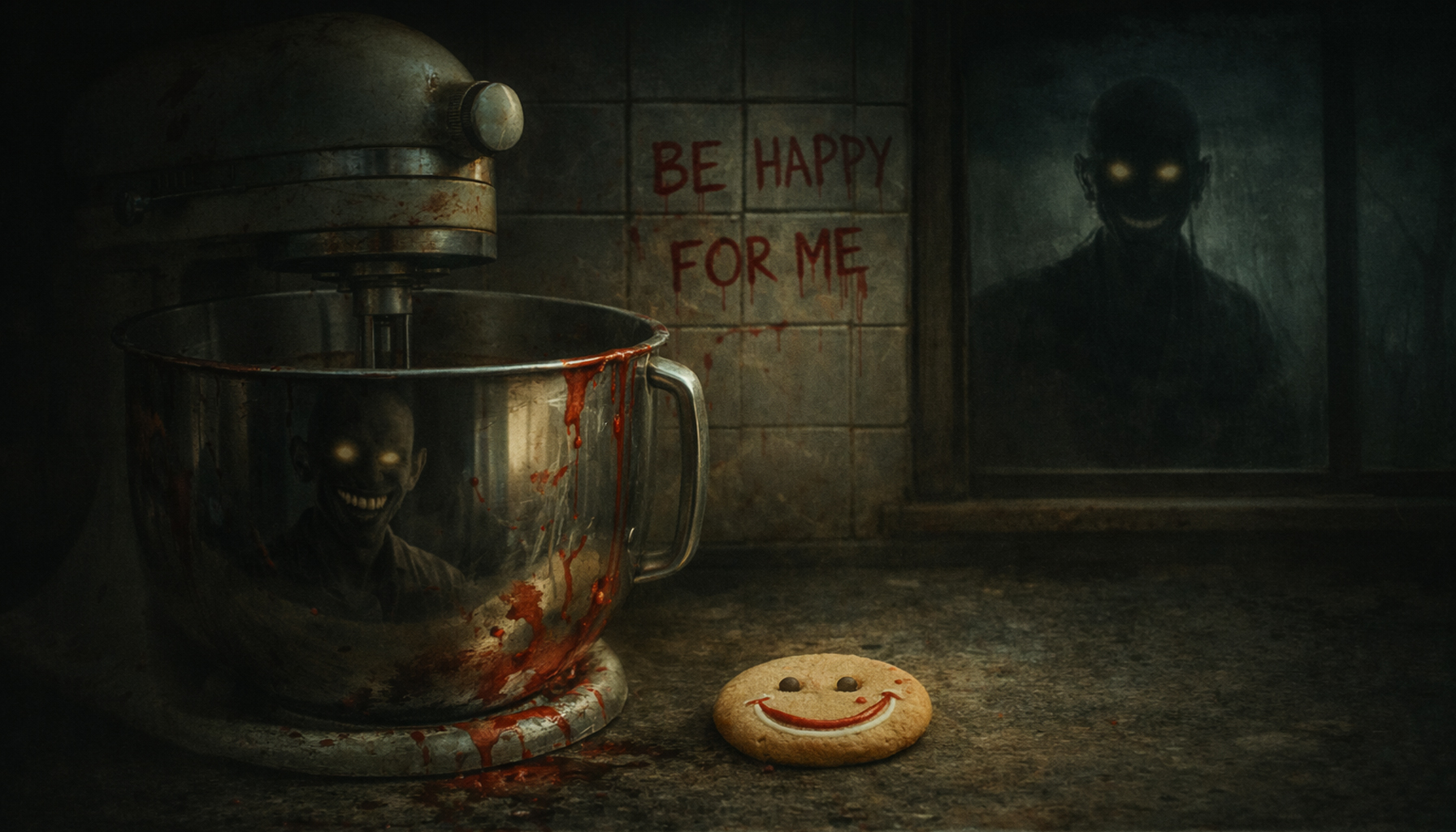
The lights went out again. When they came back, new words were written across the kitchen wall in red icing:
BE HAPPY FOR ME.
It’s signed with a smile.
I think I understand now. He doesn’t feed on misery, on the moments right after someone experiences grief, after people have given up and pretend everything’s fine. That’s why he chose me. I’d been pretending for years, grinning through every insult, every late payment, every fight with Derek. I built my whole life around forced smiles, and he smelled it on me like sugar burning.
He didn’t make me do this. He didn’t change me. He just showed me what I already was.
If anyone hears this, don’t try the ritual. Don’t even joke about it. If you find a napkin, or a recipe card, or any scrap of paper with a smiling face drawn on it, burn it, and then scatter the ashes.
And if you ever hear laughter when you’re alone, stop smiling, no matter how good it feels. Because once he knows you’re trying, he won’t stop until he gets what he wants.
He just wants everyone to be happy, no matter the cost. And that cost is more than you can bear, I assure you.
I can feel him now, standing right behind me. He’s leaning over my shoulder, watching me type. His breath is warm and smells like frosting.
He says I’m almost done. He says this story should have a happy ending.
He’s touching my face. My cheeks hurt from smiling, but he keeps pushing.
I look prettier when I smile, he says.
I want to cry, but he won’t let me.
The cursor is moving on its own now. He’s typing for me.
I’m not sure where I end and he begins anymore, and I’m not sure I care anymore.
Maybe that’s what happiness really is. The end of choices. The end of pain. The end of me.
He’s laughing again. He says he has to go now—someone else is in need of his… services.
He says he’ll return when I stop smiling.
I don’t think I ever will.
Why would I?
I’ve never been more content.
🙂
🎧 Available Audio Adaptations: None Available
Written by Craig Groshek Edited by Craig Groshek Thumbnail Art by Craig Groshek Narrated by N/A🔔 More stories from author: Craig Groshek
Publisher's Notes: N/A Author's Notes: N/AMore Stories from Author Craig Groshek:

Related Stories:
You Might Also Enjoy:




Recommended Reading:




Copyright Statement: Unless explicitly stated, all stories published on CreepypastaStories.com are the property of (and under copyright to) their respective authors, and may not be narrated or performed, adapted to film, television or audio mediums, republished in a print or electronic book, reposted on any other website, blog, or online platform, or otherwise monetized without the express written consent of its author(s).