

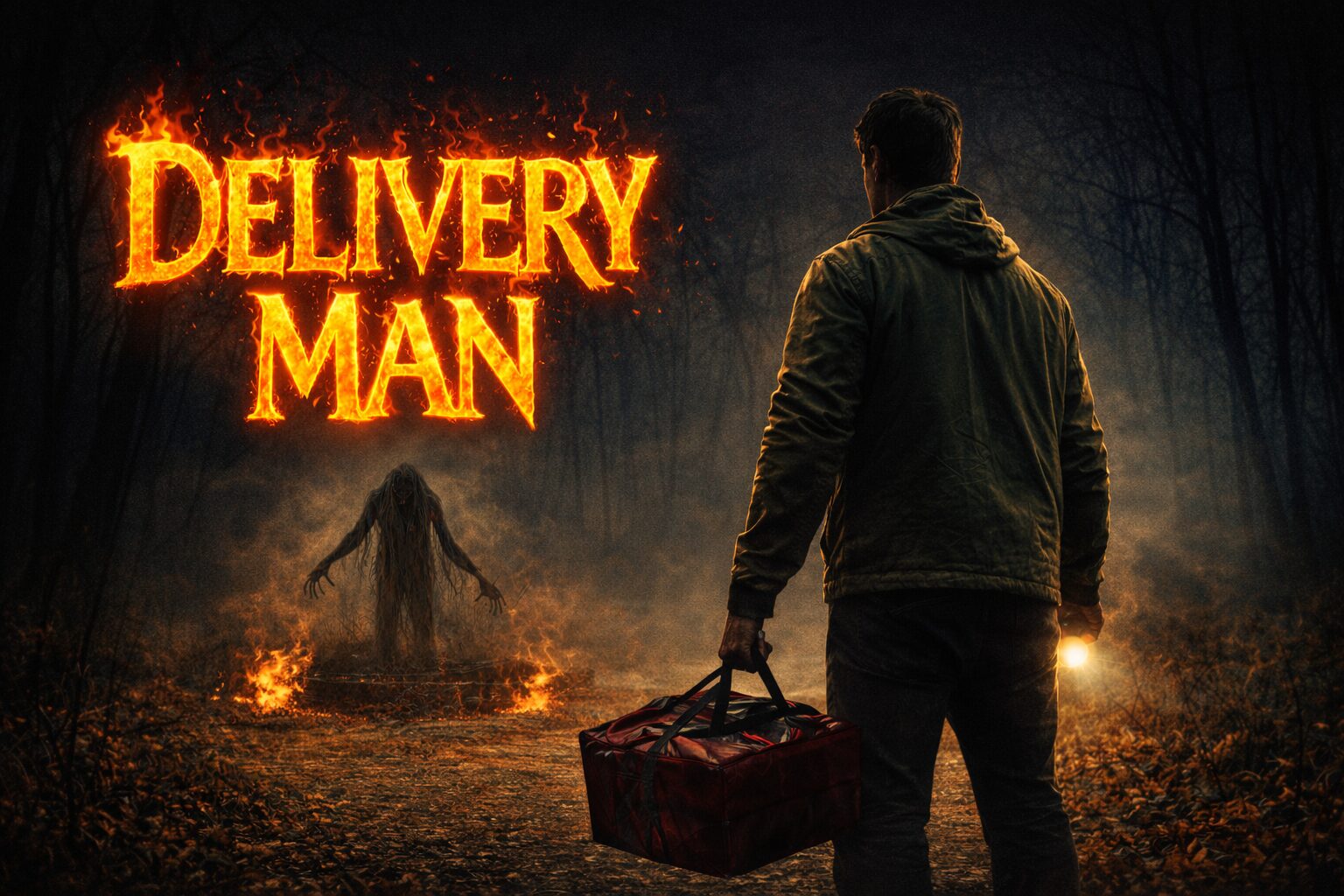
10 Apr Delivery Man
“Delivery Man”
Written by Craig Groshek Edited by Craig Groshek Thumbnail Art by Craig Groshek Narrated by N/ACopyright Statement: Unless explicitly stated, all stories published on CreepypastaStories.com are the property of (and under copyright to) their respective authors, and may not be narrated or performed, adapted to film, television or audio mediums, republished in a print or electronic book, reposted on any other website, blog, or online platform, or otherwise monetized without the express written consent of its author(s).
🎧 Available Audio Adaptations: None Available
⏰ ESTIMATED READING TIME — 49 minutes
Part I
I own a pizza place.
People hear that and picture something cozy. Brick oven. Family recipes. A guy in a clean apron tossing dough in the air while Sinatra plays in the background.
What I actually own is a small-town grease trap with a sign out front.
Bell’s Pizza had been open fourteen years, long enough that people either loved us or had a story about how I once forgot their extra marinara in 2019 and ruined their anniversary. Small towns are good like that. They support local business right up until they don’t, and then they act surprised when the place closes.
Business had been bad for a while.
Rent was late.
The walk-in cooler was making a noise that usually comes right before a repair bill I can’t afford.
I’d already stalled one supplier and was about out of excuses that sounded even halfway believable.
I was taking deliveries myself again because paying a driver had become optional in the same way paying your electric bill does when you can barely afford groceries.
That was where things stood the night the first call came in.
It was a Thursday, around eleven-thirty. We were closed, but I was still there finishing cleanup and going over receipts in the office, which was really just a back room with a metal desk and an old corkboard I mostly used to pin invoices I was avoiding.
The entire place stank like grease, dough, and bleach.
My cell phone rang.
Not the shop line. My personal phone.
That number wasn’t exactly private. Years ago I’d put it on catering flyers, Facebook ads, and some desperate “Call Jerry direct” promotions during football season. Enough people had it that a late-night business call wasn’t impossible.
Still, something about it bothered me right away.
The screen just said UNKNOWN.
I answered.
“Bell’s Pizza.”
The man on the other end said, “Jerry Bell?”
His voice was calm. Even. Not weird in any obvious way, which somehow made it worse.
“Who’s asking?”
“I’d like to place an order.”
“We’re closed.”
“I know.”
That should have been the end of it. Instead, he kept going.
“Two large pizzas. One pepperoni, one sausage and mushroom. Breadsticks. A two-liter cola. Cash payment. Two hundred dollar tip if you deliver it yourself.”
I sat up a little in my chair.
“A two hundred dollar tip.”
“Yes.”
“After closing.”
“Yes.”
“To me personally.”
“Yes.”
I looked at the clock on the wall like it might jump in and stop me from making a bad decision.
It didn’t.
“Where’s it going?”
He gave me directions that didn’t sound right. County Road 6, then a turn onto some service lane I’d never heard of, then a drainage culvert instead of a house number.
I said, “That’s not an address.”
“It’s where the delivery needs to go.”
“Who am I delivering to?”
“No one will meet you.”
That should have ended it, too.
Instead I wrote the order down.
“Then how’s this supposed to work?”
“You’ll find an envelope taped beneath the guardrail on the north side. Leave the pizzas on the concrete ledge beside the culvert. Set the bottle to the right of the boxes. Then leave.”
I didn’t say anything for a second.
The man waited.
I remember looking through the office door into the kitchen. Stainless steel counters. The prep table. The old cooler sputtering like it was one bad day from becoming a footnote in my inevitable bankruptcy filings. I remember thinking that two hundred dollars would cover one immediate headache and buy me maybe another week before the next one.
It is amazing what starts sounding reasonable when you’re short on cash.
“You’re serious,” I said.
“Yes.”
“Why all this nonsense?”
Another pause.
Then he said, “Will you take the order?”
His tone changed just enough on that line to get my attention. Still polite. Still calm. But it had some weight behind it now, like there was a wrong answer.
I knew it was off. I’m not going to sit here now and pretend I had no warning. I did. I just also had bills.
“Cash better be there,” I said.
“It will be.”
Then he hung up.
I sat there a few more seconds with the phone in my hand. Then I got up, made the pizzas, boxed everything, and loaded the delivery bag.
I locked the front door behind me and headed out.
The drive took about twenty minutes. Past the neighborhoods. Past the gas station at the edge of town. Past the stretch where the road narrowed and got darker and there stopped being any reason for normal people to be out unless they lived there.
The service lane was real, technically. It was a strip of broken pavement running along a drainage ditch, half covered with weeds and cracked wide enough to lose a tire in if you weren’t paying attention.
There were no houses, mailbox, or lights. Just the guardrail, the concrete culvert, and open dark on both sides.
I parked with the headlights pointed toward the ditch and sat there for a second with the engine running.
I told myself it was probably some rich idiot with a fetish for privacy. I told myself maybe it was kids screwing around. I told myself a lot of things.
Then I got out.
The night was eerily quiet. No bugs. No dogs. No traffic from the main road. Just the sound of my shoes on gravel and the engine ticking.
The envelope was exactly where he said it would be, taped beneath the guardrail on the north side. I pulled it loose, got back in the car, and counted the money under the dome light.
Two hundred and fifty dollars.
Real cash. No trick.
I put it in my pocket and carried the order over to the culvert.
The concrete ledge was wide enough for both boxes. I set the soda to the right, as the caller requested.
Standing there, with a warm pizza bag in one hand and a drainage ditch in front of me, I had a moment of clarity where I thought: this is stupid. Whatever this is, it’s stupid, and I should be anywhere else.
Instead I turned around, went back to my car, locked the doors, and pulled away.
At the end of the lane, I checked the mirror.
The pizzas were still there.
Then my headlights shifted, the angle changed, and I saw movement near the ledge.
Not someone walking up. Not anything clear enough to name. Whatever it was, it was low and fast, and changing position in the dark like it had been waiting just out of sight.
I looked forward and kept driving.
By the time I got back to town, I had settled on the explanation I liked best: weird customer, easy money, none of my business.
That explanation held up right until the next night, when the same numberless call came in and I answered it again.
This time, I didn’t even pretend I wasn’t going to take the order.
Part II
The second call came the next night at 11:12. The screen showed the same thing as before—no number, no name, just UNKNOWN.
I was closing again. Friday nights used to matter at Bell’s Pizza. We’d get a decent rush at dinner, a smaller one later, and then the usual late orders from people who’d been drinking and decided they needed breadsticks. Lately, it had mostly been a lot of waiting around and pretending I wasn’t worried.
I answered on the second ring.
“Bell’s Pizza.”
“Jerry.”
It was the same voice. Calm. Flat. Like this was already an arrangement and I was just keeping up my end.
“What’s the address this time?”
He gave it to me. This one was out past Miller Road, on a dead-end lane I hadn’t thought about in years. There used to be houses there when I was a kid. A few small places, chain-link fences, dogs that barked at every car. Then the county bought the land, said there were drainage problems, knocked the houses down, and left the road.
“You know that place is empty,” I said.
“I know.”
“What am I leaving it on this time?”
“The curb at the end of the cul-de-sac.”
“Very normal.”
The order was one large cheese, one large pepperoni, garlic knots, and a bottle of orange soda. This time the tip was three hundred.
I didn’t argue. I wrote it down, made the food, and drove.
That became the routine. Not every night. Sometimes there’d be a day between calls. Once there were two. Never long enough for me to stop thinking about them. The orders always came late, always after close, always to my cell. The voice never changed. Same guy, same tone, same way of talking that made it sound like he already knew what I was going to do.
The locations got worse.
One order went to a barn about fifteen minutes outside town. Old red paint gone dark from weather, roof half caved in, one wall listing hard enough that I didn’t want to park too close to it. He told me to leave the pizza on the front step.
There was no house nearby, no truck in the drive, and no lights anywhere. Just the barn, the field, and a dead tree with a swing hanging from it. I left the pizza on the step and got back in my car.
Another order went to a condemned farmhouse off Route 18. The place sat back from the road behind a line of trees and looked like it had been empty long enough for nobody to notice it anymore. Boards over the windows. Porch sagging. Weeds up past the walk. He told me there was an old well behind the house and to set the boxes beside it.
There was.
The stones around it were cracked and partly sunk into the ground. Somebody had covered it years ago with warped boards and a sheet of rusting metal. I stood there with the bag in my hand and thought about how stupid it was to be setting a sausage pizza next to an abandoned well in the middle of the night.
Then I did it anyway.
The money was always there. Sometimes taped under a mailbox that no longer had a post. Sometimes inside a coffee can under brush. Once inside a grocery bag tied to a fencepost. Always exactly where he said it would be. Always enough to make me keep going.
That’s the thing about money when you need it. It changes what you’re willing to call temporary.
The cooler repair got pushed another week because I could cover a smaller fix and hope for the best. I caught up the supplier I’d been dodging. I paid part of the rent and bought myself a few more days before my landlord started circling again. For the first time in a month, it felt like the place might stay open.
That did not improve my judgment.
I started keeping the receipts from those orders in my office drawer. At first it was just common sense. I wanted a record. If one of these people turned out to be dangerous in a more normal way, I wanted dates, times, and whatever passed for addresses. I wrote notes on the backs. “Barn step.” “Drainage ditch.” “No house.” “Cash under fencepost.” Nothing organized. Just enough that I’d remember.
I told myself that was smart.
Really, I think I was already trying to prove to myself I wasn’t making it worse in my own head.
Mitchell Mason heard about the second delivery because I made the mistake of mentioning the tip.
Mitchell had been one of my closest friends since high school. He ran a garage with his brother out on the highway and looked like a man who had been disappointed by most things and made peace with it. He stopped by Bell’s pretty often after work, usually for a pizza I discounted too heavily and forgot to ring in properly.
He came in Saturday around closing, leaned on the counter, and said, “You look rough.”
“Thank you.”
“You get robbed or dumped?”
“Neither. I delivered a pepperoni pizza to an empty road for three hundred dollars.”
He nodded once.
“Okay.”
“That’s your reaction?”
“I’m deciding what kind of stupid this is.”
I told him about the calls. Not all of it. Just enough to hear how it sounded out loud.
He listened without interrupting. When I finished, he said, “Could be drugs.”
“Pizza.”
“Drop point. Signal. Payment system. I don’t know. People do dumb things.”
“That’s your theory?”
“My other theory is rich weirdos.”
“That’s comforting.”
“It should be. Rich weirdos are easier to deal with than organized criminals.”
I told him to get out.
He stayed another twenty minutes.
The next call came Monday night.
This time the address was a roadside shrine I’d seen before but never paid much attention to. It sat off a county road in a patch of weeds with a little concrete base and a metal frame around it. Maybe it had held a saint once. Maybe a memorial plaque. Whatever had been there was gone now. Just an empty niche, melted wax, fake flowers gone gray from weather, and old offerings nobody had bothered to replace.
He wanted one supreme pizza. Thin crust. A side of wings. Lemon-lime soda.
“Set it at the base,” he said. “Do not remain there after placement.”
“Placement,” I said. “That’s a normal word to use for pizza.”
He didn’t answer. By then I had learned not to waste too much time trying to get a reaction out of him.
The shrine sat farther out than I remembered. My headlights picked it up piece by piece as I pulled over: frame, flowers, concrete base, bare patch of ground around it.
I got out with the order.
The road behind me was empty. The fields on both sides were dark. Somewhere in the distance I could hear machinery running steady.
The shrine looked worse up close. Burn marks on the concrete. Wax crusted over the base. Coins black with age. Somebody had left a little plastic angel there once, and time had worn the face off it.
I set the pizza down and crouched to put the wings beside it. That was when I noticed there were other grease stains on the concrete. Older ones. Dark circles and smears layered over each other.
Not one drop-off. Several.
I stood up and looked around. There was nobody in sight, just me, the road, and the order sitting there like I’d done this before.
Which, apparently, I had.
I got back in the car, pulled onto the road, and checked the mirror without meaning to. The shrine got smaller. The pizza was still there. Then my headlights shifted as I rounded the bend, and for a second I saw something pale near the frame. Not standing. Lower than that. Bent in a way I couldn’t make sense of before the road turned and it was gone.
I drove back with my jaw clenched so hard it hurt.
Lucy noticed I was off before I said a word. She was at my place when I got home, sitting on the couch in one of my old T-shirts, half watching some renovation show.
“You look awful,” she said.
“I get that a lot now.”
She muted the TV and sat up straighter. “What’s going on with you?”
“Nothing.”
That came out too fast.
She looked at me for a long second. “Are you in some kind of trouble?”
“No.”
“Then what is it?”
I thought about telling her. I thought about explaining that I was making after-hours deliveries to places with no people in them for money I badly needed and reasons I didn’t understand. I pictured how that would sound.
Instead I said, “Work.”
She kept looking at me.
“Jerry.”
“It’s work, Lucy.”
She let it go, but not because she believed me.
That week I got two more calls. One sent me to the end of a dirt cul-de-sac where the houses had been bulldozed years ago. Chunks of driveway left in the weeds and one rusted mailbox still standing. He had me set the pizzas on the curb at the center of the circle. Another sent me down a farm road to a broken gate with no fence attached anymore. The order went on the ground just inside the opening.
Same voice, same instructions, same money.
Each trip had something off about it. Too quiet. No dogs barking from nearby houses. No porch lights switching on. Sometimes a smell I couldn’t place, like wet metal or old yeast. Once I saw tire tracks in the mud leading toward a drop site and stopping there.
I started thinking about the next call before it came. That was the part I didn’t like admitting even to myself. It wasn’t just fear, and it wasn’t just the money either. It was the way the whole thing had started taking up room in my head. Every time my phone buzzed after ten, my stomach tightened. Every time it didn’t, I still found myself listening for it.
By the time the next order came in, I already had the pad out and a pen in my hand.
He gave me another address I didn’t know. A gravel lane behind a feed lot, then a left where I didn’t think there was a road.
I made the food. Loaded the bag. Drove out.
The stop turned out to be the rear step of a little abandoned outbuilding behind an old property line. Not quite a shed, not quite a house. Just a low structure with a warped wooden stoop and one dark doorway with no door on it.
I set the pizzas down.
I was standing up when I heard it.
One footstep.
On gravel.
Directly behind me.
It wasn’t loud or rushed. It was just one clean crunch, close enough that every muscle in my back locked up.
I did not turn around. I went to the car, got in, locked the doors, and drove off so fast I kicked gravel all over the lane.
Back at the shop, I sat in the office with the receipt in front of me and wrote the location down with a hand that was trying not to shake. That was the night I stopped thinking of them as deliveries. After that, they were assignments.
Part III
After the night behind the feed lot, I stopped tossing those special-order receipts in the drawer with everything else. I started keeping them together in a rubber-banded stack on the desk in the back office, separate from the normal business records, because by then I already knew they were not the same kind of thing.
That office was barely big enough for the desk, an old filing cabinet, and the corkboard where I pinned invoices and repair estimates. The receipts started on the desk, then spread to the chair, then onto the cabinet, because once I started looking at them side by side, I noticed things I had missed when they were coming in one at a time.
The orders were not random. The toppings changed, but not by much. There was a lot of pepperoni, a lot of sausage, and more mushrooms than most people order. The drinks were always bottled, never canned. The instructions all came down to the same thing. Leave it here. Set it there. Go immediately.
What bothered me most was how ordinary the tickets looked otherwise. Time. Order total. Tax. My handwriting. If somebody picked one up without context, it would look like regular business.
Mitchell came by on a Tuesday after closing and found me sitting at the desk with all of them spread out in front of me. He looked at the receipts, looked at me, and said, “You’ve got the face you make when the bank account’s worse than expected.”
“This is a different face,” I said. “That one’s more tired.”
He pulled out the other chair and sat down. I handed him the receipts. He went through them one at a time, slower than I expected. Then he started asking questions I should have asked myself earlier. Did the calls come on the same nights? Did the orders follow any pattern? Were the locations all in the same area? I did not have good answers, which irritated me because I should have.
I had enough money in envelopes and hiding spots to keep Bell’s Pizza going for a few more weeks, and not much else. That started to bother me more than the calls.
“I want to see them on a map,” I said, and then I got the old county road map from the bottom drawer under menus, coupon sheets, and an employee handbook nobody had opened in years. I spread it over the desk and started marking the drop sites as best I could from memory and the notes on the receipts.
Some were easy. County Road 6. Miller Road. Route 18. The shrine. The old cul-de-sac. Others took more work because the caller never gave a full address if he could avoid it. He liked landmarks, side roads, old local names, and directions that only made sense if you already knew where you were going. I ended up checking my phone for route history, then matching that to the map and the notes. Mitchell helped without making a big deal out of it. He would point, I would mark, and every so often one of us would say, “No, farther south,” or, “That had to be closer to the creek.”
By the time we had them all down, the map looked wrong in a way I could not explain. Mitchell leaned back and stared at it for a while.
“You see that?” he asked.
“I’m trying not to.”
The locations curved around the east side of town and bent down into the county in a shape I did not like. They were not in a line and they were not clustered. They sat apart from each other in a loose arc, with enough space between them that I never would have noticed anything if I had not been looking at all of them together.
Mitchell got up, took a pencil off my desk, and started drawing between the points. He connected the ditch to the barn, the barn to the shrine, the shrine to the farmhouse, and kept going until the whole thing became one shape laid over roads, property lines, and creek beds. It looked deliberate, and that was the first time either of us said that word out loud. Mitchell said it quietly, and I sat there looking at the map with a bad feeling settling in.
“There are gaps,” I said.
He nodded and said, “Yeah.”
I counted again to make sure I was not seeing something that was not there. There were spaces in the shape where it looked like more points should go. Not many. Two, maybe three, depending on how you drew the lines. I told myself that was coincidence, but when I looked at the pattern again I stopped believing that.
Mitchell did not jump straight to cults or anything like that. He stayed practical longer than I did.
“Maybe it’s land,” he said. “Old property lines. Easements. Drainage markers. Something with the county.”
“For what? Pizza-based zoning?”
He shrugged. “I’m trying to help.”
Helping meant staying another hour while we looked up old parcel maps on my office computer, which took its time doing anything. We found some of the properties without much trouble. The old farmhouse had belonged to a family that sold the land off in pieces after a fire. The cul-de-sac had once been a cluster of low-income houses before the county cleared them out. The shrine sat near what had once been a roadside memorial, though I could not find much more than that. The barn land had changed hands so many times the records stopped being useful.
The one thing all the sites had in common was that none of them felt current. They were all leftovers. They were places people had used, left behind, covered up, or stopped talking about, and that sat badly with me.
Mitchell finally stood up around one in the morning and said he needed to get home before his brother started assuming he had passed out in my office. He told me not to answer the next call alone if I could help it, which sounded good until you remembered the caller did not work around my schedule.
After he left, I stayed there staring at the map. I moved the receipts into order by date and checked the routes again. The pattern still held. If anything, it looked worse the longer I sat with it, and the empty spaces started bothering me more than the points I already had.
That was when my phone rang. The screen showed UNKNOWN again. I let it ring twice before I answered, which was the first time I had done that, and I told myself that mattered.
“Bell’s Pizza,” I said, even though my mouth had gone dry.
“Still awake, Jerry.”
I looked at the map. I looked at the receipts. Then I said, “What do you want?”
“I thought we had an arrangement.”
“We do. I bring food to empty places and collect money from hiding spots. Great system. Very normal.”
He ignored that and said, “You’ve been keeping records.”
That hit me hard enough that I almost dropped the phone.
I had not told anybody but Mitchell. I had not told Lucy. The office blinds were shut. The back door was locked. There was no reason for him to know what I was doing unless he knew a lot more than I was comfortable with.
“Who is this?” I asked, and my voice came out sharper than I meant it to.
“You don’t need a name. You only need the next address.”
I should have hung up. Instead I grabbed a pen.
He gave me another drop, farther south this time, near an old church road I barely remembered. My eyes went to one of the gaps on the map while he talked, and when I marked the general area after the call ended, it landed right where I was afraid it would. It filled one of the missing points, and I sat there staring at it for a long time before I realized how hard I was gripping the pen.
Lucy saw the board two days later.
She had been patient up to that point, more patient than I deserved. I had been sleeping badly, leaving the room every time my phone rang, and acting like a man with something to hide. She came by the shop after lunch on Thursday because she wanted to talk when I was not half out the door or pretending not to hear my phone buzz.
I was in the office when she stepped in behind me and said, “What is all this?”
I turned around and saw her looking at the corkboard.
At some point that morning, I had moved the map up there with pushpins because the desk had run out of room. The receipts were pinned around it. I had lines in pencil, notes in the margins, and old property names written down from the county records. It looked bad. Not completely unhinged, but close enough that I knew how it looked.
“It’s work,” I said, which sounded weak even to me.
Lucy looked from the board to me. “Do not insult me by saying that twice.”
I did not answer right away, and she stepped closer to the board.
“Jerry, what have you been doing?”
That question had an answer, but I did not know how to give it without sounding worse than I already did.
“I’ve been getting orders,” I said. “After hours. Big tips. Weird locations.”
She kept looking at me, waiting for the part that would make that sound less bad.
“It’s not normal,” I said. “I know that.”
“No kidding.”
“I’m trying to figure out what it is.”
She pointed at the map. “By doing this?”
“I had to write it down somewhere.”
“How long has this been going on?”
I told her, and her face changed. It was mostly disbelief, mixed with the look people get when they start lining up your recent behavior against what you told them.
“You’ve been disappearing in the middle of the night for this,” she said. “You’ve been lying to me over pizza drops to abandoned places.”
“When you say it like that, it sounds bad.”
She stared at me. “Jerry, it is bad.”
I started trying to explain it then, and that was a mistake. The more I talked, the worse it got. I told her about the hidden cash, the no-show customers, the odd instructions, and the pattern. By the time I got to the part where I thought the locations meant something, I could hear how I sounded. I sounded scared, wound up, and like a man trying too hard to force his story into a shape that made sense.
Lucy did not yell. That would have been easier.
She just said, “You should have told me before it got to this.”
Then my phone rang again.
We both looked at it.
UNKNOWN.
Lucy looked at me, then at the board, then back at the phone.
“Answer it,” she said.
I did.
The caller did not bother with greetings this time.
“You’ve been very dependable, Jerry. Two more stops and your route is complete.”
I did not answer right away. Lucy was close enough now that she could hear my side and maybe some of his if she leaned in.
“What happens after that?” I asked.
There was a pause, and then he said, “You’ll have done your part.”
The line went dead.
Lucy asked who it was, but I was still looking at the board. I picked up the pen, marked the latest location, and felt my stomach drop when I saw where it landed.
There were only two gaps left now.
I’ll keep all future revisions clear of that clipped triadic pattern.
Part IV
Lucy stayed in the office for another minute after the call ended, looking at me, the board, and the phone like she was still trying to decide which part of the situation was the worst.
“Who was that?” she asked.
I set the pen down. “The same guy.”
“The one calling you with these orders.”
“Yes.”
She looked at the board again. “And you’re telling me he somehow knows what you’ve been writing down.”
“That’s what it sounded like.”
Lucy folded her arms. She was not angry in the loud way. She was angry in the way that usually meant I had already made things worse than I understood.
“How long have you known this was bad?” she asked.
“I knew it was weird from the first one.”
“That is not what I asked.”
I did not answer right away, mostly because there was not a version of the truth that made me look any better.
She nodded once and said, “That’s what I thought.”
I tried to explain again. I told her I had taken the first order because I needed the money, and after that I had kept taking them because the cash was real and the shop was hanging by a thread. I told her the locations got worse slowly, which was true, and that I had not wanted to drag her into something I did not understand, which was also true, even if it sounded weak by then. I told her I had been trying to figure it out before I said anything.
That did not help.
Lucy listened with the same expression on her face the whole time. She was not confused anymore. She was past that. What she looked was tired.
“You should have told me after the second one,” she said.
“I know.”
“You should have told me before you started sneaking out in the middle of the night.”
“I know.”
“You should have told me before I had to find a map on your wall and hear a stranger talk about your route like you’re working for him.”
I rubbed a hand over my face. “I know.”
She let out a breath and looked down at the receipts pinned around the map. “Do you hear yourself? Do you understand how this sounds?”
“Yes.”
“Then why are you still doing it?”
That was the problem. I had an answer, and it was a bad one.
“Because the money is real,” I said. “Because I was behind on rent. Because the cooler’s dying. Because every time I thought about stopping, I thought about what happens if Bell’s closes and I lose everything anyway.”
Lucy stared at me. “So you sold your judgment for a few envelopes of cash.”
“That’s not fair.”
“It’s exactly fair.”
I started to say something back, then stopped because I did not have anything useful. She had every right to be angry, and the worst part was that I still needed her to believe me.
“I’m not saying I handled it right,” I said. “I’m saying I was trying to keep my head above water.”
“And now where are you?”
That landed harder than it should have, probably because I did not have a good answer for that either.
She walked over to the map and read some of the notes I had written in the margins. Old church road. Cleared lots. Barn parcel. County flood project. She shook her head and turned back toward me.
“You’ve been doing this by yourself?”
“Mostly. Mitchell knows.”
“Mitchell knows before I do.”
“He only knows because he came by while I was sorting receipts.”
Lucy gave me a look that said I had somehow chosen the worst possible defense.
“I’m not arguing about ranking,” I said. “I’m just telling you what happened.”
“What happened is that you shut me out. Then you lied to me. Then you stood here and expected me to act like this is all understandable because you finally decided to tell me after it got bad enough that you couldn’t hide it anymore.”
“That’s not what I’m doing.”
“That is exactly what you’re doing.”
I leaned against the desk because I was tired and because I could feel the argument going where I did not want it to go and had no idea how to stop it.
“Lucy, I know how this sounds.”
“Stop saying that like it fixes anything.”
“It doesn’t, but it’s true.”
She looked at me for a long second, and when she spoke again her voice had changed. She was still angry, but the anger had dropped out of it enough to make room for something worse.
“I’ve been watching you come apart for two weeks,” she said. “You barely sleep. You leave the room every time your phone rings. You jump at stupid little noises. You lie badly, which would almost be funny if this wasn’t so messed up. I keep asking you what’s wrong, and every time you make me feel like I’m the problem for noticing.”
“That’s not fair either.”
“No, Jerry. It is.”
I opened my mouth, then shut it again.
She kept going. “I don’t know whether this is criminal, or mental, or both. I don’t know whether somebody’s using you, or threatening you, or if you are a lot deeper in this than you’re admitting. I only know that I do not trust what you’re telling me now, because you had way too many chances to tell me before today.”
I felt that in my stomach more than anywhere else.
“I’m telling you now.”
“Because you ran out of room.”
That was mean, but it was also true enough that I could not fight it.
The office felt too small all at once. The desk, the corkboard, the map, the hum of the old computer, the smell of the kitchen out in front of it. Everything felt close and stale.
“I was trying to protect you,” I said.
Lucy looked at me like she was tired of hearing every version of me trying to make myself sound better.
“No,” she said. “You were trying to control the situation without letting anybody see how bad it was. That is not the same thing.”
I laughed once, and there was nothing funny in it. “You want me to admit I handled it badly? Fine. I handled it badly. I handled it stupidly. Happy?”
“Do not do that.”
“Do what?”
“Turn this into me being hard on you because you’re embarrassed.”
I looked away from her and at the board, because it was easier to stare at points on a map than at her face.
For a few seconds neither of us said anything.
Then she asked, “Are you going to answer the next call?”
I should have lied. It would not have helped, but I should have. Instead I said, “I don’t know.”
Lucy nodded slowly, and that was when I knew what she was about to say before she said it.
“I can’t do this,” she told me.
“Lucy.”
“No. I mean it. I can’t do this with you.”
I pushed off the desk. “You’re leaving.”
“I’m leaving because I don’t know what else to do.”
“That’s not the same thing.”
“It is from where I’m standing.”
I wanted to tell her that I would stop taking the calls. I wanted to tell her I would go to the police, throw the phone in a river, close the shop, burn the map, any of it. The problem was that she had already heard me lie enough, and I did not trust myself to promise something I was not sure I could keep.
She must have seen that on my face, because she shook her head before I said a word.
“That’s the problem, Jerry,” she said. “You still don’t know what you’re going to do.”
She went back out through the kitchen, and I followed her as far as the front counter. She grabbed her purse off the chair near the register and stopped there long enough to look at me one more time.
“I wanted you to tell me the truth,” she said. “That was all. I wanted the truth before things got this bad.”
Then she left.
I stood there for a while after the door shut behind her, listening to the bell over it settle back into place. The shop was quiet again after that, just the hum of the cooler and the low buzz from the soda case up front.
Mitchell came by around eight that night for the pizza I had promised him earlier, took one look at me, and said, “She found out.”
I nodded.
He set the box down on the counter and asked, “Is it over?”
“Yeah.”
He stayed where he was for a second, then said, “I’m sorry.”
That almost got to me more than anything else had, because Mitchell was not a man who wasted words when he did not mean them.
“She was right,” I said.
“Probably.”
“She thinks I’m either hiding something worse or losing my mind.”
Mitchell gave that a second. “From her side, that’s not an unreasonable list.”
“Thanks.”
“I’m not trying to be a jerk. I’m telling you how it looks.”
“I know how it looks.”
He glanced toward the office. “And now?”
I looked past him at the closed front door, then back toward the board in the office.
“Now I figure out what the last two points are before he decides to call again.”
Mitchell leaned on the counter. “Jerry, you understand this is already past weird.”
“I understand that.”
“You understand this is hurting people already.”
That was when I looked at him.
He held my gaze and said, “I’m not talking about ghosts or rituals or any of that yet. I mean you, Lucy, the shop, your whole life. Whatever this is, it’s already taking things.”
I did not answer because there was nothing to say to that.
After he left, I locked the front door, turned off the OPEN sign, and went back into the office. The board looked worse now, partly because Lucy had seen it and partly because she had been right about what it meant. I had let this thing into every part of my life one small step at a time, and by the time I saw what it was doing, I was already in the middle of it.
I stood there with the map for a long time, looking at the two empty spaces left in the shape.
Then the phone rang again.
Part V
The phone rang while I was still standing in the office, looking at the two empty spaces on the board. I knew who it was before I picked it up, and that knowledge sat in me like a weight I had earned.
I answered and said, “What now?”
The caller sounded almost pleased with himself.
“You’ve had a difficult day.”
“Go to hell.”
“Not yet,” he said. “Tomorrow night. Eleven forty. You’ll make another delivery. I’ll give you the location then.”
I did not write anything down this time. “What do you want?”
“I want you to keep doing your job.”
“This stopped being my job a while ago.”
He ignored that. “You’ve been reliable, Jerry. It would be a shame if you changed now.”
That line got my attention in a way the others had not. There was something firmer in it. Less polite. Less willing to play at being a customer.
“Are you threatening me?” I asked.
There was a pause, and then he said, “I am reminding you that some arrangements become more expensive when they are interrupted.”
The line went dead.
I stood there with the phone in my hand for a few seconds, then set it down harder than I meant to. Mitchell had been right. Whatever this was, it had already started taking things, and it was done pretending otherwise.
The next day was bad in the slow way. Nobody came in for lunch until almost one. The cooler made the same ugly grinding noise every few minutes. I burned a tray of garlic knots because I lost track of time looking at the board. Around two, I got a text from Lucy that just said, I told your mom to check on you. Don’t make me regret that.
I stared at the screen and said a word I do not need to repeat here.
My mother arrived at 3:15.
Linda Bell did not enter a room so much as take control of it. She came through the front door wearing a heavy coat, carrying a purse large enough to survive a flood, and looking around Bell’s Pizza like she was inspecting a motel room she had already decided to complain about.
“You look terrible,” she said before she had both feet inside.
“Good to see you too.”
She ignored that and kept going. “Have you been sleeping? Why does it smell like bleach in here? Is that cooler making that noise on purpose?”
“It’s a pizza place,” I said. “It smells like a pizza place.”
“It smells like something is losing money.”
That was my mother. She could turn concern into criticism so smoothly it almost counted as a gift.
She sat down at one of the front tables without being asked, set her purse on the chair beside her, and folded her hands. That was the posture she used when she had decided a conversation was going to happen whether anyone else wanted it or not.
“Lucy called me,” she said.
“I figured that out when you walked in.”
“She says you are involved in something strange, and she sounded upset enough that I drove over here instead of calling first.”
“She shouldn’t have done that.”
“She did. Now I’m here. Start talking.”
I should have lied. I had gotten plenty of practice by then. The problem was that my mother had known me too long. She could smell a bad excuse before I opened my mouth.
“It’s nothing you can help with,” I said.
Linda gave me a look I had been getting since childhood whenever I said something she considered both false and insulting.
“Jerry, I am too old to be handled. Tell me what is going on.”
So I told her enough to make that sentence a mistake.
I did not give her everything. I left out how badly the whole thing had gotten into my head. I left out some of the details about the sites. I gave her the broad version. Strange calls. Big tips. After-hours drops. Empty locations. Hidden cash. The board in the back office.
That last part was the one I should have kept to myself.
“Show me,” she said.
“No.”
“Show me.”
“Mom.”
She stood up.
I know there are grown men who still get pushed around by their mothers in ways they should have outgrown years earlier. I would like it noted for the record that I am one of them, and not proudly.
I took her into the office because I figured it was better than having her decide on her own which drawer to start opening.
She looked at the board for maybe fifteen seconds before she said, “This is harassment.”
“It is more than that.”
“No, it is exactly that. Somebody has decided you are an easy mark.”
“I don’t think that’s what this is.”
She turned and looked at me. “Jerry, someone is calling your private phone, sending you to empty properties, and paying you in hidden cash. That is either harassment, extortion, or something criminal. Those are the options for adults.”
“I’m being serious.”
“So am I.”
That would have gone on longer, but the phone rang.
We both looked at it.
UNKNOWN.
“Don’t answer that,” I said.
My mother reached for it before I finished the sentence.
She hit speaker and said, “This is Linda Bell, and whoever you are, you need to stop bothering my son.”
I closed my eyes for half a second because I could already feel this going wrong.
The caller was quiet for a moment. Then he said, “Mrs. Bell.”
The way he said it made the room feel smaller.
“You listen to me,” my mother said. “I don’t know what kind of stupid little game this is, but it ends now. No more calls. No more fake orders. No more threats. If you contact him again, I will take everything he’s got, all of this, straight to the police.”
I reached for the phone, but she pulled it away from me.
The caller said, very calmly, “You still live on Birch Street, don’t you, Mrs. Bell?”
My mother stopped talking.
“Yellow siding,” he went on. “White trim. The front step still cracks on the right side because your husband always said he’d fix it and never did.”
I felt every hair on my arms stand up.
Linda’s face changed, but only for a second. Then anger took over again, which was exactly the problem.
“You pathetic little creep,” she said.
The caller kept his voice level. “Arthur Bell is buried in his fire service dress uniform, but you changed the tie because the first one looked wrong under the funeral home lights. You cried in the garage before the visitation because you didn’t want Jerry to hear you.”
That shut the room down.
I took the phone out of her hand. “Stop.”
“You will complete the next delivery,” the caller said to me. “Tell your mother not to interfere again.”
Then he hung up.
Linda stood very still. I could see the fear in her face now, but I could also see the thing that was going to get her killed if I did not stop it. She was embarrassed. She was angry. She hated being made afraid, especially in front of me.
“Mom,” I said, “you stay out of this.”
She looked at me like I had just told her to stand aside while someone broke into the house.
“Absolutely not.”
“Yes.”
“No.”
I put both hands on the desk because I could feel my temper rising, and that never helped with her.
“This is not somebody you confront,” I said. “This is not some scammer you yell at until he hangs up. He knows things he should not know.”
“Which means he’s been snooping around.”
“It means more than that.”
She grabbed her purse. “Good. Then that gives us a direction.”
“Us?”
“I’m going home to get my notepad and I’m calling the sheriff’s office.”
“You are not doing that by yourself.”
“Watch me.”
I followed her out into the front of the shop, still trying to talk sense into her, which had never once in my life worked when her mind was made up.
“Mom, listen to me.”
“I am listening. I am hearing a grown man who got himself into a mess and now wants everyone else to tiptoe around it.”
“That is not what I’m saying.”
“It is what I’m hearing.”
She stopped at the front door and looked back at me.
“If somebody thinks they can frighten this family, they picked the wrong one.”
Then she left.
I called Mitchell right after that. He picked up on the second ring.
“What happened?”
“My mother happened.”
“That’s not enough information.”
I told him the short version. He said, “I’m heading over,” before I even finished.
By the time he got there, I had called my mother four times. No answer.
“I’m going to her house,” I said as soon as he walked in.
Mitchell nodded once. “I’m driving.”
Birch Street was only ten minutes away, which felt longer because I spent the whole ride calling her again and getting nothing. Her car was not in the driveway when we got there. The house was dark. Mitchell checked the back while I banged on the front door hard enough that a neighbor’s dog started barking. Nothing.
I knew then where she had gone.
The board.
She had seen the marked sites. She had heard the caller. She had decided this was now her problem, and my mother had never once in her life met a boundary she respected.
“Get in the truck,” I told Mitchell.
“Which one?”
I thought about the board. About the last call. About the point that had just been filled. About the next gap.
“The church road,” I said. “Start there.”
We found her car pulled off near the old church road about twenty minutes later. It was sitting half on the gravel shoulder, crooked enough that she had parked in a hurry. Her headlights were off. Driver’s door shut. Purse on the passenger seat.
I got out before Mitchell had fully stopped.
The road itself was narrow and lined with scrub trees and brush that had gone dark with the season. The old church had been torn down years earlier. All that was left back there was a cracked foundation, a few stones from the steps, and a field that had started reclaiming the clearing.
“Linda!” I shouted.
Nothing.
I heard Mitchell behind me, moving fast through the brush. My shoes slipped in the dirt as I crossed into the clearing. There was a flashlight on the ground near the foundation. It was still on, lying sideways in the grass and shining across the stones.
A few feet from that, there was blood.
Not a little. Enough that my brain tried to reject it at first.
“Jerry,” Mitchell said, and there was something in his voice that made me stop before I reached him.
My mother was on the far side of what used to be the church steps.
She was lying on her back with one arm bent under her and the other thrown out toward the field. Her coat was torn open. Her face was turned enough that I could tell it was her before I got close, and that was all I wanted to know. There were marks on the ground around her like she had been dragged the last few feet and set there on purpose.
I do not remember dropping to my knees, but I remember the cold in the ground when I hit it.
I remember saying, “Mom,” more than once.
I remember Mitchell pulling me back when I started to reach for her.
I remember him saying, “Don’t,” and I remember hating him for it for one full second, because not touching her felt wrong in a way I cannot explain.
Then I saw what he was looking at.
Near her hand, half sunk in the dirt, was one of my pizza receipts.
My handwriting. My paper. The order total still visible in the beam of her flashlight.
That was when I understood this had not just happened to her. It had been done for me.
We called the sheriff after that. There are parts of the next hour I can lay out clearly and parts that feel like they belong to somebody else. Questions. Lights. Deputies in heavy jackets. Mitchell answering things when I could not. Me standing there with blood on my knees and dirt on my hands and my mother lying twenty feet away because she had decided to help me the only way she knew how.
I got back to the shop well after midnight.
The phone was ringing when I walked into the office. I stared at it until it stopped. Then it started again.
This time I answered.
The caller said, “You will finish the route on time, Jerry. If you do not, more people will die.”
Part VI
I did not sleep that night.
That is not dramatic language. I mean I sat in the office until dawn with the lights on, my mother dead, Lucy gone, Mitchell dozing in a chair he was too big for, and the board on the wall looking like the answer to a question I had been stupid enough to help ask.
The sheriff’s office had taken my statement, then taken another one when the first one sounded too much like a man in shock. They did not say much about what they thought had happened, which I understood. There was blood at the church clearing, a dead woman, and a son running around with a story about mystery calls and pizza drops to empty land. Even if one of them believed me, none of them were going to say it out loud.
Mitchell stuck around after they let us go. He bought coffee from the gas station down the road, set one cup in front of me, and said, “Drink that before you pass out and crack your skull open.”
“I’m not tired,” I said.
“You look dead.”
“That’s encouraging.”
He sat down across from me and looked at the board. “He used her to send a message.”
I looked at the map and said, “I know.”
There was no point pretending otherwise. He had not just killed my mother because she got in the way. He had taken her to one of the marked sites and left one of my receipts there so I would understand what the rules were now. This had moved past hints and weirdness. It had turned into a countdown.
Mitchell was quiet for a while after that. He looked at the receipts, then at the map, then at the latest point I had marked after Lucy heard the call about two more stops.
Finally he said, “We need to figure out what he means by route.”
“I think I know what he means.”
“No,” he said. “I mean exactly. Not in a creepy voice on the phone way. I mean what part of this actually matters.”
That was the first useful thing anybody had said in hours.
I got up and started pulling receipts off the board. Mitchell helped without saying much. We laid them out by date and then by location. I wrote down the order contents, the instructions, the payment spots, and anything I could remember about the site itself. It took most of the morning, partly because I was tired and partly because every third memory wanted to get tangled up with the one that came before it.
By the time we finished, the desk was covered again.
Mitchell tapped one of the receipts with a finger. “The food doesn’t matter as much as the process.”
I looked at him. “What?”
“You keep focusing on the pizzas because that’s what you do. But think about it. The toppings change. The order size changes. The drinks change. The money changes. The sites change. The one thing that stays the same is you taking the call, making the trip, accepting payment, putting the order down where you’re told, and leaving.”
I sat with that.
He was right. I hated that he was right, but he was.
“The delivery itself,” I said.
“Yeah.”
I looked back at the board. “The same guy, doing the same thing, over and over.”
Mitchell nodded. “That sounds more like a ritual than pizza.”
That word sat differently now than it would have a week earlier. I did not like it, but I had run out of room to pretend it was silly.
We spent another hour going through county records, old property maps, and whatever scraps of local history we could pull up. Mitchell made a call to an older customer of his named Don Keller, who had been on the county road crew for years and knew more about abandoned land than most people who actually owned some. Don did not come in, but he talked to Mitchell on speaker long enough for us to learn that the old church road clearing, the cul-de-sac, the farmhouse, and at least two of the other sites all sat near older parcel lines that had been changed, condemned, buried, or wiped over by county work.
At one point Don said, “Those spots used to connect farther back than folks remember. A lot of that land got broken up after the flood project and the church fire.”
I asked, “Connected how?”
He said, “Old service roads, burial access, utility cuts, farm boundaries. Depends how far back you go.”
Then he added, “Why?”
Mitchell told him we were trying to settle an argument. That was probably the smartest lie either of us told all week.
After the call, I looked at the map again and felt something ugly settle into place.
“It’s not just a shape,” I said. “It’s a boundary.”
Mitchell did not answer right away. Then he said, “That’s what it looks like.”
I had the latest site marked already. With my mother dead at one of the points and one more point just filled, the two empty spaces on the board no longer felt like theory. They felt like appointments.
The phone rang at 10:53 that night.
Mitchell and I both looked at it. Neither of us moved for a second. Then I picked it up and hit speaker.
“Jerry,” the caller said. “You’re going to deliver now.”
I looked at Mitchell. He gave me a small nod and took out his own phone to start recording. I said, “Where?”
The caller gave me the directions. It was another bad place, farther south, out near an abandoned county pump station I only vaguely knew existed. The instructions were the same as always. Bring the order yourself. Leave it where directed. Do not remain after placement.
“What happens if I don’t?” I asked.
The caller did not answer that directly. He said, “Mrs. Bell made the cost of delay very clear.”
I had to grip the edge of the desk to keep my voice level. “You touch anybody else and I’ll kill you.”
“Then complete the route.”
He hung up.
Mitchell ended the recording and said, “Lucy.”
That was all he had to say.
The caller had not said her name, but he did not need to. We both understood. My mother was already dead. Lucy had left. She was outside the mess in every way that should have kept her safe, which meant she was exactly the person he would use next.
I made the order while Mitchell loaded a duffel bag from his truck and brought it in through the back door. It was not movie nonsense. He did not show up with shotguns and road flares and a priest. He brought work lights, two heavy flashlights, a crowbar, a tire iron, a coil of rope, a can of gas, jumper cables, a first-aid kit, a bag of rock salt from his truck bed, and a bolt cutter that looked too big for anything good.
I looked at the pile and said, “You planning to fix a car or survive the end of the world?”
He said, “I’m planning not to show up empty-handed.”
That was good enough.
The order itself was one large pepperoni, one sausage and mushroom, breadsticks, and two bottles of root beer. That detail bothered me in a way I cannot explain. Maybe it was because it felt closer to normal than some of the others. Maybe I was just past the point where any of it had to make sense.
I loaded the bag and drove. Mitchell followed in his truck with the lights off until we got close enough that we thought being seen was already part of the problem.
The pump station sat behind a chain-link fence on county land that had not looked maintained in years. The building was low and blocky with boarded windows, a rusted service door, and weeds grown high around the concrete pad. There was a drainage trench beside it and a patch of bare ground near the rear corner that did not match the rest of the lot.
The caller had told me to leave the order on that patch.
I parked, got out, and carried the bag over. Mitchell stayed back near the truck where he could watch the fence line and the tree break behind the station. We had already agreed that if this looked bad, we were not going to pretend we could handle it by being polite.
The bare patch of ground was hard-packed and oddly flat, like it had been scraped clean more than once. I set the pizzas down and the bottles beside them. Then I stood there longer than I ever had before.
Nothing happened.
The night was quiet enough that I could hear Mitchell moving somewhere behind me and the low buzz of the power lines a road over. I kept waiting for the same wrong feeling I usually got when I left one of the orders behind, but this time what I felt was something more like pressure.
Not on me. In the air.
I stepped back and looked at the ground.
There were marks there. Faint, half-covered, but real. A curved line cut shallow through the dirt. Another one crossing it. The remains of some shape that had been worn down and refreshed too many times to stay clean.
“Mitchell,” I said.
He came over with one of the flashlights and crouched beside me. When he angled the beam across the dirt, more of the lines showed up.
“This was marked already,” he said.
“Yeah.”
He looked toward the building, then back at the ground. “This isn’t a drop-off. This is part of it.”
That was when I understood something that should have been obvious earlier. None of the sites mattered on their own. The deliveries were not feeding random points. They were building toward the center.
The caller had never needed me to understand the map. He only needed me to keep driving the line.
Mitchell straightened up and said, “We need to find the last point before he sends you there.”
I looked around the lot. Past the fence was a stretch of field, then a stand of scrub trees, then a dark strip where the old flood channel ran. My eyes kept getting pulled to the same direction without a good reason for it.
“The center,” I said.
“What?”
I turned back toward the map in my head and then toward the truck where I had left the printed copy we had marked up. “The last point isn’t another edge. It’s the middle.”
Mitchell stared at me for half a second and then started walking fast toward the truck. I followed him.
We spread the map across the hood under a flashlight beam and looked at the whole pattern again. He traced the outer line with a finger, then the latest point, then the two open spaces.
“One more edge,” he said, tapping the next likely gap, “and then this.”
His finger landed in the middle of the shape, over a stretch of county land where there was no active road now, only a faint service line and an older property marker.
I knew the place once he said it out loud. There used to be a road there before the flood work. My father had driven past it with me when I was a kid and called it the back way to nowhere. Later they had blocked it off, dug half of it up, and left the rest to sink into the land.
“What’s there?” Mitchell asked.
“Nothing now.”
He looked at me. “That’s not what I asked.”
I looked back at the map. “I think that’s where he wants the last one.”
The phone rang again before we even got back to town.
I answered on speaker.
“You did well,” the caller said. “One more stop tomorrow night. After that, the route closes.”
I said nothing.
He gave me the next location. It was the missing edge point, just as Mitchell had predicted. An old farm access road north of the flood channel, near a piece of land that had been condemned after the church fire and never rebuilt.
Then he said, “The final delivery will follow immediately.”
That was as close to confirmation as we were going to get.
After the call ended, Mitchell looked at me and said, “We don’t let it get that far.”
I looked out through the windshield at the empty road ahead of us. “No.”
He folded the map and handed it back to me. “Then tomorrow night we break it.”
I wish I could tell you that hearing it put some steel in my spine. It did not. Mostly it made the whole thing feel real in a way I had been managing to delay. There was going to be one more edge point, and then the center. If he got me to the center and I did what he wanted, something ended and something else started.
We went back to the shop and stayed there the rest of the night going over what little we knew. We could not stop the first delivery without risking Lucy. We could not call the sheriff and expect them to put deputies around every condemned field in the county because a pizza guy thought a ritual was almost done. We could not sit and wait for the last call and hope panic made us smarter.
So we worked with what we had.
The same person had to keep taking the calls. The same person had to carry the order. The same person had to place it where directed. Mitchell’s theory, which by then was also mine, was that the act mattered more than the food. It was the repeated transaction that counted. Paid delivery. Accepted job. Willing completion.
If that was true, then the last thing in the world I could do was knowingly finish the final placement.
By morning we had a plan, and it was not a good one. It was only the best one we had. I would make the next run so the caller would believe the route was still intact. Mitchell would stay close. We would identify the center before the final order was placed, and when the moment came, I would break the chain myself. No clean placement. No willing completion. No neat ending for whatever had been waiting out there.
It sounded simple when you said it fast.
Around noon I got a voicemail from a number I did not know. It was not Lucy’s voice on the message. It was hers crying in the background.
Then the caller said, “Tomorrow night is your last chance to keep this contained.”
That was when the plan stopped being a plan and became the only thing left.
Part VII
I spent most of the next day trying to reach Lucy. She did not answer my calls, did not answer my texts, and did not respond when I drove past her apartment and saw her car in the lot. I stood there for a minute looking at the building, thinking about whether I should go pound on her door and tell her she might be in danger because of me, then I pictured how that conversation would go and stayed where I was.
Mitchell came by just after six with more gas, another flashlight, and a flat look on his face that said he had also not slept much. We went over the map again, then over the plan again, mostly because saying it out loud made it feel slightly less foolish. The first stop had to happen, or the caller would know we were done playing along. After that, if he sent me straight to the center, I would go, act like I was still in the chain, and break it at the last possible second. No clean placement. No willing completion. No neat ending.
That all sounded better in the office than it did in my head. By nine-thirty I was checking the clock every few minutes and getting angry at it for moving at the normal pace.
The call came at 10:48.
I put it on speaker and said, “Where?”
The caller gave me the farm access road we had already expected, along with the order. One large sausage and mushroom. One large pepperoni. Breadsticks. Root beer. He told me to leave it at the far end of the old lane where the gravel turned to dirt. Then he said, “You will wait in your vehicle afterward. You will receive the final instructions without delay.”
Mitchell and I looked at each other. That was close enough to confirmation.
I made the food while he loaded the truck. Neither of us said much. There was nothing left to say that would improve anything.
The old farm access road sat north of the flood channel where the county stopped maintaining things once there was no tax money in it. The lane was narrow and rough, with weeds pushing in from both sides and broken fence posts here and there where a property line used to matter more. I drove in first. Mitchell stayed back near the entrance with his lights off.
The place the caller wanted was exactly where Mitchell had thought it would be. The gravel ran out, the ground flattened, and there was a bare stretch of dirt near an old culvert mouth half hidden by brush. No house. No barn. No reason for anybody to be there.
I got out with the bag and carried it to the spot. The ground had the same scraped look the pump station site had. There were faint marks in it if you knew to look. I set the pizzas down, put the drinks beside them, and walked back to the car.
Then I waited.
Nothing moved for maybe thirty seconds. Then the phone rang.
“Drive south,” the caller said as soon as I answered. “Take the flood road until the barricade. Leave your vehicle there. Carry the final order the rest of the way.”
I kept my voice level. “And where am I getting the final order?”
“It’s already in your rear seat.”
Then the line went dead.
I turned around and looked.
There was a fresh insulated bag on the back seat.
I had locked the doors. I know I had. I had checked them twice before I left the shop, and again at the farm lane because by then checking locks had become something between a habit and a disease. The bag was still there anyway, sitting upright on the cracked vinyl like it had always belonged there.
I got out and walked toward Mitchell’s truck. He met me halfway.
“It’s in the car,” I said.
“What is?”
“The final order.”
He looked at me for a second, then past me at the sedan. “You didn’t put it there.”
“No.”
He did not waste time asking how. He just said, “Then let’s go before I talk myself out of this.”
The flood road was the old back way my father had once pointed out when I was a kid. Most of it had been torn up or buried after the county reworked the drainage channel, but enough remained that you could still follow it if you knew where to look. There was a metal barricade at the point where the pavement broke up for good, bent and rusted enough that somebody could have pushed past it years ago. I parked there and got out.
Mitchell pulled in behind me, climbed out with the duffel bag, and said, “Once we go past that, we do not split up.”
“Fine.”
“I’m serious.”
“So am I.”
The old road beyond the barricade sloped down toward the flood channel and then curved east into a stretch of county land nobody used anymore. Pieces of pavement still showed through in places. In others, dirt and grass had taken over. The final bag was heavier than it should have been. When I opened it to look inside, there were two pizzas, still hot, and an envelope with my name written on it in black marker.
I did not open the envelope.
We walked the rest of the way with flashlights off at first, then on once the ground got bad enough that stumbling became more likely than stealth helping us. About a quarter mile in, the old road widened without reason. What had once been a turnaround or service pad sat ahead of us, cracked and partly sunken, with the flood channel running black behind it. A concrete spillway cut down into the channel, and half the railing along it had broken away years earlier. The place looked like it had been left behind in a hurry and then ignored long enough for the county to forget who was supposed to care.
That was the center.
I knew it before I said it. Mitchell knew it too. The shape on the map had not led to a building or a shrine or any clear landmark. It had led to a place where something had been sealed, covered, and abandoned.
There was somebody waiting there.
He stood near the far edge of the concrete pad with his hands in the pockets of a dark coat. Middle-aged. Average height. Clean shoes, which was the first thing that bothered me. Nobody got to a place like that at that hour with clean shoes unless he had not walked in like we had. When he stepped forward into the thin wash of my flashlight, I recognized the voice before the face.
He looked ordinary enough that it made me angrier.
“You made good time,” he said.
Mitchell shifted beside me. “That him?”
“That’s him.”
The caller looked at Mitchell with open annoyance and said, “He should not be here.”
Mitchell said, “That sounds like your problem.”
The man did not react much to that. He looked at the insulated bag in my hand and then at me.
“Bring it here, Jerry.”
I stayed where I was. “Before I do that, tell me what this is.”
He let out a breath through his nose and looked past me toward the road like I had become tedious.
“You have been paid to complete a route. That is all you need to understand.”
“You killed my mother.”
He met my eyes then. “Your mother interfered.”
Mitchell took one step forward. I put a hand out without looking at him. I did not want him rushing this before we understood where we were standing.
The concrete pad had lines cut into it.
I could see them now that we were closer. Not fresh ones, but recently deepened. Curves, angles, long scored paths running across the pad and down toward the spillway. Some disappeared under dirt and weeds. Others had been cleaned out enough to show what they were. They matched the map well enough that I felt sick.
“This is the last point,” I said.
The man shook his head. “No. This is the closure.”
That word mattered, though I did not fully understand how until later.
He held a hand out. “Set the order on the center mark and step back. Then take the envelope and leave. You will not be contacted again.”
It was almost funny that he thought that was still worth offering.
I looked down and found the center mark. It sat near the middle of the pad, worn shallow by time and reopened recently, a round shape inside a larger pattern that ran out toward the old road and the spillway. If I had walked in blind and put the bag there, I think that would have been enough. That was what he wanted. That was what all the other stops had built toward.
I said, “No.”
For the first time since any of this started, the man looked genuinely surprised.
“You’ve come this far,” he said.
“Yeah. Far enough.”
He glanced at the bag again, then at the envelope still inside it. “You accepted payment.”
“I’m not finishing it.”
His face changed in a small way then. Not panic. Not fear. Frustration. He had been acting like a customer service problem all this time, and this was the moment he realized I had stopped caring whether I got a bad review.
Behind me, Mitchell quietly set the duffel bag down and unzipped it.
The caller heard that and looked past me again. “You do not understand what remains unfinished if you stop now.”
“That makes two of us.”
I pulled the pizzas out of the bag and let both boxes drop onto the concrete, well short of the center mark. They landed crooked and slid apart. One popped open. Cheese and grease hit the pad.
The man moved fast then. Faster than I expected. He came at me with one hand out, not to hit me, but to shove me toward the mark. I stumbled back and Mitchell came in from the side with the tire iron in his hand. He did not swing for the man’s head or turn into an action hero. He hit him hard in the arm and shoulder, enough to knock him off line and drop him to one knee.
I grabbed the rock salt out of the open duffel bag and dumped it across the center mark and the lines around it. Mitchell kicked the second pizza box apart and sent it spinning toward the spillway.
The caller got back up and shouted, “Put it down where it belongs.”
That was the first time he had raised his voice, and it did not sound human enough to help him.
I tore open the envelope he had given me and found cash inside. A lot of it. I threw that too, straight into the grease and salt on the concrete.
Then I grabbed the gas can.
Mitchell looked at me and understood right away. He backed off the pad, dragging the caller with him when the man tried to get past. They went down hard near the old railing, and I heard somebody yell, though I could not have told you which one of them it was.
I poured gas across the center mark, over the scored lines, over the smashed pizza, and down the path that led toward the spillway. I did not know if any of that mattered. I only knew I was done giving this thing careful, willing steps. If the act mattered, I was going to make sure the last act was destruction.
The ground reacted before I lit anything.
That is the part I still do not know how to explain without sounding insane. The concrete under my feet gave once, not enough to crack, but enough to move. A low sound came up through it, deep enough that I felt it in my legs before I heard it properly. The air changed. It was the same pressure I had felt at the pump station, except stronger now, strong enough that breathing took effort for a second.
The flood channel behind the spillway went dark in a way dark water should not. It did not reflect the flashlight beams anymore. It looked flat and deep at the same time.
Mitchell shouted my name.
I struck the lighter on the third try and threw it.
The gas caught at once. Fire ran across the center mark and along the scored lines in thin fast ribbons. It reached the spillway and dropped out of sight.
The sound that came up after that was not something I can put a name to. It was too low to be a scream and too full to be wind. The caller twisted free of Mitchell and lunged toward the center, maybe to save it, maybe because he thought he still could. He got three steps.
Something came up out of the spillway and took him.
I did not see all of it. I am grateful for that. I saw a shape rise where there should have been only concrete and dark water. I saw pale length where there should have been no body to attach it to. I saw movement that bent wrong and then snapped straight again. The caller made one short sound, and then he was gone over the edge.
Mitchell grabbed my coat and hauled me backward so hard I almost fell.
The concrete pad cracked down the middle.
Fire ran into the break, then vanished as the slab dropped a few inches toward the spillway. Another section gave way near the center mark, taking the burnt boxes and half the salt with it. What came up through the opening after that was not a full body and not a full face. It was enough. It was enough for me to understand that this thing had not needed much more from me to reach farther than it already had.
I smelled hot stone, burnt dough, and something wet and foul under both of them. A hand, or something with too many joints pretending to be one, reached over the edge of broken concrete and dragged itself halfway into the firelight.
Mitchell hit it with the tire iron.
It did not stop. It did not even react in a way I could recognize. It only kept coming, slow and certain, feeling across the broken pad toward where I was standing.
That was when I understood the only useful fact left. Breaking the route had stopped a clean opening. It had not stopped contact.
I grabbed the second gas can from the duffel and threw it into the broken center.
Mitchell yelled, “Move.”
We ran.
The first blast was not huge, but in a place that tight it did not need to be. The gas can went up inside the crack, the fire jumped, and the old concrete finally gave up pretending it could hold anything together. The section around the center collapsed into the spillway with a heavy tearing noise. Something hit the underside of the slab hard enough to shake the ground as we ran for the old road.
I heard Mitchell go down behind me and turned back long enough to see he had caught his foot in a gap where the pavement had broken up. I went back, grabbed him under the arm, and hauled him loose. He was cursing, which helped. Men who are still swearing are usually still useful.
We got to the cars and did not waste time arguing about which one to take. We left mine and piled into Mitchell’s truck. He drove one-handed because the other arm had gone weak after the fight on the pad. In the mirror I could see the glow behind us where the center had been, low and dirty against the tree line. Then, after one last drop in the ground, it was gone.
We did not stop until we were back in town under streetlights.
Mitchell pulled behind the shop, killed the engine, and sat there breathing hard. His hand was bleeding, his shoulder was already stiffening up, and there was dirt and soot all over both of us. I looked at him and asked, “You alive?”
He said, “Enough.”
That was good enough for me too.
We told the sheriff’s office there had been a collapse out by the old flood road and left out the rest because there was no version of the rest that anybody was going to write down without using the word unstable. Deputies went out there before dawn. What they found depended on who was telling it. The official version was an old concrete failure near a condemned spillway, evidence of fire, and signs that at least one unidentified person had been present before the collapse. They did not find the caller. They did not find much of a center either.
Bell’s Pizza closed two weeks later.
That part was almost funny in a way nothing else was. After all of that, after mystery calls and dead drop money and my mother dying on church property because she wanted to bully evil into behaving, what finally shut me down was missed work, a dead cooler, police questions, and the fact that grief is bad for customer service.
Lucy never came back. She did text once after the sheriff’s office contacted people connected to me. She asked if what happened to my mother was because of the thing I had tried to explain to her. I told her yes. She sent back, I’m sorry, and that was the last message I got from her.
Mitchell still has the limp on cold mornings. We do not talk about the flood road. We do not talk about the caller. We do not talk about what reached up through that broken pad. We talk about trucks, weather, bills, and whether the Packers will disappoint us in a way that feels fresh this year.
That leaves me.
I am writing this because the calls have started again.
Not every night. Not like before. Sometimes one comes in around closing time, even though there is no shop to close now. Sometimes the phone only rings once. Sometimes it leaves voicemail.
Most of the messages are empty. Just a few seconds of static and something low in the background that could be road noise if I wanted to be stupid about it.
The last one had words.
It was the same voice.
It said, “We still have your route.”
🎧 Available Audio Adaptations: None Available
Written by Craig Groshek Edited by Craig Groshek Thumbnail Art by Craig Groshek Narrated by N/A🔔 More stories from author: Craig Groshek
Publisher's Notes: N/A Author's Notes: N/AMore Stories from Author Craig Groshek:




Related Stories:
You Might Also Enjoy:

Recommended Reading:




Copyright Statement: Unless explicitly stated, all stories published on CreepypastaStories.com are the property of (and under copyright to) their respective authors, and may not be narrated or performed, adapted to film, television or audio mediums, republished in a print or electronic book, reposted on any other website, blog, or online platform, or otherwise monetized without the express written consent of its author(s).