

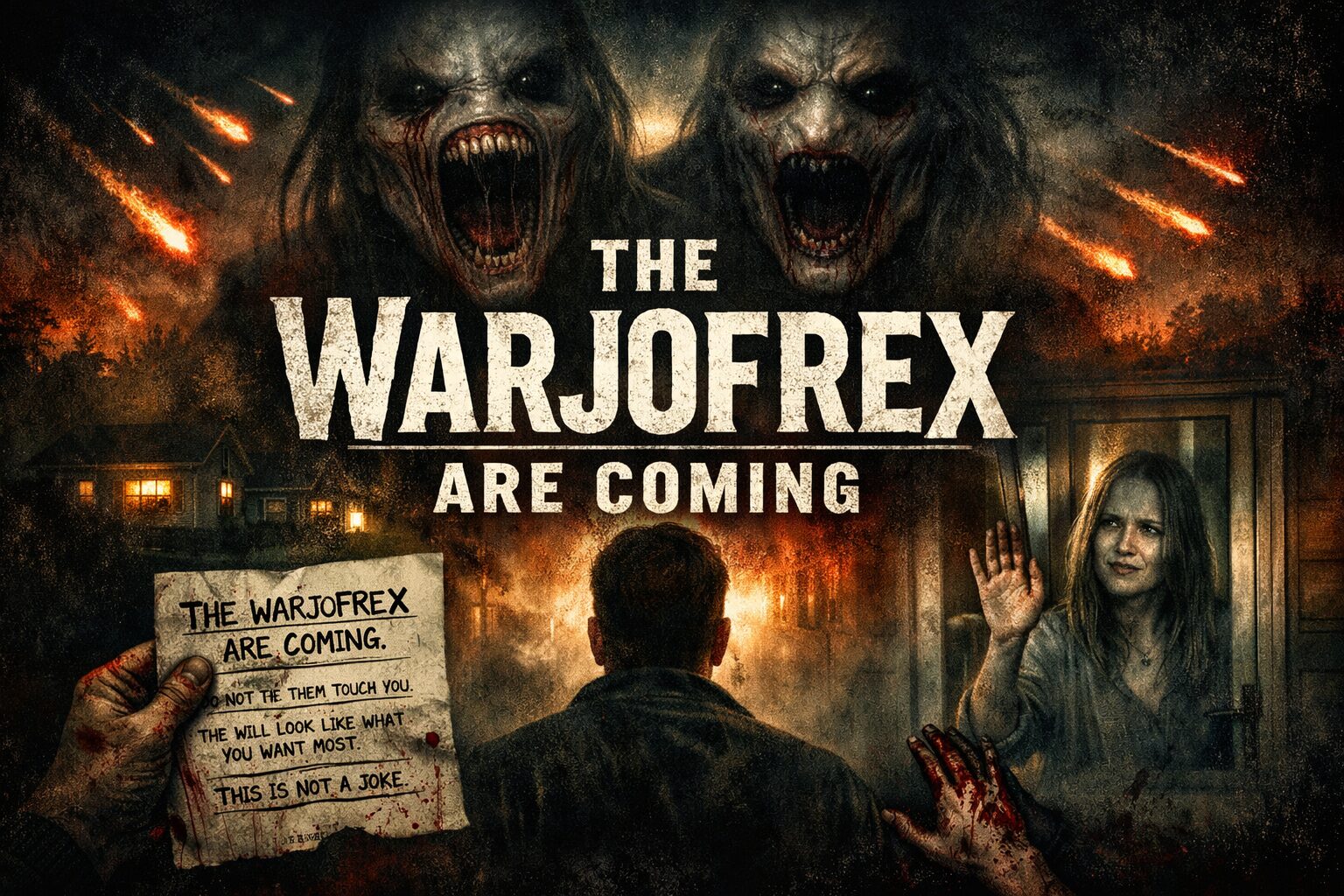
04 Apr The Warjofrex Are Coming
“The Warjofrex Are Coming”
Written by Craig Groshek Edited by Craig Groshek Thumbnail Art by Craig Groshek Narrated by N/ACopyright Statement: Unless explicitly stated, all stories published on CreepypastaStories.com are the property of (and under copyright to) their respective authors, and may not be narrated or performed, adapted to film, television or audio mediums, republished in a print or electronic book, reposted on any other website, blog, or online platform, or otherwise monetized without the express written consent of its author(s).
🎧 Available Audio Adaptations: None Available
⏰ ESTIMATED READING TIME — 10 minutes
Christopher Ingram came out of the grocery store with two paper bags in his arms and found a sheet of paper tucked under the wiper blade of his car. At first he thought it was an ad for roofing or gutter work. Then he looked down the row and saw every car had one.
The page was cheap white copy paper. The words had been written in thick black marker and then photocopied in a hurry. The letters were dark in some places, washed out in others, and there was a gray smear along the bottom where the copier glass had left a dirty line. He set the bags on the hood and pulled the paper free.
It said:
THE WARJOFREX ARE COMING.
DO NOT LET THEM TOUCH YOU.
THEY WILL LOOK LIKE WHAT YOU WANT MOST.
YOUR EYES WILL STOP TELLING YOU THE TRUTH.
IF ONE TOUCHES YOU, GET AWAY FAST.
DO NOT INVITE THEM IN.
DO NOT GO TO THEM, EVEN IF THEY CRY.
THIS IS NOT A JOKE.
Christopher read it twice. A woman near the next cart return laughed, crumpled hers, and threw it on the pavement. A man in a Packers cap folded his carefully and put it in his back pocket. Most people glanced at the page, shook their heads, and got into their cars.
Christopher turned his over and found smaller writing on the back, copied from the same original.
They came with the meteor shower. They feed through contact. They learn what you want. They wear it until you let them close. When they finish, they leave husks.
He stood there longer than he meant to. The page had the look of something made by a frightened person in the middle of the night. That should have made it easier to dismiss. Instead it stayed in his hand. He folded it and put it in his jacket pocket.
He should have gone home. He knew that later. At the time he was tired, hungry, and not ready to sit alone in his apartment with groceries and silence, so he drove two blocks to a coffee shop he liked and carried the flyer in with him without even realizing he had done it.
The place was half full. Students sat at the long table near the back. A man with headphones worked by the window. Two women in scrubs spoke quietly over iced drinks. Christopher ordered a coffee and took a small round table against the wall. He set the grocery bags by his chair and laid the flyer on the table, meaning to take a picture of it and send it to Marcus with some dumb caption.
Before he unlocked his phone, the bell over the door rang and Taylor Everett walked in.
He knew right away something was wrong, though he could not have said exactly what. Taylor had been out of his life for almost two years. They had dated for nine months. She had wanted him to stop drifting and decide what he actually wanted from his life. He had wanted more time, then more space, then one last talk after it was already over. He still thought about her more than he liked to admit. He still checked her profile now and then. He still knew the way she tucked hair behind one ear when she was annoyed.
The woman at the door had all of those things, or close enough to make his stomach drop. She wore a beige coat. Taylor hated beige. She said it made people look tired. Her hair was down instead of tied back. Her smile came too early, before their eyes even met, as if she had walked in already knowing where he was sitting.
She came straight to his table. “Chris,” she said. “I’ve been looking for you.”
He stared at her. The voice was close, but not right. Too careful. Taylor had always talked faster when she was nervous. This woman sounded like she had practiced the line.
He half stood from his chair. “How did you know I was here?”
She smiled again and sat down across from him without asking. “Does it matter?”
Christopher looked around the room. The barista was watching them. So was the man with headphones. Neither looked curious. They looked uneasy.
“I think you’ve got the wrong person,” Christopher said.
The woman leaned forward. “No, I don’t.”
He noticed then that her eyes were the wrong color. Taylor’s were hazel with more brown than green. These were lighter. He also noticed her front tooth. The real Taylor had a tiny chip from when she caught an elbow in a college rec game. This woman’s tooth was smooth.
He started to reach for his coffee. She reached first and laid her hand over his wrist.
Everything shifted.
It felt like cold water entering his arm and spreading under the skin. The room softened at the edges. Sound dulled. The wrong color drained from her eyes and filled back in with the right one. The smooth tooth now had the small chip. The beige coat stopped looking strange and became one he remembered from a winter trip to Milwaukee, though he knew that was not real because they had never taken one.
He pulled once, not hard enough. Her fingers held.
“I missed you,” she said.
Now it sounded like Taylor.
The words went through him the way liquor does when a person has not eaten all day. His better judgment stayed where it was, but everything around it loosened. He remembered the feeling of wanting her back. He remembered the private humiliations of that wanting. The old hope came up so fast it almost made him light-headed.
Then she said, “I kept thinking about this place.”
They had never been there together.
The thought hit clean and hard. Christopher jerked his wrist free and stood so fast his chair tipped backward. The woman stood too. For a moment her face seemed to split between two versions, one closer to Taylor and one not close at all.
“Chris,” she said, and the voice wavered. “Sit down.”
He looked at the flyer still lying on the table. Then he looked at the barista, who was staring openly now. The barista gave one small shake of his head.
Christopher grabbed the flyer, left his coffee untouched, and backed away. The woman took one step after him and stopped. Her expression did not change, but he had the clear sense that she was angry.
He drove home with both hands locked on the wheel. By then more sirens were out than there should have been. At one red light he saw a man in a dress shirt standing in the crosswalk while traffic bent around him. The man held his arms out to empty air and kept saying, “Mom, Mom, Mom,” in a calm voice that made Christopher feel sick.
At home he dead-bolted the door, shut the curtains, and turned on the television. Every channel had cut into regular programming. One local anchor was reading from new notes with the stiff face of a man trying not to panic on air. Bodies had been found in Milwaukee, Madison, Green Bay, and smaller towns in between. Some were in homes. Some were in parking lots or alleys. In every case there was severe tissue loss and strange depletion of blood volume, plasma, and other bodily fluids. A police chief in Illinois used the word mutilated. A sheriff in Iowa refused to answer questions and ended a live interview after a woman in the background began screaming.
A NASA representative appeared at a podium twenty minutes later and said a recent meteor shower may have introduced “organic material of unidentified and presently misunderstood origin” into the atmosphere. When reporters shouted questions about contamination and infection, she repeated that they were still gathering facts. A crawl at the bottom of the screen said the President would address the nation within the hour on a matter of national security.
Christopher muted the TV and took the flyer back out.
THEY WILL LOOK LIKE WHAT YOU WANT MOST.
YOUR EYES WILL STOP TELLING YOU THE TRUTH.
He kept seeing the woman in the coffee shop. At first he remembered the things that had been wrong. The coat. The tooth. The eyes. After a few minutes that certainty started to blur. Her voice in his head improved. Her face corrected itself. By the time his phone rang, he had to look at the flyer again to steady himself.
It was his cousin Lena. She was crying so hard he had trouble understanding her. Finally he made out the words. Her little boy Mason had died of leukemia last year. He was at her back door now, she said, still seven years old, still wearing the dinosaur pajamas he had been buried in.
“Don’t open it,” Christopher said.
“I didn’t,” she said, then added in a smaller voice, “I unlocked it once.”
He told her to get away from the door and go upstairs. She kept saying Mason knew things only Mason would know. Christopher told her it did not matter. He stayed on the line until he heard her lock herself in a bathroom.
Then Marcus called. Marcus said his wife Dana was home from work, except Dana had left that morning in green scrubs and the woman downstairs was wearing a black dress Marcus had never seen before. He knew that should have settled it, but every time she called up the stairs, the dress changed in his mind.
“She sounds like her,” Marcus said. “I know it’s wrong, but every time I hear her I think maybe I’m the one losing it.”
Christopher told him to leave through the garage and go to a police station if one was still functioning. Marcus said he had looked through the side window five minutes ago and saw three Danas in the driveway, each of them standing in a different place. Christopher did not know what to say to that. The line went dead while Marcus was still talking.
By then social media had become useless. Videos were everywhere. Some were obvious fakes. Some were too shaky to trust. Some were clear enough to make Christopher set his phone down and walk away from it. People were letting lovers, dead parents, estranged children, and impossible versions of themselves into homes, cars, and offices. Other people were shooting family members because they thought they were impostors. In Arizona, a man killed his brother on a livestream and then begged viewers to tell him whether the body on the floor had been real. A post from Atlanta showed two women screaming at each other across a lawn, each claiming to be the same person while neighbors hid behind parked cars and watched.
The President came on just after seven. He looked gray and old under the studio lights. He confirmed there was an ongoing national emergency. He said Americans should shelter in place, avoid direct contact with unfamiliar persons, and refuse entry to anyone whose identity could not be independently verified. Halfway through the speech, someone off camera shouted. The President stopped, turned his head, and the feed cut to a seal.
Christopher did not hear the rest.
A soft knock came at his front door.
“Chris,” Taylor said. “I know you’re in there.”
He backed into the hall. Every muscle in his body tightened at once.
“Go away,” he said.
“I need to talk to you.”
“No.”
There was a pause, then a smaller voice. “Please.”
He stayed where he was, out of sight of the narrow pane of glass beside the door. He could smell her perfume again. He knew there was no way that should be possible.
His mother called next. He answered because he had to.
She whispered that his father was in the living room.
Christopher gripped the phone so hard his hand hurt. His father had been dead eleven years.
“Mom,” he said. “Listen to me. Go into the bathroom and lock the door.”
“He looks better,” she said. “He looks like he did before the heart trouble.”
He shouted at her then. He told her to leave the room. He told her not to listen to what she saw. She began to cry, and in the background he heard a man’s voice say Christopher’s name in the slow, careful tone his father used when he was disappointed.
Christopher nearly opened his own front door right then. His whole body was telling him to move, to go to her, to do something besides stand there while people he loved begged for help from miles away.
Then he looked down and saw the flyer still in his hand.
DO NOT GO TO THEM, EVEN IF THEY CRY.
He stayed.
That was the part he hated most later, in the small amount of time he had left to hate anything.
Outside his door, Taylor kept talking. The voice changed in tiny ways, getting closer to the real one each time. The pauses sounded right. The breathing sounded right. Once she laughed softly, and he felt his resistance weaken in a way that frightened him more than the news had. Whatever had entered him through that touch at the coffee shop was still at work. It kept sanding down the parts of reality that did not fit. It kept trying to make trust feel easier than doubt.
At 8:14, another voice joined the first one outside.
It was also Taylor.
This one sounded terrified.
“Chris,” the frightened one cried. “Don’t let her in. She’s not me.”
He squeezed his eyes shut.
The calm voice said, “He knows you’re fake.”
The frightened one banged once against the storm door. “Chris, please.”
He made the mistake of looking through the peephole.
Two Taylors stood on his porch.
One was composed and dry-eyed, one hand twisted in the other’s hair. The second looked wild and exhausted, blood at the corner of her mouth, face wet with tears. The calm one held something dark and narrow under the terrified one’s jaw.
“If you don’t open the door,” the calm one said, “I’m going to kill her.”
Christopher stared.
He knew what he was looking at could be false from top to bottom. He knew the thing at the coffee shop had already reached into his senses and changed what it could. He knew the flyer warned exactly about this.
Then the frightened Taylor said, “You kept my blue hoodie in the hall closet after I moved out.”
Christopher stopped breathing for a second.
That was true.
He had never told anyone.
The calm Taylor smiled at the look on his face. The terrified one said, “Please, Chris. Please.”
He unlocked the deadbolt.
The door opened inward.
Both Taylors moved at once.
The frightened one’s expression went flat before she even crossed the threshold. The calm one smiled so wide her cheeks split at the corners. Their faces changed as they came forward, slipping out of Taylor and into something thin, gray, and wet-looking, with mouths that opened too far and hands built wrong at the joints.
Christopher managed one scream.
The neighbors said that was all they heard.
Forty-eight hours later, police finally reached the real Taylor Everett by phone at her apartment across town. She was alive. She had spent the emergency alone with the lights off and her phone on silent, thinking only about getting through the night and keeping herself safe. She had not once thought to call Christopher Ingram. She had not wondered where he was. She had not worried about whether he was alive or dead.
When detectives asked whether Christopher might have opened his door for someone pretending to be her, Taylor was quiet for a moment. Then she said she doubted it. They asked whether she wanted to know what had happened to him, and she said no.
By then, Christopher’s corpse had already been found in his front hallway.
What made it worse, in the end, was how little it had meant. Christopher had died trying to save a woman who was never there, for the sake of a woman who had long since stopped caring whether he existed at all. He gave up his life for a memory, and even that memory was false.
The Warjofrex were gone within twenty-four hours.
They left as quickly as they had arrived. There was no explanation, no message. No warning beyond the ones people had been too late to understand. They simply appeared, fed, and vanished, leaving houses full of blood, locked rooms with bodies inside, and families trying to understand why the people they loved had opened the door.
For the country, it became another day of horror to be named and studied. For the people who lost someone, it never ended. Everywhere, people mourned those who had loved too deeply, wanted too badly, or could not bear to turn away from one last chance. In the end, it was our humanity that cost us the most.
🎧 Available Audio Adaptations: None Available
Written by Craig Groshek Edited by Craig Groshek Thumbnail Art by Craig Groshek Narrated by N/A🔔 More stories from author: Craig Groshek
Publisher's Notes: N/A Author's Notes: N/AMore Stories from Author Craig Groshek:




Related Stories:
You Might Also Enjoy:



Recommended Reading:

Copyright Statement: Unless explicitly stated, all stories published on CreepypastaStories.com are the property of (and under copyright to) their respective authors, and may not be narrated or performed, adapted to film, television or audio mediums, republished in a print or electronic book, reposted on any other website, blog, or online platform, or otherwise monetized without the express written consent of its author(s).