

21 Oct Witness
“Witness”
Written by Craig Groshek Edited by Craig Groshek Thumbnail Art by Craig Groshek Narrated by N/ACopyright Statement: Unless explicitly stated, all stories published on CreepypastaStories.com are the property of (and under copyright to) their respective authors, and may not be narrated or performed, adapted to film, television or audio mediums, republished in a print or electronic book, reposted on any other website, blog, or online platform, or otherwise monetized without the express written consent of its author(s).
🎧 Available Audio Adaptations: None Available
⏰ ESTIMATED READING TIME — 18 minutes
I don’t post here often, and when I do, it’s usually dumb stuff—neighbor drama, weird noises in the old building, that kind of thing. This one isn’t that. I’ve been sitting on it for a few days, trying to talk myself out of even typing it, because once it’s written, it’s real, at least to me. If anybody local reads this and recognizes the park, I’m not naming it, so please don’t ask. You’ll see why.
It was one of those fall days that trick you into staying outside longer than you planned. Blue sky, almost cartoon-blue, with that odd daytime moon that looks like a thumbprint smudged on glass. The air was cool enough for a hoodie but warm if you kept moving. I took my usual walk at lunch, earbuds in my pocket because I wanted to hear the leaves underfoot, not a podcast. I work from home most days—graphic design, nothing fancy—and if I don’t force myself to go outside, I’ll wind up staring at fonts until my eyes cross.
The path in the park loops around a little league field, chain-link fences and all. I always cut along the outfield fence because it adds a couple hundred steps, and there’s a line of maples that turns early. One of them was already orange. The trees throw these long bands of shadow across the grass this time of year, and the ground gets that patchy look where it’s still green in some places and dried out in others. You can smell the old dirt from the infield even when nobody’s playing. It’s not unpleasant. It just reminds me of elementary school, the days we had to run bases in P.E. and I’d pretend to twist my ankle to sit out.
The field was empty. No cars in the lot, no families at the playground on the far side. I nodded to a guy walking a little white dog near the tennis courts, and then it was just me and the fences. I drifted toward the yellow foam cap along the top of the outfield fence, dragging my fingers along it as I went. (Gross, maybe, but it’s satisfying, like running a stick along a picket fence.) The dugouts are down beyond the baseline, set back near the trees. They’re covered benches with chain-link fronts. The city must lock them during the off-season because the doors always hang crooked.
I remember thinking how quiet it was for noon on a weekday. The only sound was the wind and a loose sign flapping somewhere—one of those metal plates the leagues use for sponsor names. It clanged just once and then stilled.
If this is boring, sorry. I need you to understand how normal it felt at the start. When you read what comes after, I don’t want you to think I arrived at the field expecting a story.
I slowed near right field to take a couple pictures of the trees. The orange one looked good against the sky, and I wanted to send it to my mom, who’s been on me to “appreciate the seasons” since I moved to Wisconsin. I lined up the shot, focused, and took another with the chain-link in the foreground. The fence makes a cool diamond pattern if you get close enough. Photographer brain engaged, designer brain taking a break. Normal.
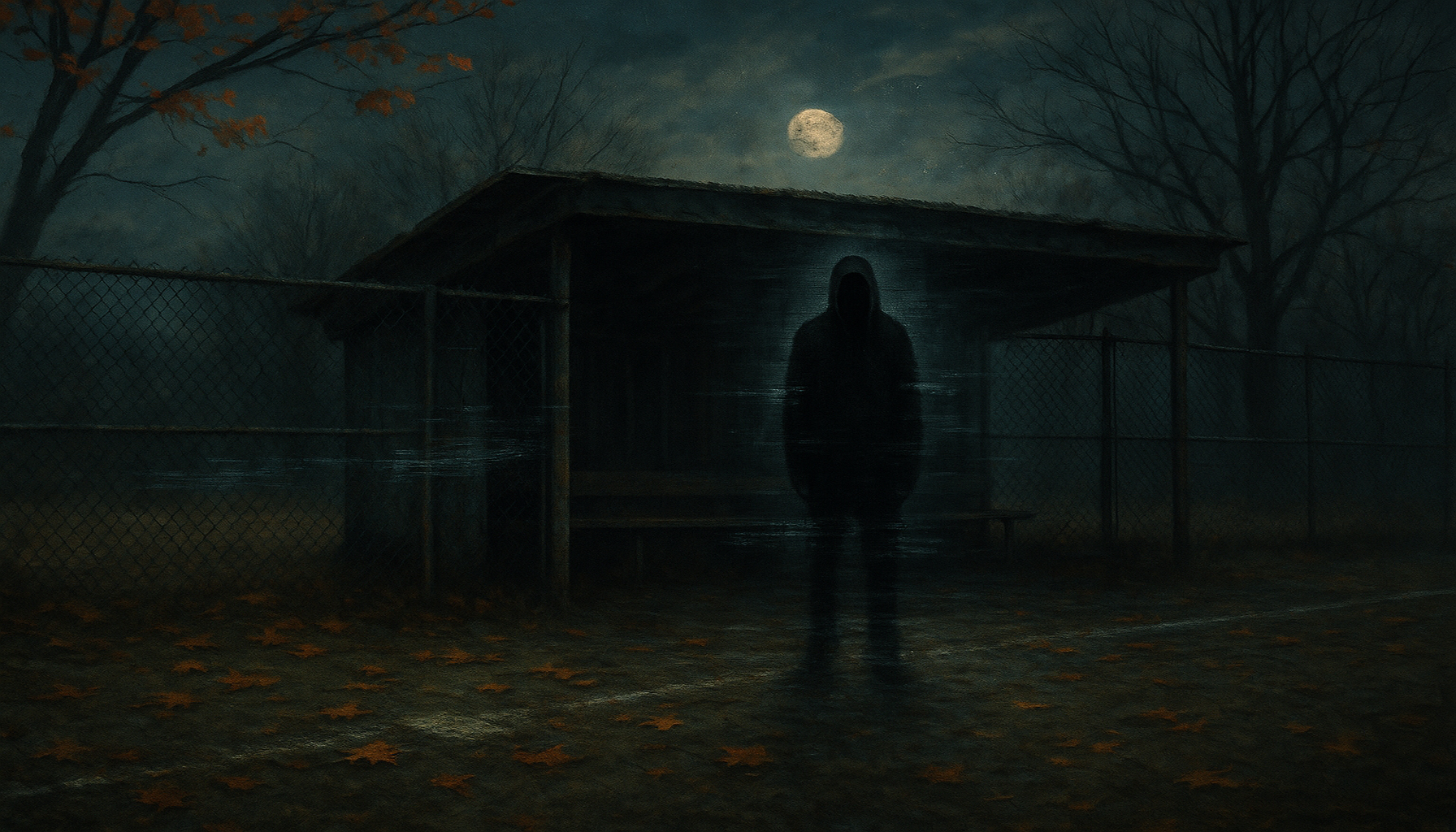
I was a few steps from the break in the fence by first base when I saw movement in the dugout.
At first, it didn’t register as anything worth noting. People cut through the park all the time. Sometimes high school kids hang back there to vape or kiss or whatever. I kept walking, squinting into the shade under the roof. There was a person. A man, I thought. Tallish. Wearing black. Hoodie up. He had that restless energy you see from people pacing during a phone call. He’d take three steps, stop, turn a little, then start again. Hands up near his face, fingers moving. Maybe he had earbuds in. Maybe he was arguing with someone. The angle made it hard to see his face through the chain-link.
I checked the parking lot out of habit. Still empty. No bikes, either. It struck me as odd that anyone would hang out alone in a dugout in the middle of the day, but it wasn’t illegal. I told myself to keep moving and mind my business.
I made it past first base and cut onto the service path that runs inside the fence. From there, you can see into the dugout better if no one’s sitting on the front bench. He wasn’t. He kept to the back where the shadows held. I could see his chest rising and falling in that exaggerated way people get when they’re fired up. His hands were talking for him, big, sharp gestures that didn’t match the distance he paced. He jabbed a finger toward the ground, then toward the roof, then to the side. The movements looked rehearsed. That’s the only way I can put it. Like he was running through marks on a stage.
This is where I probably should have turned around. The sensible part of me whispered it, but the sensible part is pretty quiet compared to the nosy part. I slowed and took out my phone, pretending to check a text while I kind of, sort of recorded a video through the screen.
Two seconds of that and I felt stupid. I lowered the phone and faced the field again, giving him his privacy. He could have been on a call about a divorce or a doctor, and there I was trying to TikTok it. The thought made me step faster toward third base, ready to hop back outside the fence and rejoin the loop.
A metallic sound came from the dugout. Not the sponsor sign. A scrape, then a clang. Like someone kicked a bat rack.
I glanced over with a reflexive half-smile that says “I heard that” without actually engaging, the way you do with strangers. He had stopped pacing. That was new. He stood very still, hands lowered, his head tilted like he was listening for something far away. I slowed again without meaning to. When he moved, it was a tiny step forward, and his posture changed, as if he’d finally realized he had an audience.
You know how some people are easy to read from far away? This man wasn’t one of them. Every time my eyes settled on a line of his body, it seemed to shift a little, like heat above asphalt. I blinked it away and blamed the sun. The dugout roof throws weird shade patterns. I told myself that and tried to believe it.
I took one more step along the fence for a better angle.
He lifted his hands to his face, palms open.
He had no phone.
He wasn’t holding anything.
He pressed his fingers along his cheeks, then pulled them away with a ragged, frustrated motion. If he said something, I didn’t hear it. The wind rose and fell, and the leaves on the maples rasped together. He turned quickly, then turned again, faster this time. Then he resumed his pacing, but tighter now, like a trapped animal circling a corner that keeps squeezing in. Something about it made the back of my neck go cold.
I told myself to stop watching and keep walking, that there were a dozen ways it would end with me feeling dumb. I’d pass the third-base bleachers, take the break in the fence, and be back on the regular path within ninety seconds. That was the plan.
For every two steps I took, curiosity pulled me back one.
The man had paused again, angled toward me. His hood cast a shadow over most of his face. I still couldn’t see his eyes, just the pale of his skin where the light hit. He brought his right hand up like he was about to speak into a mic, then stopped at his mouth and dragged the hand down, slow, like he was wiping something off that wasn’t there. He did it twice. The motion left a smear across my nerves that I couldn’t explain.
I swallowed, slipped my phone back into my pocket, and set my feet toward the exit in a way that said I was done being curious. As I moved, I decided I would tell myself a dumb story later about a guy having a bad day in a park. I would not make contact. I would not be part of his bad day.
That resolution lasted exactly three more steps.
* * * * * *
I told myself I was overreacting. Parks attract all kinds of people. Maybe he was filming a dance video or working through a panic attack. The world doesn’t revolve around me. But my body didn’t buy it. Every instinct I had was on alert.
I slowed down again, halfway between walking and standing still, pretending to tie my shoe while I peeked through the fence. The man was still pacing, faster now, like a video stuck on fast-forward for half a second, then snapping back to normal. Each step hit the concrete with the same strange delay — a slap, then a faint echo, like the sound came from somewhere else.
His gestures grew erratic, hands at his head, twisting and clawing at the air in front of him. Once, he jerked backward so violently that his hood fell, revealing a pale scalp and short, colorless hair. His face was chalk white, as if all the light in the dugout had gathered under his skin. I could see his mouth moving, but not a sound came out.
The wind kicked up, sending dry leaves tumbling along the fence line. The movement startled me, and when I looked back—I swear to God—he wasn’t quite in the same place. He hadn’t walked there. He’d just… shifted. One instant, he was on the far end of the bench; the next, he was near the middle, turned at a slightly different angle.
I blinked, and he was back at the first spot. My stomach flipped. I thought of leaving, of pretending I hadn’t seen any of it, but my curiosity locked me there. I raised my phone again, pretending to adjust the camera brightness while recording.
The picture trembled as I zoomed in. He looked solid at first. Then the outline of his right arm shimmered and broke apart. Static flashed across his body—real, visible static, the kind you see on an old TV screen. The phone camera couldn’t focus on him. The image tore for a second, a line of distortion across the screen, and when I looked up over the phone, his whole shape seemed to glitch between two slightly different positions.
I muttered, “What the hell…”
That must have been when he noticed me.
He stopped pacing and stood completely still. His head turned mechanically, almost too smoothly, as if he hadn’t rotated but slid into a new orientation. The hood fell forward again, shadowing everything but the mouth, which hung open just slightly, unmoving.
Then came the eyes. I think they were eyes. They weren’t dark exactly—more like the absence of anything. A void with faint static bleeding around the edges. Every survival instinct I had screamed at once. My throat went dry, my skin prickled, and my brain tripped over itself trying to decide between running or freezing.
I froze.
He took a step forward.
The motion wasn’t normal. It was as if he was rendered in too few frames, missing the in-betweens. He’d jerk, vanish for a fraction of a second, and then reappear a little closer. The world seemed to hesitate with him; the air rippled where his foot touched.
I stumbled back, eyes locked on him. My phone slipped from my hand and landed in the grass. I heard the thud but didn’t dare look away.
He took another step, and I swear to you, the ground under his foot blinked out. I don’t mean it caved in or cracked. It just wasn’t there for a second, a void ringed by fading pixels, before reality stitched itself back together.
That was when my brain finally screamed at me to run.
I turned and sprinted along the fence line, every nerve firing at once. Behind me, I heard nothing—no footsteps, no breath, only a faint electronic hum that built and dropped like interference.
Halfway across the field, I risked a glance back. He was closer. Much closer than he should’ve been. The air around him warped, the fence behind him flickering in and out of existence. Wherever he brushed the chain-link, the metal simply vanished for an instant, leaving gaps that reappeared with a metallic ring.
My legs felt like lead. Every few steps, I expected to feel a hand on my shoulder, or worse, to see my arm flicker out like his did. I veered toward the left, cutting around the third-base line, trying to stay in open sunlight. My breath came fast and sharp, but I didn’t dare slow.
As I ran, the world itself seemed to stutter. The shadows from the trees shifted out of sync with the wind, the clouds above freezing mid-drift for half a heartbeat before resuming. It felt like reality was buffering.
I reached the break in the fence and practically threw myself through it. My knees hit the grass hard, and I scrambled up, cutting toward the paved trail that led to the parking lot, and glanced back one last time.
He was standing at the fence, frozen in place. The sunlight caught his shape, revealing more of that strange distortion—patches of him fading transparent, flickering between solid and hollow. He raised a hand, fingers trembling as if pressing against something invisible between us.
For a moment, everything went silent. Even the wind stopped. Then he took one more step forward, and the chain-link fence where his hand touched vanished entirely.
That was all I needed. I turned and ran for the parking lot, leaving the field—and whatever he was—behind me.
I didn’t stop running until I hit the cracked pavement of the parking lot. My chest burned, and my vision tunneled from adrenaline. My car sat near the far end, alone, just like the lot had been when I arrived.
I glanced back at the field, half expecting him to be there, right behind me. But for a moment, there was nothing. The wind returned, bending the orange leaves on the maples, the sound of them oddly crisp, like paper being crumpled near a microphone.
Then I saw him again.
He wasn’t moving this time, just standing near the dugout. From that distance, he looked like a black smudge on the world, like someone had drawn him in with a thick marker and forgotten to color him all the way to the edges. Even from across the diamond, I could tell he was facing me. The sense of being seen, of being targeted, made my knees shake.
I got the car unlocked and dropped into the driver’s seat, slamming the door. My fingers fumbled the keys twice before finding the ignition.
When the engine turned over, I risked another glance.
He was gone.
The dugout was empty again.
I sat there with the car idling, staring at that patch of field, trying to decide if I’d just had a full-blown hallucination. It would’ve been easier to swallow if the air didn’t still feel… wrong. There was a faint, residual shimmer over the diamond. The chain-link fence by first base looked warped, as if it had been half melted and then resolidified mid-drip.
I reversed out of the lot and drove home on autopilot. I kept glancing at the mirrors, expecting to see that figure jogging along the shoulder or flickering in and out of existence behind me. But there was nothing but the empty road and the sound of my own heartbeat in my ears.
By the time I got home, the story had already started rewriting itself in my head. Maybe the man had been real. Maybe he’d been tweaking out on something, and my brain had filled in the gaps with panic. Or maybe he was a trick of the light, an afterimage, a migraine aura—something rational.
That night, I couldn’t sleep. Every time I closed my eyes, I saw his face, or what should have been his face. I’d caught just enough of it to know there was no normal expression under that hood. The eyes weren’t eyes. They were holes.
I told myself I’d go back the next day, in daylight, with someone else, just to prove it was fine.
I didn’t make it that far.
The next morning, while I was scrolling through local news with my coffee, I noticed something odd. A headline in the sidebar of the county paper’s website: “City Maintenance Investigates Damage to Park Equipment.”
There was no photo, just a short paragraph. It mentioned unexplained “structural degradation” to a dugout roof and chain-link fence at Pine Hollow Park—yes, that park—and requested that residents report any suspicious activity.
I stared at the words “structural degradation.” It was such a careful phrase. It didn’t say melted, or broken, or erased. It sounded like something out of a lab report.
I decided not to go back after all.
* * * * * *
Two nights later, though, I dreamed about it.
In the dream, I was standing in the dugout. The concrete under my feet vibrated like an engine idling somewhere deep underground. I looked down and saw that the floor wasn’t concrete at all—it was some kind of gray static, a surface barely pretending to be solid. Through it, shapes moved—long, angular shapes, as if the geometry itself was alive.
Then he was there again, standing inches away. His mouth opened too wide, like a frame skipping forward mid-scream, but there was no sound, just a blinding burst of that electronic hum that rattled through my skull.
I woke up gasping, convinced I could still hear it under the refrigerator noise.
The next day, I tried to forget. I didn’t tell anyone. I didn’t even watch the video I’d taken. I was too afraid it had captured something that would confirm I hadn’t imagined it. I just deleted it without looking.
For a few days, life went back to normal. Work deadlines. Groceries. The quiet comfort of pretending that nothing had happened.
Then came the headline that ended any hope of that: “Tragic Disappearance During Little League Practice at Pine Hollow Park.”
The article described an afternoon scrimmage gone wrong. Half the players and their coach had vanished mid-practice. No witnesses outside the field had seen anything, but one of the surviving kids had told police “the man came back.”
That’s what the article said, verbatim: the man came back.
The photo attached to the story showed yellow caution tape stretched across the same fence I’d run past. In the background, the dugout roof was missing a corner, as if something had taken a bite out of it. I closed my laptop and sat there staring at the floor for a long time.
I don’t know if what I saw was a ghost, or a glitch in reality, or something trying to come through, but I know this much: When it looked at me, I felt like I was the one flickering. Like I was the mistake it wanted to correct.
And now it’s not just the park. Twice this week, my TV’s gone to static when I walk into the room. My reflection in the screen looks less distinct every day.
I’m starting to think he didn’t vanish that day.
He just found a better signal.
* * * * * *
I didn’t think I’d ever go back to Pine Hollow Park after that news story, but two nights later, I found myself driving there anyway. I told myself it was about closure, a final look to prove the field was empty, that the police had handled it, that what I’d seen was just some visual anomaly. A trick of the light. A breakdown in my perception. Anything but what it really felt like.
It was a little after 9 p.m. when I pulled into the lot. The sky was clear, the moon hanging low and sharp. The field lights were off, but one of the maintenance lamps near the path had been left on, casting a cone of pale yellow that barely reached the infield.
I stepped out of the car, leaving the door open behind me.
The place was silent except for a faint hum, the kind that comes from transformers or old electrical lines. But it didn’t sound steady. It fluctuated, rising and falling in uneven waves that set my teeth on edge.
The fence was still warped where I’d seen him. The chain links nearest the dugout were twisted and blackened like they’d been heated from the inside out. The city must’ve cordoned off the area since the disappearances, but the tape was gone now, fluttering in the grass like it had melted off.
I took a few steps forward, my flashlight beam trembling against the wire mesh.
“H-hello?” I said, voice small and stupid in the dark. “Is anyone h-here?”
Nothing and no one replied.
The sound that came next wasn’t a voice, not exactly. It was more like the pop of static through a dead radio, a single burst that broke the silence. Then another. Then a third.
The dugout lights flickered on by themselves.
I stopped breathing.
He was there.
Not just visible. Present. As if the world had been waiting for me to look before it decided to render him again. He stood in the same place as before, half in shadow, body outlined in that same impossible shimmer. Only now, every few seconds, parts of him seemed to skip forward, his head rotating a fraction too far, his arm swinging mid-frame.
I backed up, hands shaking, and the hum intensified. It was coming from everywhere at once—through the fence, through the ground, through me.
“Stay back!” I whispered. “Please.”
He took a step forward, and the ground under him disappeared. The packed dirt turned black, swallowed itself, and then returned perfectly intact, as if nothing had happened. The next step left another pulse of emptiness. The air around him fractured like glass. And he was closer.
My flashlight stuttered in sync with his movement, its beam freezing and jumping. For one horrible second, I saw his face clearly. It was pale and hollow, drawn inward, collapsing on itself. His mouth opened too wide, stretching across his cheeks in a silent scream.
The chain-link between us bent inward, sucked toward him like metal drawn to a magnet.
I ran.
The light behind me exploded in a burst of static white. I didn’t look back. The hum grew into a deep, low vibration that made the ground feel unstable beneath my feet.
I hit the trail that wound toward the trees, my lungs on fire. Each step echoed twice, once normally, once delayed, like the sound was chasing me, too. When I dared a glance over my shoulder, I saw pieces of the fence winking out, then reappearing milliseconds later. Sections of grass were vanishing beneath his feet, leaving gray emptiness that spread before sealing up again like digital scar tissue.
Every time I blinked, he was closer.
I veered off the trail toward the maintenance shed near the restrooms. The metal door reflected the moonlight—a small comfort, something real to focus on. I reached for the handle, yanked, and stumbled inside.
The shed was dark, cluttered with shovels, paint cans, and bags of lime. I pressed myself into a corner, trying to catch my breath, and shut the door with a trembling hand. The humming outside cut off.
For a second, the silence was so absolute it hurt. Then came a new sound, that of faint scratching, not on the door, but in the walls. It was as if the world itself was rubbing against the edges of reality, trying to make room for him.
The temperature dropped so fast my skin broke out in goosebumps. The flashlight flickered and died.
Through the crack under the door, I saw light—not yellow or white, but gray, if gray could glow. It pulsed once, twice… and then the bottom edge of the door vanished.
The hum roared back, vibrating through the concrete floor. The shelves rattled. I could see the outline of his feet forming where the light poured in, flickering and misaligned, as if two versions of him were fighting for the same space.
He took one step forward, and the door reappeared, slamming back into existence so fast the sound made my ears ring.
And then the light was gone.
And so was he.
The humming tapered off, leaving only the faraway sound of wind in the trees. I stayed crouched in the dark for a long time, staring at the door and waiting for something else to blink out of existence. Nothing did.
When I finally opened the door and stepped into the night, the field lights were still flickering faintly in the distance. My car sat where I’d left it. I half expected it to vanish when I reached for the handle, but it didn’t.
I drove home in silence.
When I pulled into my driveway, I saw that the clock on my dashboard had frozen at 9:17 p.m.
My phone said 11:42. Two hours and twenty-five minutes, gone.
And on the grass beside my car door, there was a footprint burned into the frost—too long, too narrow, and perfectly black.
* * * * * *
I didn’t sleep that night. I couldn’t. Every time I shut my eyes, the darkness behind my eyelids would shimmer. A faint, silver static, like what used to show up between channels on an old TV. I’d blink and see his face in it. That stretched mouth. The black pits where eyes should have been.
By morning, I’d convinced myself I’d imagined most of it. I even tried to laugh about it, the way people laugh when they’ve been terrified and need to make it small enough to survive.
I told myself I’d go to work, get coffee, and pretend life was normal. And for about six hours, it almost worked.
Until my phone buzzed at lunch.
An alert from a local station appeared on my news feed: “Another Tragedy at Pine Hollow Park—Several More Missing After Little League Practice.”
I clicked the link with shaking fingers. I couldn’t believe the city had let people use the field again so soon after the last incident.
The story was short, too short for something like that. It said that during yet another late-afternoon practice, multiple children and one adult coach had once again “disappeared under unexplained circumstances.” There were no signs of a struggle. In fact, there was no physical evidence except for “minor damage to the field’s north dugout structure.”
One line in particular stood out to me: “Surviving players described seeing a man in the dugout before the incident, though investigators found no footprints or evidence anyone had been there.”
My throat went dry.
I scrolled down to the video clip embedded beneath the article. The station had sent a camera crew to the park. In the shaky footage, yellow police tape flapped across the infield. The chain-link fence I’d seen vanish and reappear was warped and half-collapsed, like someone had twisted it with invisible hands. A city worker in a reflective vest gestured to one of the cameramen, saying something about “unstable ground.”
Behind them, the dugout sat open and empty, but even through the poor resolution, I could see it—faint lines crawling across the concrete floor, patterns like static frozen mid-flicker.
I muted the clip and set my phone down.
The article had one more paragraph I hadn’t noticed earlier: “Witnesses claim to have heard an electrical buzzing noise moments before the event. The two remaining children, ages 9 and 10, were transported to St. Joseph’s Hospital. Officials have declined to comment on their condition, though one officer described them as ‘terrified and incoherent.’”
I wanted to close the tab. I wanted to delete the alert, my browser history, the memory of that day—all of it. But my curiosity wouldn’t die.
I checked the station’s social media feed. People were posting blurry screenshots and speculating. Word was spreading, and rumors were now running rampant. A few claimed the park was haunted. Others said it was a sinkhole. Someone posted a slowed-down frame from the video clip showing a pale shape just inside the dugout shadows.
It wasn’t much—a silhouette, barely visible, but it was him. The posture. The bend of the neck. That impossible black void where his face should’ve been.
I closed my laptop and pushed it away.
Hours passed without me realizing it. When I finally got up from the couch, my television screen was dark, but I could see my reflection in it, faintly distorted.
I unplugged the television to make sure it stayed off.
* * * * * *
That night, I dreamed of the field again, only this time I wasn’t in the dugout. I was under it.
The world above was transparent, like looking through frosted glass. I could see the players practicing, running bases, shouting, and laughing. None of them noticed the ground fracturing under their feet. The cracks weren’t made of dirt or stone, but static—veins of interference spreading outward from a single black shape in the center.
He was there, standing still, hands at his sides, as the static reached the children’s shoes.
When they vanished, he looked directly down. At me.
I woke up screaming, drenched in sweat.
The next morning, the paper ran a follow-up story: “Authorities Searching for Connection Between Park Disappearances and Structural Failures.”
They were calling the damage to the dugout an “anomaly in material integrity.” It read like bureaucratic nonsense, but I could see what they were trying not to say.
I’ve stayed away from the park since then. I haven’t gone on my walks. Haven’t opened my curtains after sunset. But last night, around the same time as the first encounter—9:17 p.m.— the lights in my living room flickered, and the hum came back, faint but distinct, like a reminder.
When I looked at the dark window, there was a figure standing at the edge of my yard. A man-shaped patch of black static, standing on the lawn, tilting its head slowly, as if trying to hold itself together.
I blinked, and it was gone.
* * * * * *
This morning, another headline appeared: “Pine Hollow Park Closed Indefinitely After Repeated Disturbances.”
That should’ve been the end of it. But two minutes ago, I refreshed the news site.
There’s a new story, describing another disappearance, this time in a different park, in a different city. The scenario, however, is painfully familiar: “Witnesses report seeing a suspicious man in black standing inside the dugout, pacing back and forth.”
As for me, my reflection continues to grow hazier by the day, and at this rate, I won’t have one by this time next week. And in the quiet moments, when my focus is on other things, I swear my hands and feet have flickered, glitching, as if trying to hold themselves together. But whenever I look directly, everything is fine. For now.
It’s too late for me, I’m afraid, but there’s still time for you.
If you live near a baseball field—any field—and you hear that low humming sound, don’t stop to look. Don’t film it. Don’t watch. Don’t bear witness. Just run, and never look back.
Because once he sees you, he’ll never stop following you.
And it’s only a matter of time before he catches up.
And when he does, you may just be the next to disappear.
🎧 Available Audio Adaptations: None Available
Written by Craig Groshek Edited by Craig Groshek Thumbnail Art by Craig Groshek Narrated by N/A🔔 More stories from author: Craig Groshek
Publisher's Notes: N/A Author's Notes: N/AMore Stories from Author Craig Groshek:




Related Stories:
You Might Also Enjoy:




Recommended Reading:

Copyright Statement: Unless explicitly stated, all stories published on CreepypastaStories.com are the property of (and under copyright to) their respective authors, and may not be narrated or performed, adapted to film, television or audio mediums, republished in a print or electronic book, reposted on any other website, blog, or online platform, or otherwise monetized without the express written consent of its author(s).